

Frequently asked questions about Ecosoft reverse osmosis filters and water softeners
FAQ Reverse Osmosis Ecosoft
-
What is a reverse osmosis system and how does it work?
A reverse osmosis system is a water filtration system that uses pressure to push water through a semi-permeable membrane. The membrane lets water molecules pass through while reducing dissolved salts, hardness minerals, heavy metals, bacteria, and other unwanted substances.
In a typical RO system, water first passes through prefilters that reduce sediment and chlorine. Then it goes through the RO membrane, where the main purification takes place. The purified water, called permeate, goes to the faucet or storage tank, while the water with concentrated impurities is sent to the drain as concentrate.
Some reverse osmosis systems also include a postfilter or mineralization stage to improve taste or add minerals back to the purified water. To explore available systems, visit our reverse osmosis filters range. For more details about the technology, read our guide: Everything you need to know about reverse osmosis water.
-
Why should I choose an Ecosoft reverse osmosis system?
Choose an Ecosoft reverse osmosis system if you want reliable water filtration for your home, business, or industrial application. Ecosoft RO systems help reduce dissolved impurities, chlorine, hardness minerals, heavy metals, bacteria, and PFAS, providing cleaner and better-tasting water for everyday use or specific water quality requirements.
For homes, the Ecosoft range includes classic under-sink systems with a storage tank, direct flow systems, models with pumps for low inlet pressure, and systems with mineralization for a fresher, more balanced taste. Some models also use AquaGreen technology to reduce water waste and improve recovery.
If you are interested in commercial or industrial reverse osmosis solutions, Ecosoft can help select a system based on your water quality, required capacity, application, and operating conditions. Depending on your needs, commercial and industrial RO systems can be configured to match your specific request – from cafés, restaurants, hotels, and car washes to manufacturing, boiler feed water, and other demanding applications.
To find the right model for your home, explore our reverse osmosis filters range. For business or industrial needs, you can also view our commercial reverse osmosis systems and industrial reverse osmosis systems categories. The final system choice depends on your water quality, required capacity, application, and operating conditions. If you need help selecting the right solution, please contact us – our team will review your request and help choose the best configuration.
-
What contaminants does reverse osmosis remove from water?
Reverse osmosis reduces a wide range of common water contaminants, including dissolved salts, hardness minerals, heavy metals, chlorine, PFAS, pesticides, bacteria, viruses, and fine particles. It can also help reduce limescale, nitrate, lead, and microplastics, depending on the water quality and the specific RO system.
In a reverse osmosis filter, the membrane does the main purification work by separating purified water from concentrated impurities. Prefilters and postfilters support the process by reducing sediment, chlorine, taste, and odor before or after the membrane stage. But the actual reduction depends on the source water, system type, membrane condition, and regular filter replacement.
-
Is reverse osmosis water safe for daily drinking?
Yes, reverse osmosis water is safe for daily drinking when the system is installed correctly, used with suitable feed water, and maintained according to the manufacturer’s instructions. RO filtration reduces many unwanted substances, including dissolved salts, heavy metals, bacteria, viruses, chlorine, PFAS, and other impurities, helping provide clean and better-tasting drinking water.
Because reverse osmosis also reduces minerals naturally present in water, many Ecosoft systems include a mineralization stage. It adds calcium and magnesium back to the purified water for a fresher, more balanced taste.
To choose a system for everyday drinking water, explore our reverse osmosis filters range. You can also read more in our guide: Everything you need to know about reverse osmosis water.
-
Does reverse osmosis remove chlorine from tap water?
Yes, reverse osmosis systems reduce chlorine from tap water. In most RO systems, chlorine is mainly reduced at the prefiltration stage, where carbon cartridges help protect the RO membrane and improve the taste and odor of the water.
The RO membrane then provides deeper purification by reducing dissolved salts, heavy metals, bacteria, viruses, PFAS, and other microscopic contaminants. Together, these stages help provide clean, better-tasting water for everyday drinking and cooking.
Please note, the actual chlorine reduction depends on the system model, feed water quality, cartridge condition, and regular filter replacement.
-
Can reverse osmosis remove heavy metals from water?
Yes, reverse osmosis can reduce heavy metals from water. The RO membrane acts as a very fine barrier, helping reduce dissolved contaminants such as lead, mercury, cadmium, arsenic, and other heavy metals that may be present in tap or well water.
In an RO system, heavy metals are separated from the purified water and leave the system with the concentrate stream. This helps provide cleaner and safer water for drinking, cooking, and everyday use.
The actual reduction depends on the water quality, system model, membrane condition, and regular cartridge replacement. To learn more about heavy metals in water and available purification options, read our guide: Heavy metals in water: risks, sources, and purification solutions.
-
Does an Ecosoft reverse osmosis system improve water taste?
Yes, an Ecosoft reverse osmosis system can improve the taste of tap water. RO filtration reduces substances that often affect taste and odor, such as chlorine, dissolved salts, hardness minerals, and organic compounds.
Many Ecosoft RO systems also include a carbon postfilter or mineralization stage. The postfilter helps polish the taste before water reaches the tap, while mineralization adds calcium and magnesium back to the purified water for a fresher, more balanced taste.
-
What is the difference between reverse osmosis and regular water filtration?
The main difference is the level of purification. A filter jug or flow-through drinking water filter usually improves taste and odor and reduces selected impurities such as chlorine, sediment, and some organic compounds, depending on the cartridge used.
A reverse osmosis system provides deeper purification. It uses pressure to push water through a semi-permeable membrane that reduces dissolved salts, hardness minerals, heavy metals, nitrates, PFAS, bacteria, viruses, and other microscopic contaminants.
In simple terms, filter jugs and flow-through filters are a good option for basic taste and odor improvement, while reverse osmosis is designed for more advanced drinking water purification. To learn more about how RO works, read our guide: Everything you need to know about reverse osmosis water.
-
How many filtration stages does an Ecosoft reverse osmosis system have?
The number of filtration stages depends on the Ecosoft reverse osmosis system model. Different systems use different cartridge configurations, so the number of stages and the number of cartridges are not always the same.
For example, Ecosoft PURE Balance has 6 stages of water purification and uses a 6-element annual replacement set: three prefiltration cartridges, an RO membrane, a Balance mineralizing postfilter, and a coconut carbon postfilter.
Ecosoft CROSS 90 provides 5-stage filtration in a direct flow design, but the system uses only 3 cartridges: a complex prefilter, an RO membrane, and a carbon block and postfilter. This compact cartridge setup helps provide multi-stage purification while keeping replacement simple.
Ecosoft SPARK combines 4-stage RO filtration in one 4-in-1 cartridge. It is a countertop RO dispenser that provides purified water in several options, including sparkling, cold, ambient, warm, and hot water.
-
How often should I replace reverse osmosis filters?
The replacement schedule depends on the Ecosoft RO system model, water quality, and daily water consumption. Generally, replacement frequency should always be checked in the documentation for your specific model.
For example, the PURE Balance annual replacement filter set is designed for yearly maintenance and includes all cartridges for a full one-time replacement. Cartridge replacement frequency depends on water quality, and the maximum cartridge service life from installation is 6-12 months.
For CROSS 90, pre- and postfilters typically require replacement every 12 months, while the RO membrane lasts up to 24 months. Regular cartridge replacement helps keep water quality stable, protects the RO membrane, and maintains the system’s performance.
-
How often should the reverse osmosis membrane be replaced?
The RO membrane replacement schedule depends on the Ecosoft system model, water quality, water consumption, pressure, temperature, and the condition of the prefilters. In many domestic RO systems, the membrane is replaced every 12–24 months, but the exact interval should always be checked in the documentation for your specific model.
For example, the PURE Balance annual replacement filter set is designed for yearly maintenance and includes the RO membrane for a full one-time replacement. For CROSS 90 Balance, the RO membrane is replaced every 24 months.
You may also need to replace the membrane earlier if water production drops noticeably, the TDS level of purified water increases, or the taste of the water changes. Regular prefilter replacement helps protect the membrane and maintain stable system performance.
-
Is professional installation required for an Ecosoft reverse osmosis system?
Professional installation is recommended for most Ecosoft under-sink reverse osmosis systems. Correct installation helps ensure safe connection to the cold water supply, proper drainage, leak-free operation, and stable system performance.
Some users may install a domestic RO system themselves if they have the required plumbing skills and follow the user manual, local plumbing standards, and regulations. However, if you are not sure about the installation steps, water pressure, feed water quality, or connection requirements, it is better to contact a qualified installer.
For commercial and industrial reverse osmosis systems, professional installation and start-up are required. These systems must be installed by specialists with the right qualifications and experience.
FAQ Water Softeners Ecosoft
-
What is a water softener and how does it work?
A water softener is a system that reduces water hardness. Hard water contains calcium and magnesium minerals, which can cause limescale on taps, tiles, pipes, boilers, washing machines, dishwashers, and other household appliances.
Most Ecosoft water softeners work using ion exchange. As hard water passes through the resin inside the softener, calcium and magnesium ions are exchanged for sodium ions. This helps prevent limescale buildup and makes water softer for everyday household use.
When the resin becomes saturated with hardness minerals, the softener automatically regenerates it with a salt solution. After regeneration, the resin is ready to soften water again.
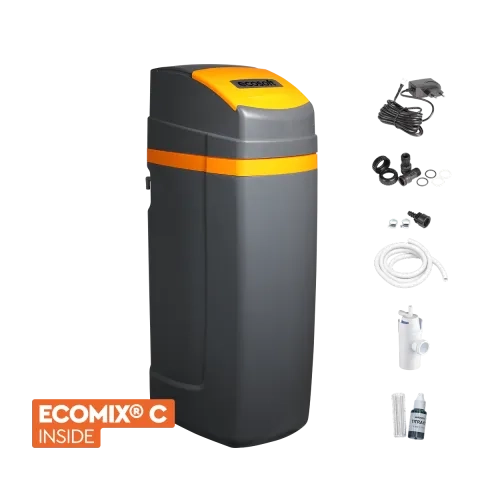
For more complex water problems, Ecosoft also offers ECOMIX® iron softeners. ECOMIX® systems are designed not only to reduce hardness, but also to help reduce iron, manganese, ammonium, and natural organic matter in water. To learn more about the technology, read our guide: What are water softeners? The complete guide.
-
Why should I install a water softener at home?
Installing a water softener at home helps protect your plumbing, bathroom surfaces, and household appliances from limescale caused by hard water. Softened water can help reduce scale buildup in pipes, boilers, washing machines, dishwashers, faucets, and showerheads.
It also makes everyday water use more comfortable. Soft water helps soap and detergents work more effectively, can reduce white marks on taps and tiles, and may help keep laundry softer after washing.
An Ecosoft water softener is a good choice if your main problem is hard water and limescale. If your water also contains iron, manganese, ammonium, or natural organic matter, an ECOMIX® iron softener may be a better solution for more complex water quality issues.
-
What problems can hard water cause?
Hard water can cause limescale buildup in pipes, boilers, water heaters, washing machines, dishwashers, faucets, showerheads, and other household appliances. Over time, this can reduce water flow, lower heating efficiency, and increase the risk of appliance wear or service issues.
Hard water can also leave white marks on taps, tiles, glass, and shower screens, making cleaning more difficult. In daily use, it may make soap and detergents less effective, so you may need to use more cleaning products, laundry detergent, or shampoo.
For the home, hard water often means more cleaning, more limescale, and less efficient appliance operation. Installing an Ecosoft water softener can help reduce hardness and protect your plumbing and appliances. If hard water is combined with iron, manganese, ammonium, or natural organic matter, an ECOMIX® iron softener may be a more suitable solution.
-
How do Ecosoft water softeners remove hardness from water?
Ecosoft water softeners reduce hardness using ion exchange. Hard water contains calcium and magnesium ions, which are responsible for limescale buildup. As water passes through the resin inside the softener, these hardness ions are exchanged for sodium ions.
Over time, the resin becomes saturated with calcium and magnesium. To restore its softening capacity, the system automatically regenerates the resin with a salt solution. During regeneration, calcium and magnesium are flushed away to the drain, and the resin becomes ready to soften water again.
This process helps reduce limescale formation in pipes, boilers, washing machines, dishwashers, faucets, and other appliances. In ECOMIX® systems, hardness reduction is combined with the reduction of other common water impurities, such as iron, manganese, ammonium, and natural organic matter.
-
What are the benefits of using an Ecosoft water softener?
An Ecosoft water softener helps protect your home from the effects of hard water. It reduces calcium and magnesium hardness minerals, helping prevent limescale buildup in pipes, boilers, washing machines, dishwashers, faucets, showerheads, and other household appliances.
Softened water can also make everyday cleaning easier. It helps reduce white marks on taps, tiles, glass, and shower screens, and allows soap, shampoo, and detergents to work more effectively.
Using a water softener can support longer appliance service life, more stable water flow, better heating efficiency, softer laundry, and a more comfortable daily water experience. For homes with more complex water quality issues, Ecosoft ECOMIX® systems can also help reduce iron, manganese, ammonium, and natural organic matter together with hardness.
-
How can a water softener protect household appliances?
A water softener protects household appliances by reducing calcium and magnesium hardness minerals in the water. These minerals are responsible for limescale, which can build up inside boilers, water heaters, washing machines, dishwashers, coffee machines, faucets, and showerheads.
When limescale forms inside appliances, it can reduce water flow, make heating less efficient, increase energy use, and cause parts to wear faster. Softened water helps reduce scale buildup, so appliances can work more efficiently and require less cleaning and maintenance.
This is especially important for appliances that heat water, because limescale can form faster at higher temperatures. By reducing hardness before water reaches the appliance, a water softener helps support stable performance and longer service life.
-
Does softened water help reduce limescale buildup?
Yes, softened water helps reduce limescale buildup. Limescale forms when calcium and magnesium hardness minerals are present in water, especially when the water is heated or evaporates on surfaces.
A water softener reduces these hardness minerals before water enters the home plumbing system. As a result, less scale can form in boilers, water heaters, washing machines, dishwashers, faucets, showerheads, tiles, and glass surfaces.
This helps keep appliances more efficient, reduces white marks and deposits, and makes everyday cleaning easier. The level of protection depends on the incoming water hardness, system settings, and regular softener maintenance.
-
Is softened water safe for everyday use?
Yes, softened water is safe for everyday household use. It can be used for washing, showering, cleaning, laundry, and most daily tasks around the home.
A water softener reduces calcium and magnesium hardness minerals and replaces them with sodium ions during the ion exchange process. This helps reduce limescale, but it can slightly increase the sodium content of the water. For most household uses, this is not a problem.
If softened water is also used for drinking or cooking, its suitability depends on the original water quality, hardness level, and personal dietary needs. For drinking water, it is best to install an additional reverse osmosis filter. RO filtration provides deeper purification and helps reduce dissolved salts, hardness minerals, heavy metals, PFAS, bacteria, viruses, and other unwanted substances.
-
Can an Ecosoft water softener improve water quality for washing and cleaning?
Yes, an Ecosoft water softener can improve water quality for washing and cleaning by reducing hardness minerals in the water. Softened water helps soap, shampoo, and detergents dissolve and work more effectively, so you may need less product for everyday cleaning and laundry.
It also helps reduce white marks, scale deposits, and soap residue on taps, tiles, shower screens, glass, and bathroom fixtures. This can make surfaces easier to clean and help them stay cleaner for longer.
For laundry, softened water can help fabrics feel softer after washing and reduce mineral buildup inside the washing machine. The final result depends on the incoming water hardness, softener settings, and regular system maintenance.
-
What water hardness level requires softening?
Water softening is usually recommended when hard water starts causing visible or practical problems, such as limescale on taps, shower screens, tiles, kettles, boilers, washing machines, or dishwashers.
The exact need for softening depends on the hardness level in your water analysis, water consumption, temperature, plumbing, appliance use, and personal comfort. If you see scale deposits, white marks, reduced appliance efficiency, or need frequent descaling, a water softener can help protect your home from hard water.
To choose the right solution, use the Ecosoft Wizard. It helps select a suitable water treatment system based on your water consumption, source water quality, and desired water quality, or contact us – our team will help you choose the best solution.
-
Can Ecosoft water softeners be used for private houses?
Yes, Ecosoft water softeners can be used for private houses. They are suitable for homes with hard water and help protect plumbing, boilers, water heaters, washing machines,
dishwashers, faucets, showerheads, and other household appliances from limescale buildup.
For a private house, the right softener depends on the water source, hardness level, number of residents, bathrooms, water consumption, and available installation space. If the water also contains iron, manganese, ammonium, or natural organic matter, an ECOMIX® system may be a more suitable option.To choose the right solution, use the Wizard or contact us – our team will help select a system based on your water quality and household needs.
-
Are Ecosoft water softeners suitable for apartments?
Yes, Ecosoft water softeners can be suitable for apartments, especially if hard water causes limescale on taps, shower screens, tiles, kettles, washing machines, dishwashers, or bathroom fixtures.
For an apartment, the right solution depends on the available installation space, water connection point, water pressure, hardness level, number of residents, and daily water consumption. Compact softeners can be installed where there is enough space and access to the water supply, drain, and power connection. To find a suitable option, use the Ecosoft Wizard tool.
For smaller homes or apartments, you can consider compact models such as the Ecosoft A-Soft 110 water softener or the Ecosoft CUBE 100 water softener.
-
How do I choose the right Ecosoft water softener model?
To choose the right Ecosoft water softener model, start with your water analysis. The most important parameters are hardness, iron, manganese, ammonium, and natural organic matter. If the main issue is only hardness and limescale, a standard Ecosoft water softener may be suitable. If the water has a more complex composition, an ECOMIX® system may be a better choice.
You should also consider the number of residents, bathrooms, daily water consumption, peak water demand, water pressure, and available installation space. These factors help determine the required softener capacity, flow rate, and regeneration frequency.
To choose the right solution, use the Ecosoft Wizard tool. It helps select a suitable water treatment system based on your water consumption, source water quality, and desired water quality.
Water softeners
-
£ 1,750.40 excl. VAT£ 1,918.40 incl. VAT
-
£ 1,192.00 excl. VAT£ 1,430.40 incl. VAT