


Ecosoft useful library
Unlock the wealth of knowledge on water treatment with the Ecosoft Useful Library. Discover insightful articles, guides, and tips to understand the importance of water treatment and make informed decisions for clean and safe water in your home or business. Trust Ecosoft for reliable expertise in achieving optimal water quality.

ECOSOFT BLOG

- Commercial water treatment

In the pursuit of a healthier lifestyle, many of us turn to various methods to ensure the safety and quality of the water we consume.

In a world where hydration is paramount, the choices we make about the water we consume can have a significant impact on our health and the environment.


- Sustainability & Health
Water, the elixir of life, is not just a vital element for our existence but also a source of endless humor.

- Water quality insights
Snow is typically composed of about 95% water and 5% air. It can be a safe source of drinking water in emergency situations, but it's important to be aware of the potential risks.

Plastic water bottles have become a ubiquitous part of our modern lives. They are convenient, portable, and often seen as a healthier alternative to sugary drinks.

- Water softening
Maintaining a thriving aquarium isn't just about keeping your aquatic residents well-fed and their habitat clean; it's also about ensuring that the water they live in is of the right quality.
- Water softening
- Water quality insights

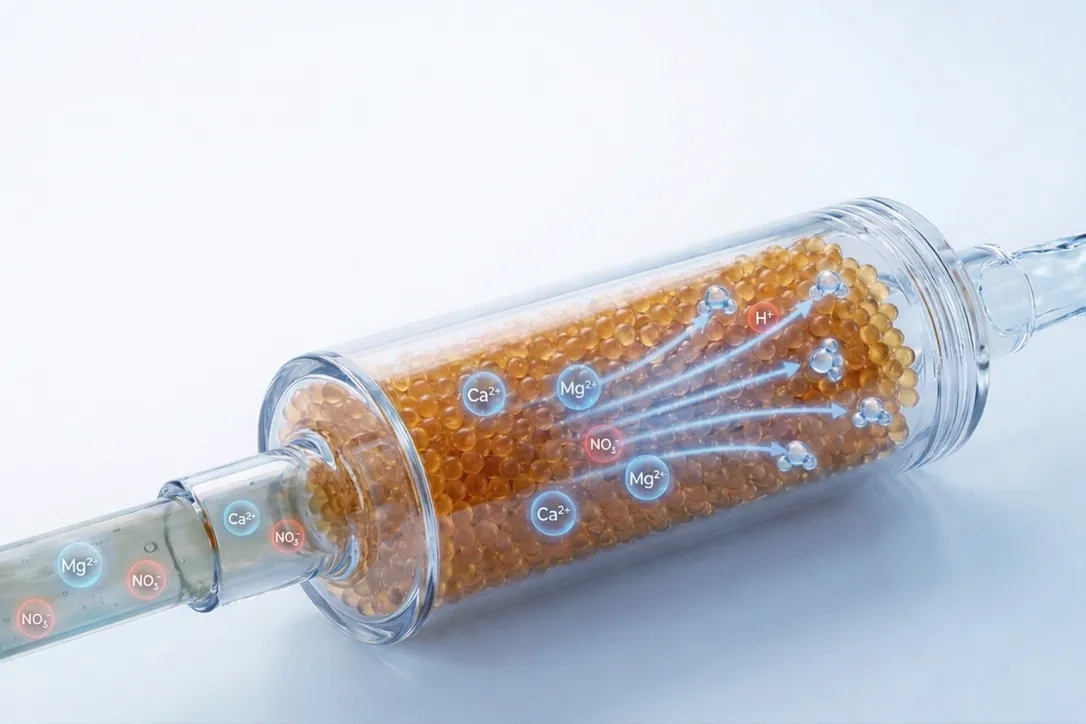
Ion exchange is a powerful method of water purification that replaces unwanted ions with safe ones. It’s used in everything from home softeners to industrial filtration.

- Drinking water
- Water quality insights
- Sustainability & Health

Choosing the right home water filter is key to protecting health, appliances, and water quality. This guide will help you find the best option for your needs.
FAQs
-
Where can I buy the Set of replacement filters 1-2-3-4 for RObust PRO at the best price?
You can purchase the Set of replacement filters 1-2-3-4 for RObust PRO at the best price directly from our official website or authorized dealers. Buying from these sources ensures you receive genuine filters that are compatible with your RObust PRO system and are backed by warranty support. Be cautious when considering third-party sellers to avoid counterfeit or low-quality filters that may compromise your system's performance and water quality.
-
What makes the Arctic Blue 370 a good choice for my home?
The Arctic Blue 370 compact water softener offers several advantages. Firstly, its efficient ion exchange process ensures you'll enjoy the benefits of soft water while minimizing water and salt consumption. Secondly, its compact design allows for flexible installation in various spaces. Additionally, this model boasts advanced features like a user-friendly digital control panel and a reliable bypass valve. Finally, with our competitive pricing, you'll be getting high-quality water softening at an excellent value.
-
Is installation of the P'URE AquaCalcium Mint reverse osmosis filter a complex process?
Installing the P'URE AquaCalcium Mint reverse osmosis filter is a relatively straightforward process, and it comes with detailed installation instructions. However, if you're not comfortable with DIY installation, we recommend hiring a professional plumber to ensure a hassle-free setup. The filter is designed for under-sink installation and includes all the necessary components, making it convenient for most households to enjoy the benefits of clean and delicious water without extensive plumbing knowledge.
-
How often should I replace Ecomix® C filter media in my water treatment system?
The frequency of media replacement depends on factors like water quality, usage, and system specifications. Ecomix® C filter media has a long service life and can be regenerated, extending its usability. Generally, it's recommended to monitor water quality regularly and replace or regenerate the media when it no longer effectively treats the water. Refer to the manufacturer's guidelines and consult with a water treatment professional for specific recommendations tailored to your system.
-
How often do I need to replace the filters in the CROSS90 reverse osmosis filter system?
The frequency of filter replacement in the CROSS90 reverse osmosis filter system depends on your water quality and usage. In most cases, the pre-filters and the membrane should be replaced every 6 to 12 months to maintain optimal performance. The post-filter may need replacement less frequently, typically every 12 to 24 months. It's essential to follow the manufacturer's recommendations and periodically check the system's performance to ensure your water remains pure and clean. Replacement filters are readily available for purchase to help you maintain the system efficiently.
-
Where can I buy the ROBUST PRO Reverse Osmosis Filter, and what is the pricing like?
You can purchase the ROBUST PRO Reverse Osmosis Filter directly from our official website or from authorized retailers. The pricing may vary depending on any ongoing promotions or bundles, so we recommend checking our website for the most up-to-date pricing information. Rest assured that the ROBUST PRO offers exceptional value for the quality and performance it delivers, making it an excellent long-term investment in your family's health and well-being.
-
How often do I need to replace these filters?
The replacement frequency depends on factors such as your water quality and usage. However, as a general guideline, we recommend replacing the pre-filter (1) and sediment filter (2) every 3 to 6 months, and the carbon filter (3) and post-filter (4) every 6 to 12 months. Regularly inspecting your filters and monitoring the water quality will help you determine when replacements are needed. Keep in mind that these recommendations may vary, so always refer to your RObust PRO's user manual for specific guidance.
-
Is the Arctic Blue 370 compact water softener easy to install?
Yes, the Arctic Blue 370 is designed for straightforward installation. It comes with detailed installation instructions, and many homeowners find it suitable for DIY installation. However, if you're not comfortable with DIY projects, it's always a good idea to hire a professional plumber to ensure a trouble-free setup. Additionally, the compact size of the Arctic Blue 370 makes it easy to fit into most utility rooms or under sinks, saving valuable space.
-
How often do I need to replace the filters in the P'URE AquaCalcium Mint reverse osmosis filter?
Filter replacement frequency depends on your water quality and usage. Generally, the pre-filter and post-filter should be replaced every 6-12 months, while the reverse osmosis membrane and mineralization filter typically last 2-3 years. However, it's essential to monitor the filter's performance and follow the manufacturer's recommendations for your specific unit. Regular maintenance ensures your filter continues to provide clean and refreshing water.
-
Where can I purchase Ecomix® C filter media at the best price?
You can buy Ecomix® C filter media, specifically the ECOMIXC25 variant, at the best price from authorized distributors, retailers, or online suppliers. To ensure you get a competitive price, consider comparing offers from different sources and verifying the product's authenticity. Always purchase from reputable suppliers to guarantee the quality of the media.
-
Is installation of the CROSS90 reverse osmosis filter complicated?
Installing the CROSS90 reverse osmosis filter is a straightforward process, and it can typically be done by homeowners without professional assistance. The system comes with detailed instructions and all the necessary components for installation. It usually involves connecting the filter to your existing water supply and setting up the faucet. If you encounter any difficulties during installation, our customer support team is available to provide guidance and assistance.
-
-
What initiatives are being undertaken to reduce plastic bottle waste?
There are a number of initiatives underway to reduce plastic bottle waste, including the development of biodegradable plastic water bottles and reusable water bottles made from recycled materials.
-
What can individuals do to ensure the safety of their tap water at home?
Here are some things you can do to ensure the safety of your tap water at home:
- Run the tap for a few seconds before using it.
- Use a water filter that is certified to remove the specific contaminants you are concerned about.
- Boil water before drinking it, especially if you are traveling to a country with poor tap water quality.
If you have any questions or concerns about the safety of your tap water, please contact your local water utility
-
What is the acceptable range for water hardness in residential settings?
The acceptable range for water hardness in residential settings is 0-120 mg/L. Water with a hardness level above 120 mg/L is considered to be hard water.
-
How often should I test my aquarium water for hardness levels?
Regular testing is crucial for maintaining ideal water parameters in your aquarium. It is recommended to test your water weekly, especially if you make changes to your water softening methods or introduce new fish to your aquarium.
By following these guidelines and adopting the right water softening approach, you'll be well on your way to providing an ideal aquatic habitat for your beloved fish, promoting their health and well-being, and ultimately creating a flourishing underwater world that you can be proud of.
-
Is fridge water filtered automatically?
Yes, water from the fridge is typically filtered automatically when dispensed through the refrigerator door.
-
Is water from the fridge purified or just filtered?
Filtered, not purified. While many impurities are removed, some contaminants may remain. Consider additional purification methods for comprehensive water safety.
-
Does a fridge filter remove chlorine?
Yes, activated carbon in refrigerator water filters effectively removes chlorine, enhancing water taste and odor.
-
What steps should I take to troubleshoot a malfunctioning well water system?
- Conduct a visual inspection
- Test the water quality
- Check for leaks or damage to well components
- Consult with a professional if issues persist
-
Why might well water have discoloration or odors?
Various contaminants, such as iron, manganese, bacteria, or tannins, can cause discoloration and odors.
-
How often should I inspect my well water system to prevent problems?
Annual inspections are recommended, along with regular water testing.
-
What are common signs of well water system issues?
- Discolored or cloudy water
- Unpleasant odors
- Reduced water pressure
- Stains on fixtures
-
Is it possible to filter or purify salt water for safe consumption?
While technologies exist to desalinate and purify salt water, these methods are not always practical in emergency situations. Additionally, they may not be readily available or accessible. It's essential to explore alternative methods for obtaining fresh water rather than relying solely on filtration or purification methods in dire circumstances.
Remember, the primary message is that drinking salt water is not a recommended practice for hydration, and efforts should be focused on finding a reliable source of fresh water.
-
Is it true that consuming salt water can lead to dehydration?
Yes, it is indeed true. Despite the tempting proximity of salt water in emergency situations, relying on it for hydration is counterproductive. The high salt content disrupts the body's equilibrium and exacerbates dehydration, posing a significant risk to your overall health.
-
Are there any benefits to drinking salt water for hydration in specific situations?
In emergency situations where no fresh water is available, consuming small amounts of salt water might be considered as a last resort. However, it's crucial to understand that this should not be viewed as a beneficial or sustainable method for hydration. It's a desperate measure and comes with risks and side effects.
-
Are the plastic bottles safe to reuse?
With environmental concerns on the rise, many individuals are considering reusing plastic bottles. We investigate the safety implications of reusing bottled water containers and explore eco-friendly alternatives.
-
How can you make eating snow safer in survival situations?
Here are a few tips for making eating snow safer in survival situations:
- Collect snow from a clean area away from roads, sidewalks, and other areas where it may be contaminated.
- Melt the snow before eating it. This will help to remove any contaminants and make it easier for your body to digest.
- Eat the snow slowly and in small amounts. This will help to prevent hypothermia.
-
Can you get sick from eating snow?
Yes, you can get sick from eating snow. Snow can contain contaminants, such as bacteria, viruses, parasites, and chemicals. Eating contaminated snow can make you sick.
-
-
What are the most common types of plastic used in water bottles?
The most common types of plastic used in water bottles are polyethylene terephthalate (PET), high-density polyethylene (HDPE), and low-density polyethylene (LDPE).
-
How to recognize good tap water quality?
Good tap water should be clear and colorless, with no odor or taste. It should also be free of any visible particles.
-
Are there any risks associated with using commercial water softeners in aquariums?
Commercial water softeners can be risky if not used correctly, as they might remove too many minerals. Proper monitoring and mineralization are essential when using these products.
-
Is it safe to eat snow when you're thirsty?
It is generally not recommended to eat snow when you're thirsty. There are a few risks associated with eating snow, including dehydration, hypothermia, and illness from contaminants. However, if you do need to eat snow, there are a few things you can do to make it safer.
-
Are there any health risks associated with using plastic water bottles?
Yes, plastic water bottles have been linked to a number of health concerns, including chemical leaching and bacterial contamination.
-
How much water should I drink a day?
The amount of drinking water you need to drink each day depends on a number of factors, including your age, activity level, and climate. However, a good general rule of thumb is to drink eight glasses of water per day.
-
What are the signs that my water might be hard?
Here are some of the signs that your water might be hard:
- Soap scum on your bathtub, shower, and sink
- Scale buildup on your plumbing fixtures and appliances
- Dry skin and hair
- Difficulty getting suds when you shower or wash dishes
- Dingy laundry
-
What is the ideal water hardness for most aquarium fish?
Most tropical freshwater fish thrive in water with a GH of 4-8°dGH and a KH of 3-6°dKH.
Can I use regular tap water for my aquarium, or should I soften it? The choice of using tap water or softening it depends on the specific requirements of the fish species in your tank. Some may do well with tap water, while others require softened water.
-
Why should I buy the Set of replacement filters for RObust PRO?
Investing in the Set of replacement filters for RObust PRO is crucial to maintain the efficiency and performance of your water filtration system. Regularly replacing filters ensures that your RObust PRO continues to provide clean, safe, and great-tasting water. Neglecting filter replacement can lead to a decline in water quality and potentially damage the system, so it's a cost-effective way to safeguard your health and the longevity of your appliance.
-
How does the Arctic Blue 370 water softener work?
The Arctic Blue 370 operates on a process known as ion exchange. It contains resin beads that attract and trap calcium and magnesium ions (hardness minerals) as water flows through the system. These minerals are then replaced with sodium ions, softening the water. When the resin beads become saturated with hardness minerals, the system initiates a regeneration cycle, where a brine solution is used to rinse and rejuvenate the resin beads, allowing them to continue softening your water effectively.
-
What are the key benefits of using the P'URE AquaCalcium Mint reverse osmosis filter?
There are several benefits to using the P'URE AquaCalcium Mint reverse osmosis filter:
- Pure and Clean Water: The reverse osmosis process removes up to 99% of impurities and contaminants, ensuring you have access to clean and safe drinking water.
- Enhanced Taste: The added mint flavor provides a pleasant and refreshing taste to your water.
- Mineral Enrichment: The filter also adds calcium to your water, which is essential for your health.
- Space-Saving Design: The compact design of the filter allows for easy installation under your sink, saving valuable counter space.
- Cost-Effective: By using this filter, you'll reduce the need for bottled water, saving you money in the long run.*
-
What are the key benefits of using Ecomix® C filter media?
Ecomix® C filter media offers several advantages:
Effective Contaminant Removal: It efficiently removes a wide range of impurities, ensuring clean and safe water.
Long-Lasting Performance: Ecomix® C has a long service life, reducing maintenance and replacement costs.
Eco-Friendly: This media is environmentally friendly and can be regenerated, minimizing waste.
Improved Water Taste and Odor: It enhances the taste and odor of treated water.
Versatile Application: Suitable for various water treatment systems, including residential and commercial setups.
-
How does the CROSS90 reverse osmosis filter compare to traditional filtration methods?
The CROSS90 reverse osmosis filter offers several advantages over traditional filtration methods. Unlike standard filters that use a simple mesh or carbon filtration, reverse osmosis utilizes a semi-permeable membrane to effectively remove even the tiniest particles, including dissolved salts and minerals. This results in water that is not only free from contaminants but also has improved taste and purity. Additionally, the direct flow design reduces water wastage, making it a more environmentally-friendly choice.
-
How does the ROBUST PRO compare to other reverse osmosis filters on the market?
The ROBUST PRO stands out due to its advanced filtration technology and reliability. It features a robust multi-stage filtration process that effectively removes a wide range of impurities while retaining essential minerals in your water. Additionally, it boasts a high flow rate and durable components, ensuring longevity and minimal maintenance. When it comes to performance, quality, and affordability, the ROBUST PRO is a top choice.
-
Is ECOMIX® sensitive to active chlorine, pH level or TDS?
ECOMIX® shows stable operation with active chlorine levels below 1 ppm and pH in the range of 5 to 9. ECOMIX® is not affected by the anion composition of the water and is stable with feed water TDS below 4000 ppm.
-
-
Can I use ECOMIX® to just remove organic matter and tannins?
ECOMIX® should not be used if organic matter reduction is the only purpose of treatment. But ECOMIX® can be used to reduce organic matter (color) and to soften water from well or municipal supply. The unit’s capacity should still be rated based on raw water hardness.
-
Is the Ferrosorb an ion exchange based product that is also regenerated by salt?
Ferrosorb is regenerated due to surface scouring mechanism during backwash. This is the reason why we always draw attention on the proper backwash flow rate.
-
My application is a well that is placed close to the surface water (lake, rivers, canals, ponds).
Water in shallow which are close to the surface water may be a mixture of well and surface water and may have higher than normal TOC and color. It could be microbiologically contaminated. In these situations, ECOMIX® is applicable but additional treatment may be required. We recommend paying attention to the color of the water and doing a tannin test. You must strictly follow the test instructions. For example, commonly used LaMotte test kits require a 30-minute wait before the results are indicated. Once complete, please send the water analysis and the tannin test results with a picture of the water in a white bucket to your water treatment specialist.
-
Do you have local partners who can help with my project?
Yes, we’d be happy to help your company with setting up the perfect water purification system.
We work closely with our local partners for such projects: they will visit your company to find out what exactly you need and then we’ll find the perfect solution for you together.
Our local partner will take care of the installation, so if you need somebody for the maintenance of your system, they’ll already know everything about it.
-
What are the feed water requirements for this membrane?
The recommended feed water parameters are: hardness up to 150 ppm as CaCO3, TDS up to 3000 mg/L, chlorides below 2000 mg/L, silica up to 20 mg/L as SiO2, free chlorine below 0.1 mg/L, chemical oxygen demand up to 5 mg O2/L, iron below 0.1 mg/L, manganese below 0.05 mg/L, no hydrogen sulfide, SDI below 5, and pH in the range of 3–10. The TDS also specifies free chlorine tolerance below 0.1 mg/L, maximum SDI 5, and operating pH range 3–10.
-
Can membranes be cleaned with regular tap water?
For full CIP cleaning, only permeate or highly demineralized water should be used. Salts from tap water can react with cleaning chemicals and precipitate inside the membrane structure.
-
What role does concentrate flow play in protecting the membrane?
Concentrate flow maintains cross-flow velocity, which helps wash contaminants away from the membrane surface. If concentrate flow is too low, particles and dissolved salts accumulate near the surface, increasing the risk of fouling and scaling. For HR-8040, stable and sufficient concentrate flow is important for long-term operation.
-
What is the main difference between Ecosoft HR and HF series membranes?
The main difference is the balance between salt rejection and permeate flow.
The High Rejection (HR) series is designed for higher salt rejection up to 99.3% at a slightly higher operating pressure of 10.3 bar, making it more suitable for applications with elevated nitrate and silicate levels. The High Flow (HF) series is designed for higher permeate flow up to 53 m³/day and energy-efficient operation at extra-low pressure of 6.9 bar, with a stabilized salt rejection of 98.0%.
The choice depends on whether the priority is higher rejection or higher flow with lower energy consumption. Therefore, for silica-rich or high-purity needs, the HR series is essential, whereas the HF series is the standard for general industrial water production.
-
Can I use ECOMIX® in cases of high iron, manganese or tannins content and with low hardness level?
ECOMIX® will operate successfully under these conditions. However, raw water hardness must be used to program the control valve and you must set the “Day Override” to 3 or 4 days. Be sure to contact your water treatment specialist if you have any questions.
-
Can you help me find the ideal specs for the water treatment system of my business?
Of course.
If we know all the details about your company, its needs, and the available infrastructure, our backoffice will find the perfect water treatment solution for you with the right functionalities and in the size you need.
If there are any special circumstances in your company, be that from a regulatory perspective or due to certain factors on-site, we might send one of our local partners to check out the details first.
-
How do high manganese levels affect membrane performance?
Like iron, manganese can oxidize and form a black deposit on the membrane surface. The problem is that manganese oxide acts as a catalyst, increasing the oxidizing effect of even trace amounts of chlorine and accelerating damage to the polyamide layer. The manganese level should be below 0.05 mg/L.
-
Are Ecosoft HR-8040 membranes compatible with standard antiscalants?
Yes, Ecosoft HR-8040 membranes are compatible with most phosphonate-based and polymer-based antiscalants. The required dose depends on the specific antiscalant and feed water composition. Antiscalants are typically dosed continuously in the range of 2 to 5 ml/m³. The exact dose can be calculated using Avista AdvisorCi.
-
What happens if the pH is outside the recommended operating range?
For continuous operation, the recommended pH range is 3–10. Operation outside this range may cause chemical degradation of the polyamide layer and reduce membrane performance over time.
-
Is it true that ECOMIX® will remove all types of iron, including ferric?
ECOMIX® will not remove ferric or oxidized iron efficiently. In applications where ferric iron is present we recommend to install a sediment filter before the ECOMIX® system to trap ferric iron particulates.
-
What exactly are PFAS?
PFAS (per- and polyfluoroalkyl substances) are synthetic compounds known for their extreme stability – hence the name "forever chemicals". As they're used in countless everyday products, they often find their way into the environment – and into drinking water.
-
What are the advantages of the Grundfos pump in this system?
The Grundfos pump used in this model offers several advantages:
- low energy consumption (0.67 kW)
- low noise level (55 dB)
- built-in dry-run protection
- high operating pressure (up to 16 bar)
- global manufacturer’s warranty from Grundfos
-
What is the maximum pressure the membrane can withstand?
The maximum allowable operating pressure is 41 bar (600 psi). However, systems typically operate at much lower pressures to optimize energy efficiency.
-
Why does permeate have high electrical conductivity after initial start-up?
This is normal during the first 15 minutes of operation. A new membrane contains a preservative solution that must be flushed out, and the membrane needs time to reach stable operating conditions. The first portion of permeate after start-up should always be discharged.
-
How can I tell whether performance loss in HR-8040 is caused by fouling or scaling?
Fouling (organic or biological) usually causes a gradual decline in permeate flow together with a moderate increase in pressure drop. Scaling, especially inorganic scaling such as calcium carbonate or silica, often causes a sharper flux drop and may be localized in the lead elements. Cleaning response is also different: fouling usually responds better to alkaline cleaning, while scaling typically requires acid cleaning. In HR-8040 systems, a combination of both may occur, so identifying the dominant cause is critical.
-
What should be used to lubricate O-rings during membrane installation?
Only glycerine should be used for lubrication. Other lubricants, especially petroleum-based ones, may permanently damage the membrane.
-
What happens if I operate the ECOMIX® system without that first regeneration?
The system will not remove the contaminants properly. There are 5 components in one bag of ECOMIX®. For proper filter operation these components need to be “layered”. When ECOMIX® is being regenerated, the mixture self-classifies into layers making it becoming ready for usage.
-
Why is hard water a problem?
Hard water always leads to limescale. The process is significatly accelerated when hard water is heated hard water is heated, for example in kettles, coffee makers, boilers or washing machines. This limescale buildup can damage your appliances, reduce their energy efficiency, and even clog your pipes.
-
How do the Ecoosft limescale filters for tap work?
Our systems use special filter media to reduce water hardness. Depending on the model, limescale-causing minerals like calcium and magnesium are either retained or replaced with gentler ions – resulting in softer water with fewer deposits.
-
What coffee machines can I use your water treatment systems with?
You can use our water treatment systems with any coffee machine as all our fittings are standardised.
Many of our café clients use our water filters for commercial coffee machines from brands like these:
- La Marzocco
- Sanremo
- Ascaso
- Astoria
- Faema
- Rancilio
- La Cimbali
- Rocket Espresso
- WMF
-
What recovery rates do your RO filters have?
The recovery rates of our reverse osmosis filters differ from product to product, but are always at least 50%.
Our RObust 1500 direct flow reverse osmosis filter, for example, has a recovery rate of 60–65%, while its small brother, the RObust Mini direct flow reverse osmosis filter, has a recovery rate of 50%.We constantly work on enhancing the efficiency and therefore sustainability of our RO filters and hope to improve recovery rates even more in the future.
-
How can I find the ideal setup for water treatment in my data centre?
We’d love to help you find the perfect water treatment solution for your data centre.
There are many factors to consider when planning the water treatment setup, and our engineers know all about them:
- What’s the quality of the inlet water?
- What’s the required capacity for the purification system in cubic metres per hour/day?
- How often will the cooling water circulate in your system? How does the composition change with each circulation?
- What’s the required pressure in your water cooling system?
If you decide to hire Ecosoft for the water treatment setup in your data centre, our engineers will help you with finding answers to all of those questions and choosing the right products for your needs.
When doing so, our experts don’t just look at the technical details though: they also consider economic efficiency, total cost of ownership (TCO), consumption of energy, reagents, and consumables, as well as maintenance.
They will help you in finding the ideal products for your data centre by thinking of every aspect of your water treatment system.
-
Can I connect multiple tanks after the system?
Yes, it is possible to connect two or more tanks to a single system.
If you have such a need, contact us at [email protected], and we will recommend the best solution.
We also suggest considering a ready-made option for this purpose — the Ecosoft Smart Water Keeper 500 L water tank.
-
What are the areas of application of this membrane?
The main applications of this membrane are car washes, glass production, household and industrial chemicals, chemical enterprises, laboratories, and distilled water preparation.
-
How does hydrogen sulfide in feed water affect the membrane?
In the presence of even trace amounts of oxidants or certain bacteria, hydrogen sulfide can be converted into elemental sulfur, which deposits inside the membrane as a sticky coating that is extremely difficult to remove.
-
Do all membrane elements in a multi-element vessel foul in the same way and what is the difference between lead and tail positions?
No. In multi-element pressure vessels in industrial systems, the type of fouling depends directly on the element position: the lead element typically suffers from physical and organic fouling, while the tail element is more exposed to mineral scaling.
The first module in the membrane vessel comes into contact with raw water at the highest flow velocity, acting as a barrier for suspended solids, bacteria, and organic matter, which results in increased differential pressure. The last element operates with highly concentrated brine, where calcium, magnesium, and silica levels often exceed solubility limits and precipitate onto the membrane surface. This phenomenon, known as scale crystallization, appears as a sharp drop in salt rejection and an increase in permeate TDS, especially at the tail end of the system. When high-rejection HR-8040 membranes are used, the risk of scaling on the tail element is higher because they reject salts more effectively, creating a steeper concentration gradient at the membrane surface. Therefore, protecting lead elements requires high-quality mechanical pretreatment, while protecting tail elements depends on proper chemical conditioning of the concentrate.
-
Can HR-8040 elements be replaced with HF-8040 without changing the pump?
Yes. Ecosoft reverse osmosis systems use pumps that can operate efficiently with different membrane types, so replacing HR-8040 elements with HF-8040 does not require a pump change.
-
Why is a top basket distributor necessary?
This distributor is necessary in order to prevent ECOMIX® from being lost during the backwashing sequence of regeneration.
-
Why can heavy metals be found in tap water?
In most cases, the issue isn’t with the water provider but with the internal plumbing of a building. Especially in older homes, pipes may still contain lead or copper, which can leach into the water over time. It’s a silent process that often goes unnoticed. A modern heavy metal water filter in your home ensures safety and gives you peace of mind by removing such residues reliably.
-
How does Ecosoft remove heavy metals from water?
Our filters use advanced technologies such as activated carbon, ion exchange, and membrane filtration. Each of them plays a vital role – from capturing fine particles to reducing metals like lead, copper, or cadmium. The result? Water that’s clean, fresh-tasting, and free from unwanted substances.
-
How can I find out how hard my water is?
You can request water hardness information from your local water provider. Alternatively, you can use test strips, or measure it yourself with a digital hardness meter.
-
How often do I need to change the filter cartridges?
Change intervals vary by model and usage. The Slim Filter Jug, for example, requires a new filter cartridge every 4 weeks, while other solutions need replacing every 3–24 months. Our premium model, the CROSS 90, even notifies you automatically with an LED indicator.
-
Do your filtration products achieve SCA-compliant water for coffee making?
Yes, you can achieve SCA-compliant water with our products.
Our direct flow reverse osmosis filter RObust COFFEE was specifically designed for coffee making and delivers SCA-compliant water through four steps:
Step 1: Pre-filtration
Mechanical impurities, chlorine, chlorinated compounds and natural organic substances are removed from your inlet water.
Step 2: Membrane filtration (RO step)
The water is pushed through a semi-permeable reverse osmosis membrane to remove 99.8% of dissolved impurities, including viruses and bacteria.
Step 3: Special coffee cartridge
Now the water is enriched with calcium (Ca) and magnesium (Mg) to enhance the aromas of the coffee brewed by your baristas.
Step 4: Post-carbon filtration
In this final step, the water is purified one last time to remove any residual odours that might impair the taste and aroma of your coffee.
But even if you decide against the RObust COFFEE for whatever reason, you can combine one of our reverse osmosis filters in your café with sediment filters, water softeners and mineralisation cartridges as needed to achieve the water quality recommended by the SCA.
If you’re unsure how to do that, we’d love to help you plan the ideal water filtration system for your coffee shop.
-
What tank volume is recommended after the system?
For an open tank, the volume should be at least equal to the hourly capacity of the system. For example, with the MO6500TP5, the minimum recommended tank size is 250–300 L. The maximum hourly water demand should also be considered.
A pressure tank is usually selected based on actual needs, with a minimum volume of around 80 L. Keep in mind that such tanks typically store only half of their total declared volume.
Only pressure tanks specifically designed for reverse osmosis water should be used. These tanks are usually constructed to prevent direct contact between the water and any metal parts.
-
What tank volume is recommended after the system?
For an open tank, the volume should be at least equal to the hourly capacity of the system.
For the MO12000TP5, the minimum recommended tank size is 400–600 L. The maximum hourly water demand of the consumer should also be taken into account.
A pressure tank is usually selected based on actual needs, with a minimum volume of around 80 L. Keep in mind that such tanks typically store only half of their total declared volume.
Only pressure tanks specifically designed for reverse osmosis water should be used. These are constructed to prevent direct contact between the water and any metal parts.
For large water needs, two or more pressure tanks can be installed in parallel. Each tank should be equipped with a check valve and a shut-off valve.
-
What tank volume is recommended after the system?
For an open tank, the volume should be at least equal to the hourly capacity of the system.
For the MO24000TP5, the minimum recommended tank size is 1 000–1 500 L. The maximum hourly water demand of the consumer should also be taken into account.
A pressure tank is usually selected based on actual needs, with a minimum volume of around 80 L. Keep in mind that such tanks typically store only half of their total declared volume.
Only pressure tanks specifically designed for reverse osmosis water should be used. These are constructed to prevent direct contact between the water and any metal parts.
For large water needs, two or more pressure tanks can be installed in parallel. Each tank should be equipped with a check valve and a shut-off valve.
-
What tank volume is recommended after the system?
For an open tank, the volume should be at least equal to the hourly capacity of the system.
For the MO36000TP5, the minimum recommended tank size is size is 1 500–2 500 L. The maximum hourly water demand of the consumer should also be taken into account.
A pressure tank is usually selected based on actual needs, with a minimum volume of around 80 L. Keep in mind that such tanks typically store only half of their total declared volume.
Only pressure tanks specifically designed for reverse osmosis water should be used. These are constructed to prevent direct contact between the water and any metal parts.
For large water needs, two or more pressure tanks can be installed in parallel. Each tank should be equipped with a check valve and a shut-off valve.
-
What happens if the system experiences backpressure from the permeate side?
If pressure in the permeate line exceeds pressure in the feed line even by 0.3–0.5 bar, the membrane selective layer may separate from the substrate. In such cases, the membrane usually has to be replaced.
-
What happens if the pressure drop across one element exceeds 1.0 bar?
A pressure drop above 1.0 bar usually indicates fouling or blockage. It can cause mechanical stress inside the element and may lead to telescoping, feed spacer damage, or damage to the membrane selective layer.
-
How long should the first portion of permeate be discharged during start-up?
During initial start-up, the first portion of permeate should be discharged for at least 60 minutes.
-
What is the Arctic Blue 370 compact water softener, and why do I need it?
The Arctic Blue 370 compact water softener is a cutting-edge appliance designed to tackle hard water problems in your home. Hard water contains minerals like calcium and magnesium, which can lead to scale buildup in your plumbing, appliances, and even on your skin and hair. The Arctic Blue 370 uses advanced ion exchange technology to remove these minerals, ensuring you have soft and scale-free water. This not only extends the lifespan of your appliances but also provides numerous benefits such as smoother skin, shinier hair, and improved water quality for everyday use.
-
What is the P'URE AquaCalcium Mint reverse osmosis filter, MO675PUREMACECO, and how does it work?
The P'URE AquaCalcium Mint reverse osmosis filter, MO675PUREMACECO, is a cutting-edge water filtration system designed to provide you with the purest and freshest drinking water. It uses a multi-stage filtration process, including reverse osmosis, to remove impurities, contaminants, and odors from your tap water. The addition of mint and calcium enhances the taste and mineral content of the water, giving you a refreshing and healthy drinking experience.
-
What is Ecomix® C filter media, and how does it work?
Ecomix® C filter media is a high-performance water treatment media designed to effectively remove impurities from water sources. It combines various filtration mechanisms, including ion exchange, adsorption, and catalytic action, to target contaminants such as heavy metals, chlorine, and organic compounds. This media enhances water quality and is ideal for residential and industrial water treatment systems.
-
What is the CROSS90 direct flow reverse osmosis filter, MO3600PECO, and what does it do?
The CROSS90 direct flow reverse osmosis filter, MO3600PECO, is a high-performance water filtration system designed to provide you with clean and purified drinking water. It utilizes reverse osmosis technology to remove contaminants, such as sediments, chemicals, and impurities, from your tap water. This system ensures you have access to fresh and great-tasting water right at your fingertips, without the need for bottled water.
-
What is the ROBUST PRO Reverse Osmosis Filter, and why should I consider buying it?
The ROBUST PRO Reverse Osmosis Filter is a high-performance water filtration system designed to provide you with clean, purified drinking water. It uses a reverse osmosis process to remove contaminants, including heavy metals, chlorine, bacteria, and more, ensuring your water is safe and great-tasting. By investing in the ROBUST PRO, you'll enjoy the benefits of healthier, better-tasting water for you and your family.
-
Can I set up the entire water treatment system for my car wash with Ecosoft products?
Yes, that is possible.
Our wide range of water treatment products includes everything you need for your car wash:
Step 1: Sediment filter
Our sediment filters remove any rust, debris and sand from the inlet water, which effectively prevents scratches in car paint.
Step 2: Water softener
Next up is the water softener. We usually recommend one with the Ecosoft Bi Block system as these are particularly powerful, use 70% less salt than traditional water softeners and have truly impressive filtration rates. In addition, some of these Bi Block water softeners are IoT-ready, which makes monitoring system status and water quality much easier for you.
Step 3: Reverse osmosis filter
State-of-the-art RO filters remove any salts and minerals from the water – our commercial-grade RO filters have an impressive recovery rate of up to 70%, giving you up to 700 litres of desalinated water for your car washing operations for any 1000 litres of inlet water. They, too, are IoT-ready, facilitating your daily workflows and quality controls.
-
Can I use ECOMIX® if it was accidentally frozen during storage?
Freezing of ECOMIX® should be avoided as it may cause damage to its components. To avoid freezing, ECOMIX® should be stored in a dry room protected from sunlight at temperatures of 35–80 °F (2–27 °C). If it does freeze, ECOMIX® should be thawed out slowly at room temperature before loading and use. Do not treat frozen ECOMIX® with heat or steam.
-
What is chlorine and why is it added to drinking water?
Chlorine is a disinfectant that kills bacteria, viruses, and germs in water. It ensures hygiene, but can also cause unpleasant taste and skin irritation.
-
What are the most common bacteria in drinking water?
Typical culprits include E. coli, Pseudomonas aeruginosa, Enterococci, and of course Legionella. These bacteria can enter the system through damaged pipes or stagnant water and may cause health issues.
-
Are heavy metals in drinking water actually harmful?
In small doses, many metals are considered low-risk – but over time, they can accumulate in the body. This is particularly relevant for children, pregnant individuals, and sensitive people. A high-quality water filter that removes fluoride and heavy metals eliminates that concern.
-
Is it better to soften water for my entire home or just in the kitchen?
That depends on your living situation: In rented flats or smaller households, kitchen filters are a quick and affordable solution. For property owners a whole-house water softener is the better approach in the long term.
Your budget also plays a role: installing a central water softening system is an investment – but it often makes sense to soften hard water and remove chlorine, heavy metals, and other impurities for your entire home.
-
What does a water softener do?
During filtration, an ion exchange reaction takes place, in which hardness ions are replaced with safe sodium ions, resulting in water with normalized hardness levels. The result? Soft, pleasant water.
-
Is soft water healthier than hard water?
No. Hard water that causes limescale buildup isn't harmful to your health – but it can affect the taste of the water in your home and damage your appliances.
-
Can I use Ecosoft water treatment systems together with my existing infrastructure?
Yes, that is possible.
The universal construction of our water treatment systems allows for a very easy installation as well as combination with other brands.
Many café operators who don’t use our 4-in-1 solution RObust COFFEE, for example, combine one of our reverse osmosis filters like the RObust Mini or the RObust 1500 with the BWT Bestmin or another mineralisation cartridge.
-
Which TDS levels are required for labs?
The Total Dissolved Solid (TDS) level required for your lab depends on the kind of work you do. The higher the TDS level, the more organic and inorganic matter is dissolved in the water, which can interfere with procedures, measurements and experiments.
General lab work usually requires a TDS level of 10 ppm or lower, while more analytical testing ideally has a TDS level of 5 ppm or lower. Very sensitive tasks such as the work with cell cultures requires an even cleaner environment with TDS levels of 1 ppm or lower.
Please keep in mind that the exact rules regarding TDS levels for certain tasks are clearly defined, usually by a local authority. Make sure to follow the standards laid out by the relevant body for your lab work.
-
Can I choose the components of the emergency water supply system?
Yes, it is possible to tailor the emergency drinking water containers to specific needs.
The standard components are:
- dosing station
- sediment filter
- sorption filters
- reverse osmosis filter
Depending on the individual situation, these components might be added to achieve the desired water quality:
- UV sterilisation
-
Do I need a reverse osmosis filter in my data centre?
Yes, a reverse osmosis (RO) filter is always recommended for water cooling systems in data centres.
While they could technically work without a RO filter, this would make getting the right purification level for your cooling water much harder and is likely to lead to operational challenges and an increased risk of system failures.
Reverse osmosis filters are particularly effective in reducing water hardness and total dissolved solids (TDS), which is critical to prevent scale formation on heat exchangers, nozzles and other elements of your water cooling systems.
-
How can I find the ideal setup for water treatment in my beverage production facility?
We’d love to help you find the perfect water treatment solution for your beverage production facility.
If you decide to hire Ecosoft for the water treatment setup in your production facility, our engineers will help you to find the ideal setup for your situation based on factors such as inlet water quality, local or European regulations for beverage production, food safety standards, drink(s) produced, factory size and more.
Apart from the technical details, our experts consider economic efficiency, total cost of ownership (TCO), consumption of energy, reagents, biocides, antiscalants, and consumables, as well as maintenance.
They will help you in finding the ideal products for your beverage production by thinking of every aspect of your water treatment system.
-
Can you help me with upgrading or optimising my water treatment system?
Yes, of course.
This usually requires an on-site visit, which is done by one of our local partners.
Once they know the current situation in your company and your requirements, we consult you on a good solution and create a personalised offer for you.
-
Is RO water safe for drinking and bathing?
Yes, reverse osmosis water is absolutely safe for drinking and bathing. In fact, water of such a high purity is often preferred for people with sensitive skin and infants.
-
Which type of tank is better to install after the system?
An open tank is the most common solution, especially if the required water flow exceeds the system capacity by three times or more. It is commonly used in private houses and car washes.
A pressure tank is suitable when the required water flow is short-term and does not exceed twice the system’s hourly capacity. It is typically used in restaurants and cafés.
-
In what cases is it recommended to preserve membranes?
If the system is stopped for up to 48 hours, the membrane can remain inside the system filled with water. If the shutdown lasts more than 2 days, the system should be flushed with fresh water once a day. If the shutdown lasts more than a week, the membrane should be preserved with a special solution to prevent bacterial and algae growth.
-
What flushing flow rate is recommended for this membrane?
A flushing flow rate of around 30–40 liters per minute at low pressure up to 2 bar is usually recommended to remove accumulated contaminants without forcing them deeper into the membrane structure.
-
How does high pH affect membrane service life?
While the membrane can withstand high pH during short cleaning cycles, continuous operation at pH above 10 can gradually damage the polyamide layer and reduce salt rejection over time.
-
What is the maximum allowable silt density index (SDI) for the feed water?
The maximum allowable feed water silt density index (15 min) is SDI 5.
-
Can you help me with finding the right scale for the water treatment system of my car wash?
Of course, we’d love to help you with that.
Once we know all the details about your car wash, its specific needs, as well as the available infrastructure and space, our backoffice will find the perfect water treatment solution for you.
If there are any special circumstances, we might send one of our local partners to visit you on-site and get a first-hand view of the situation.
Get in touch now to discuss your project
-
How often should I conduct a water test?
The frequency of water testing depends on various factors, including the source of your water, any previous issues, and local regulations. As a general guideline:
- Private wells: It is recommended to test private well water at least once a year for bacteria, nitrates, and other contaminants. Additional tests for pesticides or heavy metals may be necessary depending on the location and potential risks.
- Public water supplies: Public water suppliers are required to conduct regular testing and provide annual Consumer Confidence Reports (CCR) that detail the water quality. However, if you have concerns or notice changes in the water's taste, color, or odor, it's advisable to conduct independent testing.
-
Will ECOMIX® reduce H2 S?
Sometimes ECOMIX® may slightly reduce the rotten odor of H2 S but it is not recommended as a solution.
-
How do Ecosoft products remove chlorine from drinking water?
For chlorine removal our water filters use activated carbon filtration. This technology removes chlorine effectively and also filters out heavy metals, limescale and other contaminants.
-
How dangerous is Legionella in water?
Legionella are bacteria that can cause pneumonia (Legionnaires' disease) when inhaled – for example during a shower. Older people and those with weakened immune systems are particularly at risk.
-
What else does Ecosoft filter out?
Depending on the model, our systems also remove chlorine, limescale, PFAS, and other common contaminants. Ecosoft offers a wide range of solutions for better household water – whether you need it for drinking, cooking, making your morning coffee or to protect your appliances. We also offer scalable systems for commercial water treatment tailored to business and industry needs.
-
What else do Ecosoft systems filter?
Alongside PFAS, our filters also remove a wide range of other contaminants. This results in pure water that also tastes much better.
Apart from our solutions for your home, we also offer efficient, cost-effective solutions for industrial and commercial water treatment.
-
Who should install a water softener?
Primarily households with a central water supply, especially detached homes. But our water softeners are also great for owners of flats who want to protect their appliances.
-
Can I use the filters in a rented flat?
Absolutely! Many of our limescale filters – from jugs to under-sink systems – are perfect for rented homes. No drilling, no complex installation: just connect and enjoy fresh, clean water.
-
Which TDS do I need for the perfect brew and can I achieve it with Ecosoft?
Yes, you can achieve the TDS levels recommended by the SCA with Ecosoft water treatment systems.
The SCA recommends a TDS level of 75–250 ppm, although it’s important to note that the composition of the Total Dissolved Solids has a significant impact on the taste of your coffee.
With its combination of calcium (Ca) and magnesium (Mg), the RObust COFFEE creates water that’s optimized to enhance the unique aromas of coffee.
-
Do I need to use a tank with these systems?
We recommend using a tank whenever you connect one of our reverse osmosis filters to an additional device to average out TDS levels and achieve consistent results.
-
Are the emergency water systems energy-independent?
Yes, we specifically designed our emergency water systems to be energy-independent.
If you don’t have access to reliable energy, you can operate the emergency water filter system with generators.
-
Can I use Ecosoft water treatment systems together with my existing infrastructure?
Yes, that is possible.
The universal construction of our water treatment systems allows for a very easy installation as well as combination with other brands.
It also allows you to connect a number of filters and other products in series to achieve the perfect cooling water quality for your data centre.
-
What maximum salinity can Ecosoft’s RO systems handle?
Our RO systems for homes are designed for very complex water compositions and can handle TDS levels of up to 3000 mg/L.
They are ideal for households, private homes, or cottages where the TDS levels are above 1.000 mg/l. Since traditional water softening systems can’t handle such a composition, a reverse osmosis system is the ideal alternative.
-
What is the best way to remove hardness before reverse osmosis?
Removing hardness salts before the reverse osmosis system is the most effective solution. This can be done by using a softener.
If your feed water is more complex and contains not only hardness but also iron, manganese, or TOC, we recommend using Ecomix® filtration media.
Antiscalants can also be used effectively in industrial systems with a capacity of more than 2.0 m³/h.
-
Can I install the iron filter for well water myself?
For the best performance, we recommend professional installation by an authorized Ecosoft partner.
-
Can this membrane be used if the feed water contains high iron levels?
It is not recommended to use reverse osmosis without proper pretreatment. Reverse osmosis membranes are highly sensitive to iron, even more than to hardness salts. If iron content exceeds 0.1 mg/L, it can oxidize on the membrane surface and form a layer that is difficult to remove by standard chemical cleaning. If the feed water has a high iron content, pretreatment with iron removal or Ecomix systems is recommended.
-
Can the HR-8040 membrane remove viruses and bacteria?
Theoretically, yes, because the membrane pores are much smaller than microorganisms. However, reverse osmosis membranes are not certified as biological barriers, as leaks at O-rings or minor element defects may affect biological removal.
-
What is the maximum operating water temperature?
The maximum operating water temperature is 45°C, or 113°F.
-
What can a water test reveal about the quality of my water?
A water test can reveal various aspects of water quality, including:
- Bacterial contamination: Testing can detect the presence of harmful bacteria, such as E. coli or coliforms, which can cause waterborne illnesses.
- Chemical pollutants: The test can identify the presence of chemicals like lead, arsenic, nitrates, pesticides, or volatile organic compounds (VOCs) that may pose health risks.
- pH and mineral content: Water tests can measure the pH level and the concentration of minerals, such as calcium, magnesium, or iron, which may affect taste, hardness, or corrosiveness.
- Overall safety: A comprehensive water test provides an overall assessment of the safety and compliance of your water supply with regulatory standards.
-
How can I get a water test done?
There are different options for getting a water test done:
- Local laboratories: Many local or state health departments offer water testing services. They can provide instructions on how to collect the water sample and where to send it for analysis.
- Home testing kits: Home water testing kits are available for purchase online or in stores. These kits typically come with instructions and test strips or vials to collect the water sample. Some kits allow you to send the sample to a laboratory for further analysis.
- Professional services: You can also hire professional water testing services to collect the water sample and perform comprehensive analysis. They often provide detailed reports and recommendations based on the results.
-
Can I use Ecosoft water treatment systems together with my existing infrastructure?
Yes, that is possible.
The universal construction of our water treatment systems – be that water softeners, sediment filters or RO filters – allows for a very easy installation as well as combination with other brands.
-
Is ECOMIX® sensitive to H2 S?
ECOMIX® is not sensitive to hydrogen sulfide content in well water and its efficiency will not be affected.
-
How do Ecosoft water filters remove bacteria?
Our bacteria water filters use reverse osmosis. With this technology, water is pushed through ultra-fine membranes that block even the smallest particles, bacteria and germs.
-
How often should I change the filter cartridges?
It depends on the model and your water usage. Filter jugs typically need a cartridge change every four weeks, while reverse osmosis systems can go 6 to 24 months between changes. The CROSS 90 system even has a smart LED indicator that tells you exactly when to replace the filter – easy and convenient.
For our whole-house water softeners, you'll need to regularly refill the regeneration salt. -
Are there softeners for water with iron or manganese?
Yes, Ecosoft offers systems specifically designed for water with high iron and manganese levels. Our Titanium Gold and Anthracite Gold products were developed for just that.
-
What are the benefits of soft water for coffee machines or kettles?
It extends the life of your appliances as it prevents limescale buildup in the coffe maker or your kettle. This doesn't just extend the lifespan of your appliances, it also saves money, time, and energy.
-
Do I need to use a tank with your water purification systems in my café?
While it’s not strictly necessary to use a tank when using our commercial water filtration system in your café, we do recommend it: Using a tank helps to average TDS levels in the water, which results in consistent coffee flavour.
-
Can I use the emergency water treatment system together with my existing infrastructure?
Yes, that is possible.
To allow universal usage, the emergency water filter system is fitted with standardised connections, meaning you can easily connect it to your local energy grid or water supply.
-
Do I need a water-treatment specialist to operate the emergency water supply system?
No, anybody who read the manual can operate the emergency drinking water supply system safely.
A number of control devices is installed to help you run the supply system – and if you run into any issues, our support is here for you.
-
What are the steps of the water purification process for the cooling water in my data centre?
The exact steps required to achieve ideal cooling water in your data centre depend on a number of factors, but here are some of the most common water treatment processes:
Sediment filtering
Depending on the water quality in your location, the first step might be to remove any suspended particles like sand or rust from the soon-to-be cooling water.
Oxidation or ECOMIX® purification
If necessary, an oxidation process followed by another filtration step is added to reduce the levels of iron and manganese in the water, which can oxidise in your cooling water and clog nozzles or promote corrosion. Here at Ecosoft, we implement our patented ECOMIX® purification technology for this step.
Water softening
An ion exchange process or reverse osmosis removes, calcium and magnesium from the water – they are the primary factors in scale formation on heat exchange surfaces and can accelerate corrosion. If you need to remove other salts, TDS or silica (SiO₂), you might need to add a reverse osmosis step to your water purification system.
Biocide disinfection
When bacteria, algae and other microorganisms are present in water cooling systems, they could lead to biofilm formation and microbiologically influenced corrosion. You can control their growth in your data centre with the help of biocides.
-
Can I use Ecosoft water treatment systems together with my existing infrastructure?
Yes, that is possible.
The universal construction of our water treatment systems allows for a very easy installation as well as combination with other brands.
It also allows you to connect a number of filters and other products in series to achieve the perfect water quality for your beverage production from soft drinks to liquor.
-
The Ecosoft dealer in my region isn’t my company's preferred partner – can I still get your products?
We’d love that.
Just let us know if that’s the case for you and we can work something out.
-
What water treatment system is best for my kitchen equipment?
While all of our water treatment systems purify water for use in your kitchen equipment reliably, the perfect choice depends on a number of factors like the following:
- How many appliances will use the purified water?
- How high is the daily consumption of the purified water?
- How big or small is the space available for a water filtration system in your restaurant?
- What quality does the inlet water have in your restaurant?
If you’re unsure about the best water filtration setup for your restaurant, we’d love to help you.
-
-
What kind of pre-treatment is required before the system?
If you use tap water as a feed source, it must be pre-filtered from fine particles and chlorine before entering the RO system. Well water may contain hardness, iron, manganese, silica, or hydrogen sulfide — all of which can quickly damage the membrane. Some of these issues can be addressed by using an antiscalant.
We recommend performing a detailed laboratory analysis of your well water. For tailored advice, feel free to contact us at [email protected].
-
Can performance change with ambient temperature?
Yes, membrane performance depends directly on water temperature. As temperature decreases, water viscosity increases, making it harder for water to pass through the membrane. As a result, permeate flow decreases. A drop of 1°C typically reduces performance by about 3%, so if the water is 10°C colder, permeate flow may be about 30% lower. This is normal membrane operation.
-
Why may permeate flow exceed the design value?
This may be caused by higher-than-expected feed water temperature or, more seriously, by a mechanical leak such as O-ring failure or damage to a membrane leaf.
-
What is the maximum operating pressure for this membrane element?
The maximum allowable operating pressure for this membrane element is 41 bar, or approximately 600 psi.
-
Why should I consider a water test for my drinking water?
A water test is essential for understanding the quality and safety of your drinking water. It helps identify potential contaminants, such as bacteria, heavy metals, pesticides, or chemicals, that may be present in the water supply. By conducting a water test, you can make informed decisions about water treatment options, protect your health, and ensure the well-being of your family.
-
How can I get rid of the sulfur smell in my water?
There are several methods to remove the sulfur smell from water. One common solution is the use of activated carbon filters, which can effectively absorb and neutralize hydrogen sulfide gas. Additionally, aeration systems can introduce oxygen into the water, helping to reduce the presence of the gas. Chlorination or chemical oxidation methods may also be employed to eliminate the sulfur smell. It is advisable to consult a water treatment professional to determine the most suitable method for your specific situation.
-
How often do iron filters need maintenance, and what are the maintenance requirements?
The maintenance requirements for iron filters can vary depending on the specific model and the water conditions. Generally, iron filters may require regular backwashing to clean out accumulated iron particles and other debris. Some filters may also require periodic media replacement or regeneration. It's important to follow the manufacturer's guidelines for maintenance and consider factors such as water usage, iron concentration, and the filter's lifespan to determine the frequency of maintenance tasks. Regular monitoring of water quality and consultation with a professional can help ensure the iron filter continues to operate effectively.
-
What types of iron filters are available for well water treatment?
There are different types of iron filters available for well water treatment, including catalytic carbon filters, birm filters, and greensand filters. Each type has its own advantages and is effective at removing iron from water to varying degrees. The choice of the iron filter type depends on the specific characteristics of your well water and the desired level of iron removal.
-
Can I install a reverse osmosis system myself to save money?
While it is possible to install a reverse osmosis system yourself, it is generally recommended to have it installed by a professional. Proper installation is crucial for the system to function optimally and ensure the quality of the water produced. Additionally, if you're not familiar with plumbing or have limited DIY experience, it's best to consult a professional to avoid any potential issues or damage.
-
My car wash is very small or very big, can I still use your products?
Of course. Since we have such a wide range of products, we have the right size for any car wash size.
If you are unsure about which products are best suited for your needs, do let us know – we’d love to help you with planning the ideal solution for your business.
-
Can I use ECOMIX® if there is aeration or oxidant dosing ahead of the unit?
We do not recommend installation of oxidation and/or aeration before the ECOMIX® system. If you have to use aeration or oxidant dosing for any reason we highly recommend pretreatment with a multimedia sediment filter and an activated carbon filter to remove residual active chlorine.
-
Is chlorine in water harmful to my health?
At low levels, chlorine is considered safe. However, sensitive individuals, small children or pets may experience irritation or sensitivity. And let’s be honest – it just doesn’t taste good.
-
How does an Ecosoft filter improve the taste of my water?
By removing chlorine and other substances that affect taste, the water tastes noticeably fresher, smoother and more natural. Ideal for hot drinks, baby food or simply a refreshing glass of water.
-
How often should I replace the filter?
That depends on the model and usage – for our systems, the cartridge replacement interval ranges from 1 to 24 months. The CROSS 90 even features an LED display that reminds you automatically.
-
How does Ecosoft remove PFAS from water?
Our reverse osmosis systems are particularly effective in removing PFAS: the water passes through a multi-layer membrane that blocks even the tiniest molecules and only lets pure water through. The result is safe, clean water that's free from any chemical residues including PFAS.
-
Are essential minerals preserved?
Yes and no – reverse osmosis initially removes everything, including beneficial minerals. However, our PURE Balance models and the STANDARD PRO reintroduce calcium and magnesium after filtration. This gives you safe water that’s also mineral-balanced.
-
What are common pollutants in drinking water?
Common pollutants in water include chlorine, limescale, heavy metals like lead and copper, PFAS, iron, manganese, and microorganisms. Depending on your region and plumbing, levels may vary.
-
Are there compact softeners for small spaces?
Absolutely. Ecosoft offers space-saving solutions. The smallest model is Ecosoft Pink 100 (470 mm tall).
-
-
What TDS is required for the inlet water?
The required TDS level of the inlet water depends on the filter you use. All our RObust reverse osmosis filters require a TDS level of 1,000 ppm or less.
-
Are the emergency water supply systems smart?
While many of our products are IoT-ready, our current emergency water supply solutions aren’t smart.
-
Do I need to use a tank with your emergency water supply container?
No tank is required, but you can install one if it makes sense in your situation.
The emergency water supply can use water directly from any underground or surface water source, but if the water consumption varies greatly and the consumption is greater than the productivity during peaks, a tank can be helpful.
-
Are your products for data centre water treatment smart?
Yes, we do have a number of smart products for water treatment in data centres.
We know that monitoring performance is key in the smooth operation of data centres, which is why we’ve developed a number of IoT-ready products such as reverse osmosis filters to purify your cooling water.
-
What are the required purification steps for water in drink production?
The exact steps required to achieve the ideal water quality for your beverage production depend on a number of factors, but here are some of the most widely used technologies and processes:
Mechanical cleaning
This pre-treatment of inlet water is done either with ultrafiltration, cartridge filters or backfill filters to avoid clogging or contamination of subsequent water treatment systems in your production facility.
Complex purification
In this step, impurities such as hardness salts, iron, manganese, and organic matter are removed from the water intended for beverage production – we often recommend our patented ECOMIX® technology for this step.
Sorption purification
Chlorinated water doesn’t taste very good, but it’s the standard in many countries for health reasons. To remove any residual chlorine from the water to be used in the drinks you produce, activated carbon filters are often added.
Reverse osmosis (RO)
The final purification step is usually RO filtration, which removes about 99% of all dissolved impurities and makes sure the water complies with sanitary-chemical and microbiological standards.
-
Can I order consumables for my water treatment system directly from Ecosoft?
Of course, that’s what our online shop is for.
Just create an account (you’ll need your VAT ID for that) and once we checked your information, you’ll have access to our B2B online shop. And don’t worry, that usually doesn’t take longer than one business day.
-
How does filtered water improve coffee taste?
Filtered water is free from any unwanted substances and lets the bean’s true flavour shine. That means more aroma, more depth, and more enjoyment in every cup.
-
Will water treatment improve food & beverage taste?
Yes, it will.
Tap water usually contains impurities or might be chlorinated depending on where you live, all of which interferes with the taste of the dishes and drinks you prepare in your restaurant.
In order to achieve next-level taste in the food and drinks you serve in your restaurant, we recommend pure water that’s been filtered to remove any impurities.
A great starting point for this would be one of our reverse osmosis filters like the RObust 1500 or the RObust 4000, which are eco-friendly and provide great purification results that will elevate the taste of your dishes and drinks.
-
Can I use well water for irrigation in my greenhouse?
Technically yes, but in most cases, it’s advisable to treat the well water first.
Well water often contains high levels of iron, manganese, hardness, or total dissolved solids (TDS), which can damage your plants and clog your irrigation systems.
If you’re unsure about the water quality in your well, we recommend a water test. This will tell you exactly how your well water is composed and what kind of treatment it needs to be suitable for irrigation in your greenhouse.
-
How much water is wasted during the filtration?
Thankfully, our modern reverse osmosis systems are very efficient: they recover up to 75% of water, keeping waste to an absolute minimum.
Not just good for you, also good for the environment.
-
How to check filter water at home?
You can check water quality at home by taste, smell, and simple test kits. For precise results, consider laboratory testing.
-
Which membrane elements are the best for the MO6500TP5?
If you choose a professional line of commercial reverse osmosis systems, it makes sense to get the most out of it.
For complex water and extended service life, DuPont membrane elements are recommended.
If you require higher capacity, we suggest using DuPont FilmTec XLE PRO 4040.
If your priority is better quality of purified water, DuPont FilmTec LCLE 4040 can be used.
To get an estimate of the water quality you will receive, contact us at [email protected].
-
Which membrane elements are the best for the MO12000TP5?
If you choose a professional line of commercial reverse osmosis systems, it makes sense to get the most out of it.
For complex water and extended service life, DuPont membrane elements are recommended.
If you require higher capacity, we suggest using DuPont FilmTec XLE PRO 4040.
If your priority is better quality of purified water, DuPont FilmTec LCLE 4040 can be used.
To get an estimate of the water quality you will receive, contact us at [email protected].
-
Which membrane elements are the best for the MO24000TP5?
If you choose a professional line of commercial reverse osmosis systems, it makes sense to get the most out of it.
For complex water and extended service life, DuPont membrane elements are recommended.
If you require higher capacity, we suggest using DuPont FilmTec XLE PRO 4040.
If your priority is better quality of purified water, DuPont FilmTec LCLE 4040 can be used.
To get an estimate of the water quality you will receive, contact us at [email protected].
-
Which membrane elements are the best for the MO36000TP5?
If you choose a professional line of commercial reverse osmosis systems, it makes sense to get the most out of it.
For complex water and extended service life, DuPont membrane elements are recommended.
If you require higher capacity, we suggest using DuPont FilmTec XLE PRO 4040.
If your priority is better quality of purified water, DuPont FilmTec LCLE 4040 can be used.
To get an estimate of the water quality you will receive, contact us at [email protected].
-
What happens to the iron after filtration?
The captured iron is flushed out during regeneration, keeping your filter system efficient and long-lasting.
-
How should a new or preserved membrane be stored?
Store the membrane in a cool, dry place away from direct sunlight, in sealed packaging or in a preservative solution to prevent damage during storage.
-
Is Ecosoft HF-4040 suitable for highly mineralized water?
No, Ecosoft HF-4040 is best suited for low-mineralized feed water such as tap or well water, with TDS up to 1500 mg/L. For water with higher salinity, a membrane with higher salt rejection is generally a better choice.
-
What are the recommended storage temperatures for new membranes?
New membrane elements should be stored in a cool, dry place away from direct sunlight, ideally at temperatures between 5°C and 35°C. Freezing must be strictly avoided.
-
At what applied pressure is the HF-8040-440 tested?
Under standard test conditions, the HF-8040-440 is tested at an applied pressure of 6.9 bar, or approximately 100 psi.
-
Are your products smart?
Yes, many of our products are smart.
Most of our commercial-grade reverse osmosis filters are IoT-ready, which makes running your car wash much easier.
-
How can I use a TDS tester effectively?
To use a TDS tester effectively, follow these tips:
- Ensure the tester is calibrated correctly according to the manufacturer's instructions.
- Rinse the testing probe with distilled or deionized water before and after each use to remove any residue.
- Submerge the testing probe into the water sample, avoiding any air bubbles, and wait for the reading to stabilize.
- Take multiple readings from different locations to get a representative average.
- Keep track of the readings over time to monitor any changes in water quality.
-
What are the effects of hard water?
Hard water can have several effects on daily life. It can lead to the formation of limescale deposits on fixtures, appliances, and plumbing systems, reducing their efficiency and lifespan. Hard water may also interfere with the lathering ability of soaps and detergents, requiring larger amounts to achieve the desired cleaning effect. Additionally, hard water can leave spots and streaks on dishes and glassware when they dry, affecting their appearance.
-
How is water hardness measured?
Water hardness is typically measured in units of milligrams per liter (mg/L) or parts per million (ppm) of calcium carbonate (CaCO₃). This measurement is known as the Total Hardness. It can be determined through laboratory analysis or by using test kits that provide instant results. The hardness level is often categorized as soft (less than 60 mg/L), moderately hard (60-120 mg/L), hard (120-180 mg/L), or very hard (above 180 mg/L).
-
What are the benefits of using shower filters?
Using shower filters can offer several benefits for both your health and the overall showering experience. Some of the key benefits include:
- Reduced exposure to chlorine: Shower filters effectively remove chlorine from the water, which can cause dryness and irritation of the skin and scalp.
- Healthier skin and hair: By removing impurities and chemicals, shower filters help maintain the natural moisture balance of your skin and hair, preventing dryness, itchiness, and dullness.
- Protection against harmful substances: Shower filters can reduce the presence of heavy metals, volatile organic compounds (VOCs), and other potentially harmful substances in the water, providing an extra layer of protection.
- Improved air quality: When using a shower filter, the reduction of chlorine and other chemicals can help improve the air quality in your bathroom by reducing the release of chlorine vapors.
-
How do I determine the right size of iron filter for my well water system?
To determine the right size of an iron filter for your well water system, you need to consider factors such as the flow rate of your water, the level of iron contamination, and the specific needs of your household. It's recommended to consult with a water treatment professional who can assess your water quality and provide guidance on selecting the appropriate size for your iron filter.
-
How can we control microorganisms in water?
Controlling microorganisms in water is essential to ensure safe and clean water supplies. Several measures can be taken, including:
- Water treatment: Implementing proper water treatment processes, such as filtration, disinfection (e.g., chlorination), and advanced treatment technologies, can help remove or inactivate microorganisms.
- Regular testing: Regular monitoring and testing of water sources for microbial contaminants are crucial to detect any potential issues and take appropriate actions promptly.
- Sanitation practices: Promoting good sanitation practices, including proper waste disposal, maintenance of septic systems, and adequate hygiene practices, can help prevent the introduction of microorganisms into water sources.
- Watershed protection: Protecting watersheds and preventing pollution from entering water bodies can help minimize the presence of microorganisms in the environment and subsequently in water sources.
-
Is it possible to use ECOMIX® when iron content in water is higher than the limit of 15 ppm?
There are ECOMIX® units in operation which successfully remove iron in even greater concentrations. However, before doing so you should contact your water treatment specialist with a complete water analysis.
-
How often do I need to change the filters?
It depends on the model and your water usage. Filter jugs typically need a cartridge change every four weeks, while reverse osmosis systems can go 6 to 24 months between changes. The CROSS 90 system even has a smart LED indicator that tells you exactly when to replace the filter – easy and convenient.
-
How often do I need to change the filter elements?
This depends on the model and how much water you use. The filter cartridges usually last for several months before needing replacement. Detailed guidance is provided in each product description. The CROSS 90 makes things extra easy with a smart LED indicator that tells you exactly when to change the filter.
-
How do these substances get into tap water?
Some come from outdated pipes or home installations, others from environmental sources – such as fertilisers, industrial waste or water treatment processes.
-
How do Ecosoft water filters remove these pollutants?
Our filters use sorption with activated carbon, membrane technology, and ion exchange. This effectively removes harmful water contaminants while retaining essential minerals.
-
Is soft water healthy?
The dissolved minerals in hard water that cause limescale aren't harmful to humans. They are inconvenient though and can damage your water pipes and your appliances, though.
-
Will the emergency water supply work in real-life conditions?
Yes. Most of our solutions have been tested in real-life conditions in Ukraine. They were deployed to refugee camps, hospitals, emergency accommodations, and temporary military camps.
-
Are your products for beverage water treatment smart?
Yes, we do have a number of smart water treatment products for the beverage industry.
Here at Ecosoft, we know that monitoring performance is key to ensure smooth production workflows in the drink industry, which is why we developed a number of IoT-ready products such as reverse osmosis filters for your water purification.
-
Can I use softened water in an espresso machine?
Yes – but we recommend using a water filter for your coffee machine that also re-mineralises the water. Not all minerals are bad – elements like magnesium and calcium actually play a vital role in perfecting your coffee’s flavour.
-
Do I need to use a tank with your water purification systems in my restaurant?
While it’s not strictly necessary to use a tank when using our commercial water filtration system in your restaurant, we do recommend it for certain use cases: For example, using a tank for the water used by your coffee machine helps to average TDS levels in the water, which results in consistent coffee flavour.
We recommend installing a tank in all cases where our reverse osmosis filters are connected to additional devices.
-
How often do I need to service the water treatment system?
The service intervals for your irrigation water treatment system vary and depend on a few factors such as the setup you choose, inlet water quality and level of water usage.
You need to replace pre-filters and RO membranes regularly, although you can elongate those intervals for the latter by installing a CIP station that periodically cleans the membranes.
Here are some typical replacement intervals:
- Mechanical pre-filters: 8–12 weeks (might be shorter if your irrigation water has high turbidity)
- RO membranes: last up to 3 years (maybe longer if you use a CIP system)
- UV lamps: once a year
For bigger plant nurseries, greenhouses and garden centres, we recommend our IoT-ready water treatment solutions: these smart systems allow you to monitor water quality and system performance remotely, allowing for maintenance planning, reducing downtimes and ensuring consistent water output.
-
Aren’t some minerals good? Can I keep minerals in my RO water?
You are absolutely right, some minerals are actually good and healthy.
That’s why our blending options allow you to adjust the mineral content of the purified water.
-
How to make a water filter at home?
A DIY water filter can be made with gravel, sand, and activated carbon. However, such methods are not reliable for drinking water. For safe results, always use certified home water filters.
-
-
Can the system operate 24/7?
Yes, the MO12000TP5 is designed for continuous 24/7 operation in commercial environments.
Its robust Grundfos® pump and stainless steel frame ensure long-term durability.
The OC5000 controller manages automatic on/off cycles, flushing, and dry-run protection to safeguard the system.
The open-frame design allows quick and easy maintenance to reduce downtime.
-
Can the system operate 24/7?
Yes, the MO24000TP5 is designed for continuous 24/7 operation in commercial environments.
Its robust Grundfos® pump and stainless steel frame ensure long-term durability.
The OC5000 controller manages automatic on/off cycles, flushing, and dry-run protection to safeguard the system.
The open-frame design allows quick and easy maintenance to reduce downtime.
-
Can the system operate 24/7?
Yes, the MO36000TP5 is designed for continuous 24/7 operation in commercial environments.
Its robust Grundfos® pump and stainless steel frame ensure long-term durability.
The OC5000 controller manages automatic on/off cycles, flushing, and dry-run protection to safeguard the system.
The open-frame design allows quick and easy maintenance to reduce downtime.
-
How can I know the volume capacity of Ecolite Ultrasoft in my system?
You can estimate it using the formula:
Volume Capacity (m³) = Ecolite Ultrasoft volume (L) × [Ion-exchange capacity (g CaCO₃/L) ÷ Influent hardness (ppm CaCO₃)],
where the ion-exchange capacity of Ecolite Soft is 60 g CaCO₃/L.For example, if an Ecosoft 16×65 water softener is filled with 125 L of Ecolite Ultrasoft and the influent water hardness is 200 ppm CaCO₃, the treated water volume before regeneration will be 37.5 m³.
-
How can I know the volume capacity of Ecolite Demin in my system?
You can estimate it using the formula:
Volume Capacity (m³) = Ecolite Demin volume (L) × [20 ÷ Conductivity (µS/cm)].
For example, if reverse osmosis water with 16 µS/cm conductivity is polished using 100 L of Ecolite Demin, the treated water volume before replacement will be 125 m³.
-
Does an iron filter work with older wells?
Yes. Ecosoft filters can upgrade most existing systems. You just need sufficient pump pressure and, ideally, a recent water analysis to ensure proper setup.
-
Which membrane elements are the best for the MO6500TI6?
If you choose a professional line of commercial reverse osmosis systems, it makes sense to get the most out of it.
For complex water and extended service life, DuPont membrane elements are recommended.
If you require higher capacity, we suggest using DuPont FilmTec XLE PRO 4040.
If your priority is better quality of purified water, DuPont FilmTec LCLE 4040 can be used.
To get an estimate of the water quality you will receive, contact us at [email protected].
-
Does UV sterilization work in cloudy or turbid water?
No, it is significantly less effective in turbid or cloudy water.
For UV light to neutralize microorganisms, it must physically reach them. If the water contains suspended particles such as sand, silt, or rust, these particles can act as shields. Bacteria may “hide” behind them and pass through the chamber without sufficient UV exposure. This is known as the shadowing effect.
For reliable biological protection, proper mechanical pre-filtration is required before the UV sterilizer.
-
What is the difference between Ecosoft HR-4040 and Ecosoft HF-4040 membranes?
Ecosoft HR-4040 membranes offer higher salt rejection than HF-4040 membranes and can remove nitrates and silicates from water more efficiently. Ecosoft HF-4040 membranes have lower salt rejection, but provide higher permeate flow at extra-low operating pressure and are recommended for feed water with TDS up to 1500 mg/L.
-
What is the maximum feed water temperature?
The maximum operating water temperature is 45°C. Standard performance calculations are based on test conditions at 25°C.
-
Does the salt rejection of the HR-8040 change over time?
Yes. Salt rejection is typically highest during the first months of operation. Over time, and after repeated chemical cleanings, the polymer structure may gradually degrade, which can lead to increased salt passage.
-
What is the stabilized salt rejection of the HF-8040-440?
The stabilized salt rejection of the HF-8040-440 is 98.0%.
-
What do the TDS readings indicate about water quality?
TDS readings provide an estimate of the overall quality of the water based on the concentration of dissolved solids. Higher TDS levels may indicate the presence of minerals, salts, metals, or other impurities in the water. However, it's important to note that TDS alone doesn't provide specific information about the types of contaminants present. Additional testing may be necessary to identify specific substances or pollutants.
-
What is a TDS tester, and how does it work?
A TDS tester, also known as a Total Dissolved Solids tester, is a device used to measure the concentration of dissolved solids in a liquid. It works by measuring the electrical conductivity of the liquid, which is directly related to the concentration of dissolved solids. The tester provides a numerical value that indicates the TDS level, giving an idea of the overall water quality.
-
Can water hardness be treated?
Yes, water hardness can be treated to reduce its effects. Water softening is a common method used to remove calcium and magnesium ions from water. It involves the use of ion-exchange resin or salt-based water softeners that replace the calcium and magnesium ions with sodium ions. Other methods such as reverse osmosis and lime softening are also used to address water hardness. The choice of treatment depends on the specific hardness level, budget, and other factors.
-
What is water hardness?
Water hardness refers to the concentration of minerals, particularly calcium and magnesium ions, in water. It is a measure of the water's ability to form lather with soap. Hard water contains high levels of these minerals, while soft water has lower concentrations. Water hardness is an important water quality parameter that can have various effects on plumbing systems, appliances, and daily activities.
-
Can the sulfur smell in water be prevented?
Preventing the sulfur smell in water depends on the specific source of the issue. For well water, regular maintenance and monitoring of the well system are crucial. Ensuring proper ventilation and disinfection of the well can help minimize the growth of sulfur-producing bacteria. Additionally, addressing any issues with plumbing systems, such as corroded pipes or hot water heaters, can also prevent the sulfur smell. Regular water testing and treatment, if necessary, can help maintain water quality and prevent the recurrence of the sulfur smell.
-
Is the sulfur smell in water harmful?
In most cases, the sulfur smell in water is not harmful to human health. However, it can be unpleasant and affect the taste of drinking water, making it less desirable. Additionally, high levels of hydrogen sulfide gas can be toxic and pose a risk if inhaled in large quantities. It is recommended to address the issue of sulfur smell in water to improve its quality and eliminate any potential health concerns.
-
What causes a sulfur smell in water?
The presence of a sulfur smell in water is usually caused by the presence of hydrogen sulfide gas. This gas can be produced when organic matter decays, particularly in environments with low oxygen levels such as groundwater and wells. Bacteria that thrive in these conditions release hydrogen sulfide as a byproduct, leading to the characteristic rotten egg smell in water.
-
Can I convert hard water to soft water in my home?
Yes, you can convert hard water to soft water through a process called water softening. This typically involves using a water softener, which removes the excess minerals in the water and replaces them with sodium or potassium ions. Water softeners can be installed at the point of entry to treat all water entering the house or at specific points of use, such as under a sink or for the shower.
-
What are the effects of using soft water versus hard water?
Soft water tends to be more beneficial for household use. It can prevent mineral buildup in pipes and appliances, leading to improved lifespan and efficiency. Soft water also allows for better soap lathering and can result in softer, smoother skin and hair. In contrast, hard water may leave mineral deposits on surfaces, reduce soap efficiency, and contribute to scaling in appliances.
-
What is the difference between soft water and hard water?
Soft water and hard water differ in their mineral content. Soft water has low levels of minerals, specifically calcium, and magnesium, while hard water contains higher concentrations of these minerals.
-
How do I choose the right shower filter for my needs?
When selecting a shower filter, consider the following factors:
- Water quality: Determine the impurities present in your water supply by conducting a water quality test, if possible. This will help you choose a filter that targets the specific contaminants you want to remove.
- Filter type: Different shower filters use various filtering media. Research and choose a filter that suits your requirements, such as activated carbon filters for chlorine removal or KDF filters for heavy metal reduction.
- Filter lifespan: Check the expected lifespan of the filter cartridge and consider how often you will need to replace it. This can impact the long-term cost and maintenance of the filter.
- Installation and compatibility: Ensure that the filter is easy to install and compatible with your existing showerhead or plumbing setup.
- Budget: Determine your budget range and look for filters that offer a balance between cost and performance.
-
Do shower filters really work?
Yes, shower filters do work in effectively reducing the levels of impurities and chemicals in the water. The filtering media present in shower filters are designed to capture and trap contaminants, resulting in cleaner and healthier water for showering. However, it's important to note that the effectiveness of a shower filter can vary depending on its quality, design, and the specific impurities present in the water supply. It's recommended to choose a high-quality filter that suits your specific needs and to replace the filter cartridge as per the manufacturer's instructions for optimal performance.
-
Are there any ongoing maintenance costs for a reverse osmosis system?
Yes, reverse osmosis systems require regular maintenance to ensure their efficiency and longevity. The main maintenance cost is the replacement of filters, which typically need to be changed every 6 to 12 months, depending on the specific system and water quality. The cost of filter replacements can vary but generally falls within the range mentioned earlier, between $50 and $150 annually. It's important to factor in these ongoing maintenance costs when considering the overall cost of a reverse osmosis system.
-
Are there any additional costs associated with a reverse osmosis system?
In addition to the initial cost of the system, there might be some additional costs to consider. These can include the cost of professional installation if you choose to hire a plumber or technician. Furthermore, you may need to factor in the cost of periodic filter replacements, which usually range from $50 to $150 annually, depending on the number and type of filters required by your specific system.
-
Why does my reverse osmosis water taste strange?
If your reverse osmosis water tastes strange, it could be due to a few reasons. Firstly, check the age of your filters. Over time, the carbon filters in the system can become saturated, leading to an unpleasant taste or odor in the water. Replacing the filters at the recommended intervals can help alleviate this issue. Another possibility is the presence of dissolved minerals in the water. While reverse osmosis systems are designed to remove most minerals, some may still pass through or accumulate on the membrane. In such cases, using a post-filter or a remineralization cartridge can enhance the taste of the water. If the problem persists or worsens, it is advisable to consult a professional or consider getting your water tested for potential contaminants.
-
How do water's chemical properties affect its role in biological systems?
Water's chemical properties are vital for life's processes. Its ability to act as a solvent allows for the transport of nutrients, minerals, and waste products within living organisms. Water's capacity to participate in chemical reactions as an acid or base is essential for maintaining pH balance in biological systems. Additionally, water's cohesion and surface tension enable capillary action, facilitating the movement of water through plants and the blood vessels of animals. Its electrolytic properties are also fundamental for many biochemical reactions that occur within cells.
-
My tank holds a bag and a half of media. Can I use half a bag of ECOMIX® and save the other half for another installation? ?
Each bag contains 5 separate components in specific amounts. ECOMIX® components are thoroughly mixed during production and there should be no problem using half a bag. If you intend to use just half it is important to shake the bag before loading the vessel. To avoid the trouble, you can order ECOMIX® in full AND half bags. Specify packaging when ordering from your supplier.
-
Can I use Ecosoft filters in a rented flat?
Absolutely! Many of our filters are designed specifically for tenants. No drilling, no permanent changes – just clean water, anytime. And when you move, your filter moves with you. Ideal for anyone who wants flexibility and high water quality.
-
Are pollutants in drinking water harmful to health?
Generally, amounts are below legal limits. However, substances like heavy metals, PFAS, or microbes can accumulate in the body over time. Sensitive individuals – such as children or pregnant people – should prioritise very clean water.
-
How often does a water softener need maintenance?
Our systems are extremely low-maintenance. Depending on the model, you’ll only need to occasionally top up the salt – the rest is fully automatic. Water softening has never been this easy!
-
Do I need to use a tank with your water purification systems in my data centre?
No, you don’t need to use a tank with our purification systems for the cooling water in your data centre – the purified water flows into your cooling water circuit directly.
-
-
How often should I change the filter cartridge?
That depends on the system you’re using. Some filters last 1 month, others up to 6. The CROSS 90 Balance even has an LED display that lets you know exactly when it’s time for a change. The RObust Mini is also easy to maintain, with user-friendly cartridge replacement designed for regular home use.
-
Are your products for restaurant water treatment smart?
While many of our products are IoT-ready, our current solutions for the food and beverage industry aren’t smart.
-
Do I need a reverse osmosis system for my irrigation?
While it’s not strictly necessary to use a reverse osmosis (RO) system for irrigation water, it is highly recommended: this technology is ideally suited to prepare your local water for watering plants.
Reverse osmosis effectively reduces salinity, sodium, chloride, and total hardness of your local water, making it perfect for watering sensitive crops.
With an RO filter, you can ensure stable EC levels and prevent salt buildup on plant leaves and in the soil, while at the same time protecting sensitive irrigation equipment like misting and fogging systems.
-
Do these RO systems require salt to work?
No, they don’t.
One of the great things about the reverse osmosis technology is that it uses membrane filtration, meaning it doesn’t need any salts or chemicals to work.
That makes reverse osmosis such a good choice not just for you and your family, but also for the environment.
-
How long do sorption materials last?
It depends on water quality and usage. Some materials last several months, while others (like macroporous resins) can last years with proper maintenance.
-
How often should I replace my filter?
Water filters themselves are built to last for years. However, their internal consumables — like cartridges and membranes — need regular replacement:
- Sediment and carbon cartridges: every 1–3 months
- Post-filter and mineralization: every 6 months
- RO membranes: once a year
Proper maintenance ensures consistent water quality and extends system lifespan.
-
Can I increase the system’s capacity and productivity in the future?
Yes, you can increase the system’s capacity over time.
You can add an additional pressure vessel with a 4″ RO membrane to increase the flow rate in the MO6500TP5. This does not require a pump upgrade and involves only minimal piping modifications.
When increasing productivity, you should adjust the following:
- optimize the pre-treatment setup
- add an antiscalant or softener if necessary
-
What does the MO12000TP5 system marking mean?
The model name MO12000TP5 contains information about the system's specifications:
- MO – product range name
- 12000 – average daily capacity (12 000 L/day)
- T – tap water application
- P – powder-coated frame and plastic pressure line
- 5 – Ecosoft OC5000 controller
-
Can I increase the system’s capacity and productivity in the future?
Yes, you can increase the system’s capacity over time.
You can add two additional pressure vessels with 4″ reverse osmosis membranes to increase the flow rate of the MO24000TP5. This does not require a pump upgrade and only minimal piping modifications.
Please note that the frame does not include designated space for the additional membranes, but they can be installed next to the system.
When increasing productivity, you should adjust the following:
- optimize the pre-treatment setup
- add an antiscalant or softener if necessary
-
What does the MO36000TP5 system marking mean?
The model name MO36000TP5 contains information about the system's specifications:
- MO – product range name
- 36000 – average daily capacity (36 000 L/day)
- T – tap water application
- P – powder-coated frame and plastic pressure line
- 5 – Ecosoft OC5000 controller
-
Can ECOMIX® A be used for iron and manganese removal in water with low hardness?
It is not recommended. ECOMIX® A performs best when the water contains sufficient hardness ions, which help maintain the optimal balance between all components of the media.
-
Can ECOMIX® C be used for iron and manganese removal in water with low hardness?
It is not recommended. ECOMIX® C performs best when the water contains sufficient hardness ions, which help maintain the optimal balance between all components of the media.
-
Can ECOMIX® P be used for iron and manganese removal in water with low hardness?
It is not recommended. ECOMIX® P performs best when the water contains sufficient hardness ions, which help maintain the optimal balance between all components of the media.
-
How can I know the volume capacity of Ecolite Soft in my system?
You can estimate it using a simple formula:
Volume Capacity (m³) = Ecolite Soft volume (L) × [Ion-exchange capacity (g CaCO₃/L) ÷ Influent hardness (ppm CaCO₃)],
where the ion-exchange capacity of Ecolite Soft is 50 g CaCO₃/L.For example, if an Ecosoft 14x65 water softener is filled with 100 L of Ecolite Soft and the influent water hardness is 200 ppm CaCO₃, the treated water volume before regeneration will be 25 m³.
-
Can the resin be regenerated?
No. Ecolite Demin is supplied as a ready-to-use equilibrated mixed bed designed for single-use or limited-cycle operation. Regeneration is possible only in industrial systems equipped with separate resin separation units.
-
Why is a 3-component filter better than a 2-component filter?
A 3-component filter offers better sealing thanks to the additional nut, which applies even pressure to the gasket and helps prevent leaks. It also simplifies installation and removal, making it easier to tighten or loosen without damaging the threads. The nut ensures even load distribution across the connection, reducing the risk of mechanical damage.
-
How often does an Ecosoft iron filter for well water need maintenance?
Almost never! The system regenerates automatically. Just refill the salt tank every few weeks – the rest takes care of itself.
-
What are the advantages of the Grundfos pump used in brackish water systems?
The Grundfos pump used in this model offers several advantages:
- low energy consumption (1.5 kW)
- single-phase power supply (1 × 220–230 V)
- low noise level (55 dB)
- built-in dry-run protection
- high operating pressure (up to 25 bar)
- wetted parts made of AISI 316 stainless steel
- global manufacturer’s warranty from Grundfos
-
Will the UV lamp remove sand, chlorine, or iron from my water?
No. A UV sterilizer is designed exclusively for biological disinfection.
-
What is the operating pH range of this membrane?
The operating pH range is 3–10 in operational mode and 2–12 in chemical cleaning mode. This allows effective chemical cleaning under controlled conditions.
-
Can Ecosoft HR-8040 membranes handle sudden increases in turbidity?
No. HR-8040 membranes are sensitive to suspended solids. If turbidity spikes occur, the feed water should be diverted or additionally filtered to prevent plugging of the feed spacers.
-
What is the nominal permeate flow rate of a single HF-8040-440 element?
The nominal permeate flow rate of one HF-8040-440 element is 53.0 m³/day, or approximately 14,000 GPD, under standard test conditions.
-
Can ECOMIX® C filter media help with limescale?
ECOMIX® C filter media can help with limescale issues. It's designed to effectively reduce and prevent limescale buildup by utilizing ion exchange technology. This process exchanges calcium and magnesium ions (which cause limescale) with sodium ions, thereby softening the water and reducing the mineral content that contributes to limescale formation.
-
Where can I buy the RObust PRO Reverse Osmosis Filter, and what is the pricing like?
The RObust PRO can be purchased directly through Ecosoft’s product page here. Pricing details are available on the website, providing options based on specific business needs.
-
How does ECOMIX® A contribute to the overall clarity of water?
By removing particulates, iron, and other turbidity-causing elements, ECOMIX® A ensures that your water is crystal clear.
-
Is professional installation required for setting up this reverse osmosis filter?
While professional installation is recommended, it's possible for individuals with basic DIY skills to install the system.
For more details and to view our full range of products, visit our domestic product page. Whether you're looking to buy or simply seeking more information about the cost and how much an Ecosoft water filter can improve your life, you'll find everything you need with us.
-
Can the FilmTec™ BW30 PRO-400 Membrane element withstand challenging feedwater conditions?
Yes, the FilmTec™ BW30 PRO-400 Membrane element is specifically engineered to handle challenging feedwater conditions, ensuring consistent performance and long-term durability even in demanding industrial settings.
-
Is professional installation required for setting up this reverse osmosis filter?
While our STANDARD reverse osmosis filter is designed for user-friendly installation, we recommend consulting the user manual or contacting our customer support for assistance. Professional installation can ensure optimal performance and longevity of the filtration system.
-
Where can Pure PMB101-2 Mixed bed ion exchange resin be used?
It is ideal for laboratories needing high-purity water for analytical purposes and experiments, the pharmaceutical industry for drug production, electronics manufacturing for semiconductor production, commercial aquariums and aquatic centers for maintaining water quality, the food and beverage industry for production processes, and hospitals and healthcare facilities for sterile and deionized water applications. By using Pure PMB101-2, industries and facilities can achieve consistent high-purity water, essential for maintaining quality and efficiency in various processes.
-
Can the RObust 1500 reverse osmosis filter be installed under the sink?
Absolutely, the RObust 1500 is designed for easy under-sink installation, saving space and providing a convenient and efficient way to access clean, purified water right from your kitchen tap.
-
What is the lifespan of the filters used in the P'URE Balance reverse osmosis system, and how often do they need to be replaced?
The filters in the P'URE Balance reverse osmosis system typically have a lifespan of around 6-12 months, depending on the water quality and usage. Regular maintenance and timely replacement of filters are recommended to ensure the continued high performance and efficiency of the filtration system.
-
Is professional installation required for the RObust Mini reverse osmosis filter?
While professional installation is recommended for optimal performance, the RObust Mini is designed for easy installation and comes with a detailed user manual, making it possible for individuals with basic plumbing knowledge to install it themselves.
-
How does Ecomix® A contribute to the overall clarity of aquarium water?
Ecomix® A is engineered to enhance water clarity by efficiently removing impurities and organic pollutants. Through its advanced chemical and biological filtration properties, it curtails the accumulation of particulate matter and cloudiness, leading to visibly cleaner and healthier water. Its unique composition aids in maintaining an optimal balance, fostering a vibrant and natural aquatic ecosystem.
-
Does the Robust 3000MAX RO filter system come with a warranty, and if so, what is the duration of the warranty period?
Yes, the Robust 3000MAX RO filter system is backed by a comprehensive warranty of 5 years, providing you with peace of mind and reliable support for an extended period.
-
Is the ECOMIX® CALCULATOR suitable for all types of water treatment applications?
The ECOMIX® CALCULATOR is a versatile tool suitable for a wide range of water treatment applications, including residential, commercial, and industrial settings. It can help select the right Ecomix type and controller settings for varying water quality and filter size requirements. However, for extremely specialized or unique applications, it's advisable to consult with our water treatment experts for personalized recommendations. In most cases, the calculator will provide an excellent starting point for achieving optimal filtration results.
-
How can I be sure that Ecosoft Water Filters will meet my specific water treatment needs?
We understand that water quality can vary from one location to another. That's why we offer a free water analysis service. Simply contact us, and we'll help you assess your water quality and recommend the most suitable solution for your specific needs. Our goal is to provide tailored water treatment solutions that address your unique concerns and deliver the best possible results.
-
Can I purchase Ecosoft water treatment products online, and do you offer customer support?
Yes, you can easily purchase Ecosoft water treatment products through our online store. We offer a user-friendly shopping experience with detailed product information, secure payment options, and fast shipping. Additionally, our dedicated customer support team is available to assist you with product selection, installation guidance, and any other questions you may have. At Ecosoft, we are committed to providing a seamless and satisfying shopping experience for our valued customers.
-
Are iron filters capable of removing other contaminants besides iron?
While iron filters are primarily designed to remove iron from well water, many models also have the ability to remove other contaminants such as manganese, hydrogen sulfide (rotten egg odor), and sediment. However, the specific capabilities of an iron filter may vary, so it's important to check the product specifications and consult with the manufacturer or water treatment professional to ensure it can address your specific water quality concerns.
-
What is the average cost of a reverse osmosis system?
The cost of a reverse osmosis system can vary depending on various factors such as the brand, quality, features, and capacity of the system. On average, you can expect to pay between $200 and $800 for a residential reverse osmosis system. However, high-end systems with advanced features can cost even more.
-
How do microorganisms affect water quality?
Microorganisms play a crucial role in the overall quality of water. Beneficial microorganisms, such as certain types of bacteria and algae, contribute to the ecological balance of aquatic ecosystems. They help in the breakdown of organic matter, nutrient cycling, and maintaining water clarity. However, harmful microorganisms can contaminate water and cause various diseases when ingested or come into contact with the human body.
-
What are microorganisms in water?
Microorganisms in water are tiny living organisms that can be found in various bodies of water, including lakes, rivers, oceans, and even in tap water. They are diverse and include bacteria, viruses, fungi, and algae. While some microorganisms are harmless or even beneficial, others can cause waterborne diseases and pose health risks.
-
What is the importance of water's physical properties?
The physical properties of water play a crucial role in supporting life and shaping the Earth's environment. Water's high boiling and freezing points allow it to exist as a liquid over a wide range of temperatures, creating stable habitats for aquatic organisms. Its ability to dissolve and transport various substances enables nutrient absorption in plants and animals. The expansion of water when it freezes helps protect aquatic life in cold environments. Additionally, water's high specific heat capacity regulates temperature on Earth, influencing climate patterns and weather systems.
-
How can I improve the taste and smell of my water?
If you are experiencing unpleasant tastes or smells in your water, there are several steps you can take to improve its quality. First, you can try using an activated carbon filter, which can help remove certain contaminants and reduce odors. These filters are available in various forms, including faucet-mounted filters, pitcher filters, and whole-house filtration systems. Additionally, storing tap water in an open container for a short period can allow volatile compounds, such as chlorine, to dissipate, improving the taste and smell. If the issue persists or you suspect a more significant problem, it is recommended to have your water tested by a certified laboratory to identify any specific contaminants or concerns. Based on the test results, appropriate treatment methods can be determined to ensure safe and pleasant-tasting water.
-
Is it normal for water to have a chlorine smell?
In certain cases, a chlorine smell in water can be normal and expected. Chlorine is often used as a disinfectant in municipal water treatment processes to kill bacteria and other microorganisms. While chlorine is effective in reducing potential health risks, it can leave a distinct odor. This smell is more noticeable in tap water because the chlorine dissipates when left exposed to air. In most cases, the chlorine smell is not harmful and can be reduced by letting the water sit in an open container or using activated carbon filters. However, if the chlorine smell is excessively strong or persistent, it is advisable to contact your water utility provider for further investigation.
-
What does the taste of water indicate?
The taste of water can be indicative of its quality and various factors that may affect it. Generally, water should taste neutral, with no discernible flavor. However, certain tastes can suggest underlying issues. For instance, a metallic taste may indicate the presence of minerals such as iron, copper, or zinc. A salty taste might be a sign of elevated sodium levels or contamination with seawater. Additionally, an earthy or musty taste could suggest the presence of algae or organic matter. While some tastes may be harmless, others can affect the water's palatability or indicate potential health concerns. If you experience an unusual or persistent taste in your water, it is recommended to have it tested to determine the cause and ensure its suitability for consumption.
-
How will the TDS change after the system with ECOMIX®?
The TDS after the ECOMIX® system will increase by an average of 10% of the original content. This is due to the replacement of hardness cations with harmless sodium cations during ion exchange.
-
Can I use your water filters in an office or café?
Absolutely! Our chlorine filters are versatile and perfect for offices, cafés, or other commercial settings. Whether you want better water quality for your staff or your guests – our solutions deliver fresh, chlorine-free water. For specific requirements, we also offer process water treatment systems that adapt flexibly to your business.
-
Can I use Ecosoft filters in rental properties?
Absolutely! Our systems can be installed with minimal effort – perfect for kitchens in rented flats or apartments. Simply install the filter under your sink and enjoy clean water instantly.
-
How will a water softener improve my daily life?
You’ll see a major difference! From reduced cleaning time to extended appliance life, to softer skin and hair. In the long run, you'll also notice lower utility bills.
-
Can I order consumables for my water treatment system directly from Ecosoft?
Of course, that’s what our online shop is for.
Just create an account and shop away.
-
What’s the best water filter for coffee machines?
That depends on your situation. If you’re looking for a flexible, affordable solution, we recommend the Slim Jug. If you're looking for long-term high performance, go with the CROSS 90 Balance or the RObust Mini — the latter is specially designed for coffee applications and delivers outstanding results for home use.
-
Can I achieve the TDS levels needed for specialty coffee with Ecosoft?
Yes, you can achieve the TDS levels recommended by the SCA with Ecosoft water treatment systems.
The SCA recommends a TDS level of 75–250 ppm, although it’s important to note that the composition of the Total Dissolved Solids has a significant impact on the taste of your coffee.
With its combination of calcium (Ca) and magnesium (Mg), the RObust COFFEE creates water that’s optimized to enhance the unique aromas of coffee.
-
Can poor water quality cause allergies or skin problems?
Yes. Chlorine, heavy metals, or microorganisms can cause irritation, itchiness, or allergic reactions – especially in children and people with sensitive skin or eczema.
-
How do you fix water that smells like rotten eggs?
Identify the source, usually your well or water heater, then treat it with aeration, catalytic filtration, or a system like AQUAPOINT based on your water test.
-
How does water quality affect crop yield and fertiliser use?
Poor water quality can block nutrient uptake and increase the need for chemical correction.
If you use high-quality water in your irrigation, crops can absorb the nutrients more effectively, which reduces the need for fertilisers and improves yields.
At the same time, pure water (e.g. after reverse osmosis) can reduce soil erosion in agriculture and positively impact growth and development of your crops.
-
How noisy are these RO filters?
Thanks to the modern Grundfos Scala 2 pump, our RO units are very low-noise – perfect for residential use in your home.
-
What are the most common sorption materials?
Ion exchange resins, activated carbon, and catalytic carbons like Centaur® 12x40 are widely used in household and industrial filtration.
-
What is the concept of ion exchange resin?
An ion exchange resin is a polymer with charged groups that attract and replace unwanted ions in water with harmless ones, improving water quality.
-
Is filtration enough to purify water?
Filtration is a basic stage, but full purification requires additional processes, such as reverse osmosis or UV lamp disinfection.
-
What water quality can I expect after filtration?
To determine the quality of water after the system, you can use software to calculate the operating parameters and expected purity.
Projection tools like Wave from DuPont and QPlus from LG allow for detailed modelling. You can also use the Ecosoft RO calculator to get an approximate estimate based on basic input data.
If you would like support with this, send your feed water parameters to [email protected] — we’ll be happy to help.
-
Can the tank be completely filled with ECOMIX® A?
No. The tank must have at least 40% freeboard above the ECOMIX® A bed to ensure proper regeneration.
-
Can the tank be completely filled with ECOMIX® C?
No. The tank must have at least 40% freeboard above the ECOMIX® C bed to ensure proper regeneration.
-
Can the tank be completely filled with ECOMIX® P?
No. The tank must have at least 40% freeboard above the ECOMIX® P bed to ensure proper regeneration.
-
What is the working exchange capacity of Ecolite Soft?
The typical working exchange capacity is approximately 1 g-eq/L, which corresponds to about 50 g CaCO₃/L of resin under standard operating conditions.
-
Can Ecolite Ultrasoft be used for iron removal?
It is primarily designed for hardness removal. For water with high iron content, a specialized mixed-media ECOMIX® is recommended.
-
Can Ecolite Demin be used after reverse osmosis?
Yes. This is one of its main applications: final polishing of RO permeate to achieve ultrapure water quality.
-
Why is PET a better material?
PET is a durable, lightweight material with excellent impact and chemical resistance, making it suitable for long-term use even in challenging conditions. Compared to SAN, it is tougher and more resilient. PET is also widely recyclable, which makes it a more eco-friendly choice.
-
Is iron in well water harmful to health?
Small amounts aren’t dangerous, but higher iron concentrations affect taste, hygiene, and plumbing. Experts recommend filtering iron before the water enters your home system.
-
Why is the water sometimes warm when I first open the tap?
If the system has not been used for several hours, the water remains inside the chamber and may absorb heat from the operating UV lamp. This is normal. Simply let the water run for a few seconds until it returns to its usual temperature.
-
What kind of water is the Ecosoft HR-4040 membrane designed for?
Ecosoft HR-4040 membranes are designed for purification of low-mineralized feed water, such as tap or well water, with TDS up to 2500 mg/L. In Ecosoft RO systems operating at 75% recovery and feed water temperature of 12°C, feed water TDS of 2500 mg/L typically corresponds to permeate TDS of approximately 100 mg/L.
-
What kind of water is the Ecosoft HF-4040 membrane designed for?
Ecosoft HF-4040 membranes are designed for purification of low-mineralized feed water, such as tap or well water, with TDS up to 1500 mg/L. In Ecosoft RO systems operating at 75% recovery and feed water temperature of 12°C, feed water TDS of 1500 mg/L typically corresponds to permeate TDS of approximately 100 mg/L.
-
How should telescoping be prevented in 8040 elements?
Telescoping is prevented by using a thrust ring at the end of the pressure vessel. Make sure the thrust ring is installed correctly to prevent physical damage caused by high pressure drop.
-
What does 440 in the model name mean?
It refers to the membrane active area in square feet, which is approximately 40.9 m².
-
What to сonsider before purchasing a drinking water filter?
You need to know:
- the condition of your water, if its quality does not meet the values acceptable for tap water, you may need to change the cartridges more often;
- the pressure in the pipeline: if you are going to install a flow-through filter for cold water, this issue is not fundamental, but the reverse osmosis system may simply not work if the pipeline pressure is less than 2 atm. For unstable pressure readings of 2-3 atmospheres, we recommend choosing a filter model with a pump so that there is enough water for the whole family. If there is a problem of frequent water hammer, we recommend installing an additional pressure regulator to avoid leaks.
-
What does ECOMIX® C filter media remove from water?
ECOMIX® C filter media effectively removes iron, manganese, hardness, organic matter, and ammonium from water. This comprehensive filtration improves water quality, making it safe for consumption and use in various applications.
-
Is professional installation required for setting up this reverse osmosis filter?
While professional installation is recommended to ensure optimal performance and warranty validation, the system comes with detailed instructions for those who prefer a DIY approach.
-
How often should the ECOMIX® A filter media be replaced?
Replacement depends on the volume of water treated and the level of contaminants. Regular assessments will help determine the optimal replacement schedule to maintain peak efficiency.
-
What water pressure system is the Ecosoft standard reverse osmosis filter with mineralization and pump designed for?
It’s designed for a wide range of pressures, especially benefiting from the built-in pump in low-pressure areas.
-
What happens if you drink lemon water everyday?
For most healthy people, it’s safe and hydrating. Watch for signs of enamel erosion or stomach irritation.
-
What is the average salt rejection rate of the FilmTec™ BW30 PRO-400 Membrane element?
The FilmTec™ BW30 PRO-400 Membrane element demonstrates an average salt rejection rate of 99.5% under standard testing conditions, providing high-quality permeate for various industrial applications.
-
Can the ELP-4040 4" membrane element be used for both commercial and residential applications?
Yes, the ELP-4040 4" membrane element is versatile and suitable for a wide range of applications, including both commercial and residential water treatment systems.
-
For what type of water can Pure PMB101-2 Mixed bed ion exchange resin be used?
Pure PMB101-2 mixed bed ion exchange resin is used for the deionization of water, making it suitable for ultra-pure water production in laboratories, electronics manufacturing, pharmaceuticals, and other industries where extremely high purity is required.
-
Does the RObust 1500 reverse osmosis filter remove fluoride from water?
Yes, the RObust 1500 filter is equipped with advanced technology that efficiently removes fluoride, as well as other harmful contaminants such as chlorine, lead, and bacteria, ensuring the water you drink is pure and safe.
-
Can the P'URE Balance filter be easily installed in a home or office setting without professional assistance?
Yes, the P'URE Balance filter comes with a user-friendly installation manual, making it simple for users to set up the system without the need for professional assistance. The quick-connect fittings enable easy integration with standard plumbing connections.
-
-
What type of contaminants can the RObust Mini effectively remove from water?
The RObust Mini is equipped with a powerful reverse osmosis membrane that can effectively eliminate a wide range of contaminants, including heavy metals, bacteria, viruses, chlorine, and other impurities commonly found in water.
-
Can Ecomix® A filter media be used in both freshwater and saltwater aquariums?
Yes, Ecomix® A filter media is designed to be versatile and can be effectively used in both freshwater and saltwater aquariums. Its formulation is tailored to accommodate the specific needs of various aquatic environments, making it an ideal choice for aquarists seeking a reliable filtration solution for a diverse range of tank setups.
-
What is the average water wastage ratio of the Robust 3000MAX RO filter during the filtration process?
The Robust 3000MAX RO filter boasts an impressive water wastage ratio of 1:1, making it an eco-friendly choice without compromising the efficiency of the filtration process.
-
What benefits does the Ecomix system offer, and how does selecting the right type and controller settings impact performance?
Ecomix filters are known for their exceptional water treatment capabilities. By using the ECOMIX® CALCULATOR to choose the correct Ecomix type and controller settings, you can experience several benefits:
Improved water quality: Ecomix filters are designed to effectively remove impurities and contaminants, resulting in cleaner and safer water.
Cost-efficiency: Selecting the right Ecomix type and controller settings ensures optimal filter performance, reducing operational costs.
Extended filter life: Properly matched settings help prolong the lifespan of your Ecomix filter, reducing maintenance frequency and replacement costs.
Environmental impact: Efficient filtration reduces water waste and minimizes the environmental footprint.
Ultimately, the calculator helps you maximize the advantages of the Ecomix system.*
-
-
How do Ecosoft products compare to other water treatment brands on the market?
Ecosoft stands out in the market for its commitment to quality, innovation, and sustainability. Our products are known for their reliable performance, efficient water treatment, and long-lasting durability. We prioritize customer satisfaction and ensure that our products meet or exceed industry standards. Plus, Ecosoft's competitive pricing and exceptional customer support make us a preferred choice for both homeowners and businesses seeking top-tier water treatment solutions.
-
What are the chemical properties of water?
Water exhibits various chemical properties due to its molecular structure. It is composed of two hydrogen atoms bonded to one oxygen atom, forming a molecule with the chemical formula H2O. Water is a versatile solvent, capable of dissolving many different substances, which is vital for biological processes. It also acts as both an acid and a base, meaning it can donate and accept protons. Additionally, water undergoes electrolysis, splitting into hydrogen and oxygen gases when an electric current is passed through it.
-
Can the smell of water indicate its quality?
Yes, the smell of water can provide valuable information about its quality. While pure water is typically odorless, certain odors can indicate the presence of contaminants or other issues. For example, a rotten egg or sulfur-like smell may indicate the presence of hydrogen sulfide gas, which can occur naturally in groundwater or be produced by certain bacteria. A musty or earthy smell may suggest the presence of algae, molds, or organic matter. It's important to note that some odors may not necessarily indicate a health risk, but they can still be unpleasant. If you notice a strong or persistent odor in your water, it is advisable to have it tested to determine the cause and ensure its safety for consumption.
-
Should I use resin cleaners or salt with resin cleaners when I regenerate ECOMIX® system?
No, resin cleaners should not be used with ECOMIX®. There are several reported cases when ECOMIX® efficiency was severely impaired after usage of resin cleaners. Regular softener salt and proper regeneration sequencing will keep ECOMIX® clean.
-
Do chlorine filters remove important minerals from the water?
Our reverse osmosis systems remineralise the water after filtration – depending on the model with calcium or magnesium for taste and health.
-
Are Ecosoft filters suitable for rental flats?
Yes. Ecosoft systems are designed for easy use at home – including rental properties.
To enjoy filtered water conveniently, you’ll need either a 2-way kitchen tap or a separate drinking water faucet. Installing a separate faucet usually requires drilling a small hole in your sink or countertop.
Our recommendation: always check with the owner or property manager of your rental before installing such a system to make sure it’s allowed in your kitchen.
-
How can I find out if my water is contaminated?
Taste and smell can give you clues – maybe you notice chlorine or metallic notes? If you want to be certain, a professional water test is essential.
-
Do Ecosoft systems consume a lot of electricity or water?
No. Ecosoft systems are engineered for maximum energy and water efficiency – perfect for environmentally conscious homes.
-
How do you ensure your local partners are qualified?
Here at Ecosoft, we value our partners. As we are a manufacturing company, we rely on them to install our products and maintain them once they are set up in your home.
It’s a partnership designed to bring you the best service possible – together with our partners, we are the ultimate water expert.
We provide our partners with documentation and other material they might need, and we offer continuous training to ensure they are perfectly equipped to install and maintain our products.
-
What does added magnesium do in coffee water?
Magnesium plays a key role in coffee flavour. It helps extract aromas evenly and supports a well-rounded taste.
Our CROSS 90 Balance system re-mineralises the water with magnesium and calcium after filtering – giving your coffee more depth, more crema and a perfectly balanced flavour.
-
-
Is boiled tap water free from pollutants?
Boiling kills germs and bacteria but does not remove dissolved contaminants like nitrates, heavy metals, or microplastics. In fact, evaporation can concentrate these substances, making the water potentially less safe. For chemical pollutants, filtration is more effective.
-
What are the benefits of Ecosoft’s modular water treatment systems?
The standardised construction of our modular solutions allows you to build exactly the water treatment solution you need.
Our irrigation water treatment systems are compact and can be combined to serve any horticultural or agricultural operation from small garden centres to medium plant nurseries and large, industrial greenhouses or produce farms.
All irrigation water treatment systems are designed for easy integration, maintenance, and use.
This is one of our most popular product combinations for irrigation:
- Mechanical pre-filter (disc or media-based) such as this backwash filter to remove sand, silt, and suspended solids.
- Iron removal filter such as the BF1665 with the high-performance filter medium Filter-Ox™.
- RO filter + high salt rejection membrane like the MO3 8” reverse osmosis filter or the IoT-ready MO36000 4” reverse osmosis system to remove salt and pathogens from your irrigation water.
- UV disinfection unit like this Ecosoft UV steriliser to prevent pathogen spread.
In addition, many greenhouse operators like to install a CIP station for RO membrane maintenance and to prevent scale formation.
-
How does a reverse osmosis water filter work?
The technology behind reverse osmosis is as simple as it is genius!
The water is pushed through a semi-permeable membrane that only lets water molecules pass through. This process is highly effective in removing hardness salts, nitrates, PFAS, heavy metals as well as other contaminants such as most viruses and bacteria.
This simple method reliably filters out 99% of contaminants.
-
Can sorption remove heavy metals from water?
Yes. Ion exchange resins and some activated carbons are very effective at removing heavy metals like lead and cadmium.
-
Is ion exchange the same as reverse osmosis?
No, ion exchange removes specific ions through chemical replacement, while reverse osmosis uses a membrane to physically filter out almost all dissolved substances.
-
Come scegliere un filtro d’acqua per la casa?
Valuta innanzitutto la tua fonte d’acqua (acquedotto o pozzo), i problemi visibili (odore, colore) e le tue esigenze d’uso (solo acqua da bere o per tutta la casa). Prima di scegliere un sistema, è consigliabile analizzare la qualità dell’acqua.
-
How can I calculate the capacity of the MO12000TP5 for my setup?
You can estimate the system performance using the graph provided in the Ecosoft Professional MO12000TP5 RO technical data sheet in the Downloads on this page (left sidebar).
To calculate the permeate flow rate at 25 °C and feed water TDS of 1 500 mg/L, refer to the chart below:

Ecosoft MO12000TP5 flow rate chart- On the FEED WATER TDS axis, mark the point corresponding to 1 500 mg/L (1).
- Draw a line to intersect the curve for 25 °C (2).
- From the point of intersection, draw a line toward the PERMEATE FLOW RATE axis (3).
The result is approximately 480 L/h.
To get the most accurate estimate, a complete feed water analysis is required.
If you already have this analysis and know the water temperature, feel free to send us the data. We will calculate the performance using specialized software such as Wave from DuPont or QPlus from LG. Contact us at [email protected] — we look forward to your requests.
-
How can I calculate the capacity of the MO24000TP5 for my setup?
You can estimate the system performance using the graph provided in the Ecosoft Professional MO24000TP5 RO technical data sheet in the Downloads on this page (left sidebar).
To calculate the permeate flow rate at 15°C and feed water TDS of 1 500 mg/L, refer to the chart below:

Ecosoft MO24000TP5 flow rate chart- On the FEED WATER TDS axis, mark the point corresponding to 1 500 mg/L (1).
- Draw a line to intersect the curve for 15 °C (2).
- From the point of intersection, draw a line toward the PERMEATE FLOW RATE axis (3).
The result is approximately 1 050 L/h.
To get the most accurate estimate, a complete feed water analysis is required.
If you already have this analysis and know the water temperature, feel free to send us the data. We will calculate the performance using specialized software such as Wave from DuPont or QPlus from LG. Contact us at [email protected] — we look forward to your requests.
-
How can I calculate the capacity of the MO36000TP5 for my setup?
You can estimate the system performance using the graph provided in the Ecosoft Professional MO36000TP5 RO technical data sheet in the Downloads on this page (left sidebar).
To calculate the permeate flow rate at 15°C and feed water TDS of 1 500 mg/L, refer to the chart below:

Ecosoft MO36000TP5 flow rate chart- On the FEED WATER TDS axis, mark the point corresponding to 1 500 mg/L (1).
- Draw a line to intersect the curve for 15 °C (2).
- From the point of intersection, draw a line toward the PERMEATE FLOW RATE axis (3).
The result is approximately 1 420 L/h.
To get the most accurate estimate, a complete feed water analysis is required.
If you already have this analysis and know the water temperature, feel free to send us the data. We will calculate the performance using specialized software such as Wave from DuPont or QPlus from LG. Contact us at [email protected] — we look forward to your requests.
-
-
How does TDS change after treatment with ECOMIX® C?
TDS may increase by about 10% compared to the original level. This occurs because hardness cations are replaced with harmless sodium ions during ion exchange.
-
Why is the softening capacity of ECOMIX® P lower than that of a standard cation exchange resin?
It only appears lower. The capacity of the cation exchange part is rated separately because ECOMIX® P contains five different components, not just cation resin. The softening efficiency of the complete media remains comparable to standard cation resins.
-
Is pre-filtration required?
Yes. It is recommended to install a sediment pre-filter (20–100 µm) before the softener to prevent clogging and extend the resin’s service life.
-
Is Ecolite Demin suitable for drinking water applications?
No. Ecolite Demin is intended for technical and industrial water treatment processes, not for direct use in drinking water systems.
-
How can I recognize iron in my well water?
Brownish stains, cloudy water, or a metallic taste are clear signs of dissolved iron. If you let it sit, you’ll often see a rusty film forming at the bottom of the glass.
-
Can empty CO₂ bottles be exchanged for full ones?
Yes. You can order a CO₂ refill pack through the exchange system: return four empty CO₂ bottles and receive four refilled ones. You only pay for the CO₂ refill.
-
How often do I need to add salt to the Core softener?
Salt should always be maintained above the water level in the brine tank — ideally, it should fill about 2/3 of the tank volume. The exact frequency depends on your water hardness and daily water usage, but for a typical household, this means checking the salt level every 2–4 weeks and refilling as needed. Never let the salt run out completely, as this may interrupt the regeneration process and reduce softening performance.
-
How can I calculate the capacity of the MO6500TI6 for my setup?
You can estimate the system performance using the graph provided in the Ecosoft Professional MO6500TI6 RO technical data sheet in the Downloads on this page (left sidebar).
To calculate the permeate flow rate at 25 °C and feed water TDS of 1,500 mg/L, refer to the chart below:

Ecosoft MO6500TI6 flow rate chart- On the FEED WATER TDS axis, mark the point corresponding to 1,500 mg/L (1).
- Draw a line to intersect the curve for 25 °C (2).
- From the point of intersection, draw a line toward the PERMEATE FLOW RATE axis (3).
The result is approximately 250 L/h.
To get the most accurate estimate, a complete feed water analysis is required.
If you already have this analysis and know the water temperature, feel free to send us the data. We will calculate the performance using specialized software such as Wave from DuPont or QPlus from LG. contact us at [email protected] — we look forward to your requests.
-
What type of connection does the OC6000 controller use?
The OC6000 controller currently operates using a 2G mobile connection. If 2G networks are not available in your country, remote monitoring via the cloud platform will not be possible.
The OC6000 controller does not support Ethernet, Wi-Fi, or Bluetooth data transmission.
A new controller, OC6100, is expected in 2026. It will support 4G connectivity and provide the option to connect via wired internet.
-
What is the recovery rate of the MO6500BI6 system?
The recovery rate of brackish water reverse osmosis systems typically ranges from 40% to 60%. The exact value depends on the feed water quality, primarily its TDS level.
Lower feed water TDS allows for higher recovery. To estimate the recovery rate for your specific application, please send a water analysis to [email protected]..
-
Can a UV sterilizer replace boiling water?
Yes. UV disinfection effectively neutralizes bacteria and viruses and is more efficient than boiling for microbiological protection. At the same time, it preserves the natural taste of water and retains beneficial minerals that can be affected by heat treatment.
-
What is the nominal flow rate of one Ecosoft HR-4040 element?
The nominal permeate flow rate of one Ecosoft HR-4040 element is 11.2 m³/day, or approximately 2900 GPD.
-
What is the nominal flow rate of one Ecosoft HF-4040 element?
The nominal permeate flow rate of one Ecosoft HF-4040 element is 10.2 m³/day, or approximately 2400 GPD.
-
What is the typical service life of this membrane?
With proper pretreatment and regular cleaning, the typical membrane lifespan is 3 to 5 years, although some industrial systems may operate for more than 7 years. Under difficult water conditions, service life may be reduced to 1.5–2 years.
-
What is the recommended feed water TDS for the HF-8040-440?
This membrane is recommended for feed water with TDS up to 1500 mg/L.
-
What do you need to install a filter?
To connect the drinking filter you will need:
- a drill with a ½'' drill bit;
- a wrench;
- Phillips screwdriver;
- self-tapping screws.
-
How does ECOMIX® C filter media affect the smell and taste of water?
ECOMIX® C filter media significantly improves the smell and taste of water by removing iron, manganese, organic matter, and ammonium, which are common sources of unpleasant odors and flavors. This ensures that the treated water is clean, fresh, and palatable.
-
How long can the RObust PRO operate without replacing its filtering elements?
Depending on water usage and initial water quality, the filtering elements typically last for 6 to 12 months before needing replacement.
-
How does ECOMIX® A filter media affect the smell and taste of water?
It significantly improves both by removing compounds that cause foul odors and tastes, ensuring that your water is not only safe but also pleasant to consume.
-
Is maintenance required for the Ecosoft standard reverse osmosis filter with mineralization and pump?
Yes, periodic maintenance, including filter changes, is necessary to maintain optimal performance.
-
What happens to skin when you drink lemon water for 7 days?
You might notice fresher-looking skin due to improved hydration, but lemon alone isn’t a magic skin solution.
-
What is the operating pressure range for the FilmTec™ BW30 PRO-400 Membrane element?
The FilmTec™ BW30 PRO-400 Membrane element is designed to operate effectively within a pressure range of 150 to 600 psi (10.3 to 41.4 bar).
-
How does the built-in pump enhance the performance of this filtration system?
The built-in pump in our STANDARD reverse osmosis filter is designed to optimize water pressure, facilitating a faster filtration rate and ensuring a steady flow of purified water, even in low-pressure environments.
-
What is the recommended usage duration for the Pure PMB101-2 Mixed bed ion exchange resin?
The Pure PMB101-2 Mixed bed ion exchange resin is recommended for use for up to 6 months, ensuring consistent and reliable water purification.
-
How often should the filters be replaced in the RObust 1500 reverse osmosis system?
For optimal performance, it is recommended to replace the filters of the RObust 1500 every 6 to 12 months, depending on your water quality and usage.
-
What are the key features that set the P'URE Balance reverse osmosis filter apart from other filtration systems?
The P'URE Balance reverse osmosis filter is equipped with an innovative leak-proof design, an intuitive LED display for filter life monitoring, and a high flow rate, ensuring clean and purified water at a faster pace compared to traditional filters.
-
What is the water flow rate of the CROSS90 direct flow reverse osmosis filter?
The water flow rate of the CROSS90 direct flow reverse osmosis filter is approximately 0.3 gallons per minute, ensuring quick access to clean, purified water.
-
Does the RObust Mini come with a warranty?
Yes, the RObust Mini reverse osmosis filter comes with a comprehensive 2-year warranty, ensuring that you can enjoy its high-quality performance with peace of mind.
-
How frequently should Ecomix® A filter media be replaced in a standard aquarium setup?
The longevity of Ecomix® A filter media largely depends on the aquarium's bio-load and the frequency of maintenance. As a general guideline, we recommend replacing the filter media every 3 to 6 months to ensure its optimal performance. Regular monitoring of water parameters and the filter's efficiency is crucial for determining the appropriate replacement interval.
-
Can the Robust 3000MAX filter system effectively remove fluoride from the water?
Yes, the Robust 3000MAX filter system is equipped with specialized filters that efficiently remove fluoride, ensuring your water is safe and clean for consumption.
-
How can I use the ECOMIX® CALCULATOR to select the correct Ecomix type and controller settings for my application?
Using the ECOMIX® CALCULATOR is easy. Here's a step-by-step guide:
- Access the calculator on our commercial page.
- Input your water quality data, including parameters like water hardness, iron content, and pH levels.
- Specify your filter size and capacity requirements.
- Click the "Calculate" button.
- The calculator will generate a recommendation for the ideal Ecomix type and controller settings based on your inputs.
- Review the recommendations and make your selection accordingly.
It's a quick and efficient way to ensure your Ecomix filter is perfectly tailored to your water treatment needs.*
-
How do Ecosoft Water Filters contribute to sustainability?
At Ecosoft, sustainability is at the core of our mission. Our water treatment systems are designed to reduce the environmental impact of water usage. We use advanced filtration technologies that minimize water waste, and our products are energy-efficient. Additionally, our commitment to quality ensures that our systems have a longer lifespan, reducing the need for frequent replacements. By choosing Ecosoft, you're not only improving your water quality but also reducing your ecological footprint.
-
Are Ecosoft water treatment products eco-friendly and sustainable?
Yes, sustainability is at the core of Ecosoft's product philosophy. We are committed to providing innovative water treatment solutions that are environmentally friendly. Our products are designed to reduce water wastage, minimize energy consumption, and use eco-friendly materials. Additionally, Ecosoft offers recycling programs for our cartridges and filters, ensuring that your water treatment system remains sustainable throughout its lifecycle.
-
How does chlorination work as a water disinfection method?
Chlorination is a widely used method for water disinfection. It involves adding chlorine-based chemicals, such as chlorine gas or sodium hypochlorite, to water. Chlorine acts as a powerful disinfectant, killing a wide range of bacteria, viruses, and other microorganisms. It can be applied at different stages of the water treatment process, including during pre-treatment, primary disinfection, and residual disinfection to maintain water quality throughout the distribution system.
-
Why is the softening capacity of ECOMIX® so low compared to cation softening resin?
The softening capacity is not lower. The capacity of the cation resin component of ECOMIX® is rated lower because a bag of ECOMIX® contains more than just cation resin. Cation softening resin is only one of the five components in ECOMIX®.
-
Which is the right water softener for my home?
That depends on several factors. Call us or send us a message – we’ll help you find the perfect model based on household size, water hardness, and usage. Or explore our shop now:
Pink – compact water softeners, ideal for apartments
Titanium – water softener for households
Anthracite – water softener for houses
-
Can you help me find the ideal specs for the water treatment system in my home?
Of course.
We work closely with our local partners to help you find the ideal setup for your home water treatment system.
They will help you find out what kind of water treatment you’ll need, develop the ideal setup and install it for you.
-
What can affect the taste of coffee?
There are many things that can affect the taste of your coffee – and water contains many of the deciding factors:
- Chlorine: Masks subtle aromas and creates a sharp smell
- Hardness: Overpowers flavour and flattens the crema
- Heavy metals: Disturb the mouthfeel and strain your machine
- Micro-contaminants: Disrupt extraction balance
An Ecosoft water filter for your coffee machine solves these problems and ensures consistent water quality – and consistent coffee flavour. -
Do your filtration products achieve SCA-compliant water for coffee making?
Yes, you can achieve SCA-compliant water with our products.
Our direct flow reverse osmosis filter RObust COFFEE was specifically designed for coffee making and delivers SCA-compliant water through four steps:
Step 1: Pre-filtration
Mechanical impurities, chlorine, chlorinated compounds and natural organic substances are removed from your inlet water.
Step 2: Membrane filtration (RO step)
The water is pushed through a semi-permeable reverse osmosis membrane to remove 99.8% of dissolved impurities, including viruses and bacteria.
Step 3: Special coffee cartridge
Now the water is enriched with calcium (Ca) and magnesium (Mg) to enhance the aromas of the coffee brewed by your baristas.
Step 4: Post-carbon filtration
In this final step, the water is purified one last time to remove any residual odours that might impair the taste and aroma of your coffee.
But even if you decide against the RObust COFFEE for whatever reason, you can combine one of our reverse osmosis filters in your restaurant with sediment filters, water softeners and mineralisation cartridges as needed to achieve the water quality recommended by the SCA.
If you’re unsure how to do that, we’d love to help you plan the ideal water filtration system for the coffee station in your restaurant.
-
Is hydrogen sulfide in drinking water harmful?
In small amounts, it’s not usually dangerous to health. However, high concentrations can cause eye, nose, and throat irritation when inhaled, and the gas can corrode plumbing and appliances over time.
-
Does lemon water make you pee more?
Yes. Lemon water can have a mild diuretic effect, meaning it may increase urine production. This is partly due to the natural diuretic properties of citric acid and partly because drinking more fluids in general increases urination. For most people, this is harmless, but if you already have a condition requiring fluid restriction, consult your doctor.
-
How does the installation of a reverse osmosis water system work?
While installing a reverse osmosis system is really easy if you choose Ecosoft, it should still always be done by a professional. Our modular plug-and-play solutions like the MO5000 RO filter unit make installation and maintenance very easy for qualified technicians, which makes it cheaper for you.
These skid-mounted RO systems for your home or cottage are pre-assembled in the factory and arrive on a steel frame with all key components pre-configured, so your technician can easily install them.
As such, the installation of these reverse osmosis water systems is extremely easy.
-
Is it better to drink filtered or purified water?
Purified water offers higher quality and safety, especially in areas with poor tap water. Filtered water improves taste but may leave some contaminants.
-
How often do I need to add salt to the Pink softener?
Salt should always be maintained above the water level in the brine tank — ideally, it should fill about 2/3 of the tank volume. The exact frequency depends on your water hardness and daily water usage, but for a typical household, this means checking the salt level every 2–4 weeks and refilling as needed. Never let the salt run out completely, as this may interrupt the regeneration process and reduce softening performance.
-
How often do I need to add salt to the Anthracite Azure softener?
Salt should always be maintained above the water level in the brine tank — ideally, it should fill about 2/3 of the tank volume. The exact frequency depends on your water hardness and daily water usage, but for a typical household, this means checking the salt level every 2–4 months and refilling as needed. Never let the salt run out completely, as this may interrupt the regeneration process and reduce softening performance.
-
How often do I need to add salt to the Anthracite Gold softener?
Salt should always be maintained above the water level in the brine tank — ideally, it should fill about 2/3 of the tank volume. The exact frequency depends on your water hardness and daily water usage, but for a typical household, this means checking the salt level every 2–4 months and refilling as needed. Never let the salt run out completely, as this may interrupt the regeneration process and reduce softening performance.
-
What are the advantages of the Professional line?
The Professional line offers several advantages:
- components from leading global manufacturers ensure reliability
- modular design enables easy connection of a dosing station and options such as permeate flushing or raw water blending for different water qualities
- technical support from Ecosoft experts and a 12-month warranty
-
How does TDS change after treatment with ECOMIX® A?
TDS may increase by about 10% compared to the original level. This occurs because hardness cations are replaced with harmless sodium ions during ion exchange.
-
Is it necessary to install a sediment filter before ECOMIX® C?
Yes, it is highly recommended. Fine particles can clog the media surface and reduce ECOMIX® C efficiency.
-
Can Ecolite Soft be used for iron removal?
It is primarily designed for hardness removal. For water with high iron content, a specialized mixed-media ECOMIX® is recommended.
-
Can Ecolite Ultrasoft be used in high-flow or commercial systems?
Yes. Its uniform particle size allows stable performance in domestic, commercial, and industrial applications where low pressure drop and high flow rates are important.
-
-
Are cartridges from other manufacturers compatible with the housing?
Yes, the housing is designed with standard dimensions, making it compatible with cartridges from other manufacturers.
However, for optimal performance and guaranteed quality, we recommend using original Ecosoft replacement cartridges.
The housing supports widely used configurations such as DOE and COE.
-
How does the filter remove iron and tannins?
By adsorption and autocatalytic oxidation. Iron and manganese are oxidized and trapped within the media, while tannins and organic matter are removed through sorption — resulting in clear, great-tasting water.
-
How much sparkling water does one CO₂ bottle provide?
One CO₂ bottle provides up to 60 liters of sparkling water.
-
How can I connect the OС6000 system to BMS (Building Management System) or Smart Home?
At the moment, the OC6000 controller does not support integration with Building Management Systems (BMS) or Smart Home platforms.
An updated controller, OC6100, is expected in 2026. It will offer expanded connectivity options and is planned to support integration with BMS and Smart Home systems.
-
Which membrane elements are recommended for the MO6500BI6 system?
For brackish water applications, membrane elements designed for high salt content should be used.
For the MO6500BI6, commonly used options include:
The final choice depends on your feed water quality and the required permeate parameters. To estimate the expected water quality, please [email protected].
-
Should I unplug the UV system when water is not in use?
No, we do not recommend switching the system on and off frequently. This can reduce the service life of the UV lamp and ballast. In addition, the lamp requires a warm-up period to reach full intensity, so immediate water use after restart may result in insufficient disinfection.
-
What is the typical operating pressure for the HR-4040?
The typical operating pressure is around 7–10 bar (100–150 psi), depending on feed water temperature and salinity.
-
When should you choose the high flow (HF) membrane?
The HF membrane is a good choice when the priority is maximum energy savings or operation with low-power pumps capable of delivering only 6–7 bar. It is suitable for purification of relatively clean tap water with low salt content, where extremely high salt rejection is not required. At the same time, it should be used with high-quality pretreatment to protect the membrane from rapid fouling.
-
When should the membrane be cleaned?
Cleaning-In-Place (CIP) should be performed when normalized permeate flow drops by 10%, salt passage increases by 10%, or differential pressure increases by 15%.
-
What are the recommended applications for Ecosoft HF-8040-440 membranes?
Recommended applications include steam and hot water boilers, drinking water production, beverages, livestock and poultry farms, aquaculture, greenhouses, conservatories, mist humidification systems, laundries, and the food industry.
-
Which water filter to install?
In this article, you will learn how to install a reverse osmosis filter and a flow-through filter for drinking water. If you are just at the stage of choosing a home filter, we recommend that you study the information here. We have tried to thoroughly but briefly review the principle of operation, as well as the advantages and disadvantages of household water treatment equipment.
-
-
Which type of water can be purified using the RObust PRO?
The RObust PRO is capable of purifying both hard and soft water, making it versatile for use in various geographic locations.
-
For what type of water can ECOMIX® A filter media be used?
ECOMIX® A is designed to treat a variety of water types, including well water and municipally supplied water, effectively handling issues from hardness to chemical contaminants.
-
How many stages of purification are there in the standard reverse osmosis filter with mineralization and pump?
There are five key stages designed to ensure the highest water quality.
-
Can lemon water reduce belly fat?
Lemon water does not directly burn fat or target belly fat. It’s a low-calorie drink that can replace higher-calorie beverages like juice or soda, which may help with weight management over time. Drinking a glass before meals may help you feel fuller and prevent overeating, but sustainable fat loss requires a balanced diet and regular physical activity.
-
What is the production capacity of the FilmTec™ BW30 PRO-400 Membrane element?
The FilmTec™ BW30 PRO-400 Membrane element has a production capacity of 9,000 gallons per day (34 m³/day) of permeate at a standard test condition of 2,000 ppm NaCl solution.
-
What does the mineralization process in the STANDARD reverse osmosis filter entail?
The mineralization process in our STANDARD reverse osmosis filter involves infusing essential minerals back into the water, ensuring a balanced and refreshing taste without compromising the filtration efficiency.
-
What is the average lifespan of the ELP-4040 4" membrane element?
The ELP-4040 4" membrane element typically has a lifespan of approximately 2-3 years, depending on usage and water quality.
-
-
What is the filtration capacity of the RObust 1500 reverse osmosis filter?
The RObust 1500 filter has an impressive filtration capacity of 1500 gallons per day, making it ideal for households with high water consumption needs.
-
How does the P'URE Balance reverse osmosis filter ensure the removal of contaminants from water?
The P'URE Balance reverse osmosis filter employs a multi-stage filtration process that includes a semi-permeable membrane to effectively eliminate impurities such as heavy metals, bacteria, and harmful chemicals from water.
-
How often does the CROSS90 direct flow reverse osmosis filter need to be replaced?
The CROSS90 direct flow reverse osmosis filter typically requires replacement every 12 months, depending on usage and water quality.
-
What is the maximum daily water production capacity of the RObust Mini reverse osmosis filter?
The RObust Mini is capable of producing up to 1000 gallons of purified water per day, making it ideal for both residential and commercial use.
-
-
How often should the RO membranes be replaced in the Robust 3000MAX reverse osmosis filter?
The RO membranes in the Robust 3000MAX reverse osmosis filter generally need to be replaced every 2-3 years, depending on the quality of the feed water and the frequency of usage.
-
What is the ECOMIX® CALCULATOR by Ecosoft, and how does it work?
The ECOMIX® CALCULATOR is a powerful tool developed by Ecosoft to help users select the right Ecomix type and controller settings based on their water quality and filter size requirements. It's a user-friendly interface that simplifies the process of choosing the optimal Ecomix filter for your specific needs. Simply input your water quality parameters and filter size details into the calculator, and it will provide you with recommended Ecomix types and controller settings to achieve the best filtration results.
-
What is Ecosoft Water Filters, and what solutions do they offer for homes and businesses?
Ecosoft Water Filters is a leading provider of innovative and sustainable water treatment solutions. We offer a wide range of products designed to improve the quality of water in homes and businesses. Our solutions include water filtration systems, water softeners, reverse osmosis systems, and more. Whether you need to remove impurities, soften hard water, or ensure the purity of your drinking water, Ecosoft has a solution for you.
-
What types of water treatment products does Ecosoft offer for homes and businesses?
Ecosoft offers a wide range of water treatment products designed for both residential and commercial applications. Our product catalog includes water softeners, reverse osmosis systems, whole-house filtration systems, and commercial-grade water treatment solutions. Whether you need to improve the quality of your drinking water at home or require a comprehensive water treatment solution for your business, Ecosoft has you covered.
-
What are the standard methods of water disinfection?
There are several standard methods of water disinfection used to remove or kill harmful microorganisms. These include chlorination, ultraviolet (UV) disinfection, ozone treatment, and filtration. Each method has its advantages and limitations, and the choice depends on factors such as the quality of the water source and the desired level of disinfection.
-
How often should I change the filter cartridges?
Reverse osmosis systems can go 6 to 24 months between changes. The CROSS 90 system even has a smart LED indicator that tells you exactly when to replace the filter – easy and convenient.
-
Why doesn’t my coffee have a nice crema?
It’s often not the machine or the beans – it’s the water. Hard or chlorinated water affects extraction, which makes the crema look flat or patchy. Using a water filter to purify your water before brewing your coffee can help with that.
-
Do you have any RO filters specifically designed for restaurants?
Yes, we do.
The RObust 4000 was specifically designed with restaurants in mind: the ultra-compact direct flow reverse osmosis filter purifies water to ensure it doesn’t damage your dishwasher or other restaurant equipment.
The RObust 4000 is designed for continuous operation of up to 20 hours per day, has a great recovery rate of up to 60–65% and provides up to 3l of purified water per minute.
Apart from that, many of our restaurant clients happily use some of our other RO products for water filtration in their restaurant:
- RObust Mini: direct flow RO filter with enough performance for small places like cafés at a very reasonable price
- RObust 1500: direct flow RO filter with a high flow rate, perfect for cafés, hotels, offices, schools, laboratories, dental offices, private homes, and more.
- RObust 3000 MAX: direct flow RO filter with a high flow rate, designed to supply purified water to various kitchen equipment such as ice makers, steamers, ovens, dishwashers, water dispensers, and more
-
How can I tell if my water quality is poor without testing it?
A strange smell (like chlorine or rotten eggs), cloudy water, metallic taste, or residue in your kettle can all be signs of poor water quality. Stained laundry or skin irritation after showering may also indicate issues.
-
How do you get rid of hydrogen sulfide in well water?
The best method depends on the concentration. Aeration works for low levels, while catalytic carbon filters handle moderate ones. For full household protection, a multi-stage system like Ecosoft AQUAPOINT is the most effective and low-maintenance option.
-
What organ does lemon water help?
The citric acid in lemon juice can increase citrate levels in urine, which may help prevent certain types of kidney stones, particularly calcium oxalate stones. That’s why lemon water is sometimes recommended as part of a kidney stone prevention plan. However, to have a therapeutic effect, the amount of lemon juice needs to be higher than what most people add to a casual glass of lemon water.
-
Do you offer mobile water treatment for seasonal farms?
Yes, of course!
Ecosoft has a number of mobile water treatment units such as containerised solutions or skid-mounted systems you can use on seasonal or remote farms.
All of these mobile water treatment units are plug-and-play solutions that provide pure water for your irrigation or humidification as well as clean drinking water for your farm personnel.
-
Is the filter change in the reverse osmosis system complicated?
No – our goal is to make your life easier, so we make sure that you can change the filters in your RO system yourself without much of a hassle.
You’ll find detailed instructions about the filter change for your RO unit in your user manual, but rest assured that all Ecosoft water treatment systems have been designed with you in mind: the membrane units are easily accessible, making membrane changes and other maintenance tasks quick and painless.
-
What is the ion exchange process in water treatment?
Water passes through a bed of ion exchange resin, where undesirable ions are captured and replaced by ions from the resin — softening, demineralising, or purifying the water.
-
What is the difference between filtered and purified water?
Filtered water removes larger particles and chlorine. Purified water — like that from reverse osmosis — eliminates up to 99.8% of all contaminants, including bacteria and dissolved solids.
-
Is softened water safe to drink?
Yes. Softened water has reduced hardness, which improves comfort and equipment protection, but remains safe for drinking. It contains fewer calcium and magnesium ions, but no harmful substances are added or introduced.
-
What applications is the MO6500TP5 suitable for?
The MO6500TP5 is suitable for a wide range of commercial and residential applications thanks to its ability to produce up to 6 500 L of purified water per day with high efficiency.
Our 20-year collaboration with water professionals worldwide has led to the development of standardized, easy-to-use, and customizable reverse osmosis units.
-
-
What applications is the MO24000TP5 suitable for?
The MO24000TP5 is suitable for a variety of commercial and residential applications due to its ability to produce up to 24 000 L of purified water per day with high efficiency.
Our 20-year collaboration with water professionals worldwide has helped us develop standardized, easy-to-use, and customizable reverse osmosis units.
-
What applications is the MO36000TP5 suitable for?
The MO36000TP5 is suitable for a wide range of commercial and residential applications thanks to its ability to produce up to 36 000 L of purified water per day with high efficiency.
Our 20-year collaboration with water professionals worldwide has helped us develop standardized, easy-to-use, and customizable reverse osmosis units.
-
Is it necessary to install a sediment filter before ECOMIX® A?
Yes, it is highly recommended. Fine particles can clog the media surface and reduce ECOMIX® A efficiency.
-
Can I use ECOMIX® C only to remove organic matter?
It is not recommended to use ECOMIX® solely for organic matter reduction. However, ECOMIX® C can effectively reduce organics and color while also softening well or municipal water. The system capacity should still be calculated based on the raw water hardness.
-
Is it necessary to install a sediment filter before ECOMIX® P?
Yes, it is highly recommended. Fine particles can clog the media surface and reduce ECOMIX® P efficiency.
-
What is the typical service life of Ecolite Soft?
Under normal operating conditions, the resin lasts about 3–5 years, depending on water quality and regeneration frequency.
-
How does Ecolite Ultrasoft differ from Ecolite Soft for water softening?
Ecolite Ultrasoft features uniform spherical beads that provide more consistent flow, lower pressure drop, and faster ion exchange kinetics compared to Ecolite Soft. This ensures higher efficiency and stable performance in compact or high-flow systems.
-
What is Ecosoft Ecolite Demin used for?
Ecolite Demin is an equilibrated mixed bed ion exchange resin designed for deep demineralization and polishing of water to produce high-purity or ultrapure water.
-
Can the filter housing be installed outdoors?
It is technically possible to install the housing outdoors if the ambient temperature stays within the system’s operating range (+5 to +50 °C).
However, we do not recommend outdoor installation for the following reasons:
- Exposure to direct sunlight and open air can lead to microorganism growth inside the housing, especially if any organic matter is present. This can shorten the cartridge service life, reduce flow, and even pose a health risk.
- Prolonged UV exposure can make the plastic brittle, potentially compromising the housing’s durability and performance.
For these reasons, we recommend installing the housing in a shaded, protected area, away from direct sunlight.
-
Do I need to return empty bottles when ordering a refill pack?
Yes. The refill pack works on an exchange basis: you return four empty CO₂ bottles and receive four refilled ones. You only pay for the CO₂ refill.
-
What is the Core softener and what is it used for?
The Core is a compact water softener for tap water, designed to remove hardness that cause limescale in pipes and household appliances. It protects your home’s plumbing system and extends the life of equipment like washing machines, boilers, and dishwashers.
-
How can I add my system to the remote monitoring account?
If you are installing your first system with the OC6000 controller, you need to request access to the remote monitoring platform.
Please contact us via the contact form or by email at [email protected] and include the following information:
- your email address
- phone number
- company name
- first and last name
Once your account is created, our team will provide you with access details. You can then add your system to the account by entering the system model, serial number, and IMEI. The system will appear automatically in your account.
The system model and serial number are indicated on the system nameplate, while the IMEI can be found in the controller menu.
-
How can I calculate the capacity of the MO6500BI6 for my setup?
You can estimate the system performance using the graph provided in the Ecosoft Professional MO6500BI6 RO technical data sheet in the Downloads on this page (left sidebar).
To calculate the permeate flow rate at 15 °C and feed water TDS of 7,500 mg/L, refer to the chart below:
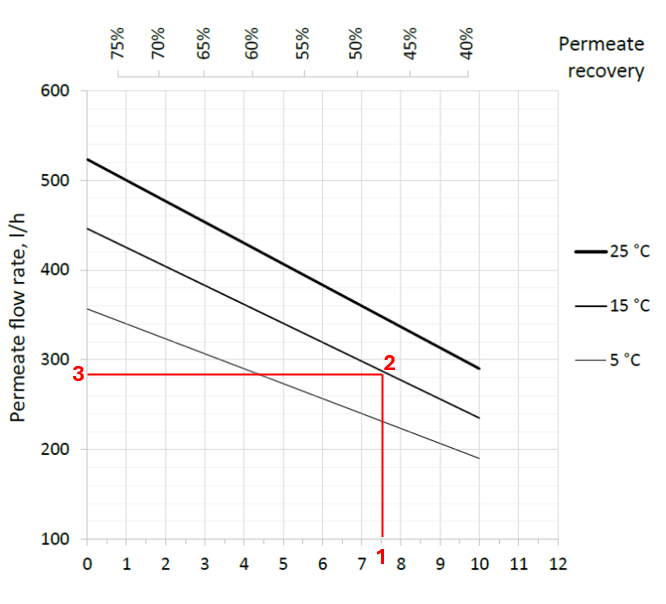
Ecosoft MO6500BI6 flow rate chart- On the FEED WATER TDS axis, mark the point corresponding to 7,500 mg/L (1).
- Draw a line to intersect the curve for 15 °C (2).
- From the point of intersection, draw a line toward the PERMEATE FLOW RATE axis (3).
The result is approximately 280 L/h.
To get the most accurate estimate, a complete feed water analysis is required.
If you already have this analysis and know the water temperature, feel free to send us the data. We will calculate the performance using specialized software such as Wave from DuPont or QPlus from LG. Contact us at [email protected] — we look forward to your requests.
-
Why should I replace the UV lamp every year if it still glows blue?
The blue light is only a visual indicator that the lamp is on. Over time, the UV-C intensity that inactivates bacteria and viruses gradually decreases. After about 9,000 hours of operation (approximately one year), the lamp may still appear bright, but its disinfection performance is no longer sufficient for reliable protection.
-
What is the main advantage of the HR series membranes?
The main advantage of the HR series membranes is efficient operation at low pressure while maintaining high salt rejection and permeate flow, allowing the use of less powerful pumps. They can also be used with feed water containing elevated nitrate and silicate levels.
-
What are the applications of this membrane?
This membrane is suited for commercial applications including water purification in private homes, drinking water production, beverages, breweries, livestock and poultry farms, aquaculture, greenhouses, mist humidification systems, laundries, and the food industry.
-
How does HR-8040 perform in water with high silica levels?
The HR-8040 membrane utilizes a denser polymer structure to provide the highest level of silica rejection.
Due to its 99.3% selectivity, the concentration of dissolved silica at the membrane boundary layer increases significantly faster than in the HF-8040. This leads to a faster saturation point, making the risk of glass-like scale formation on the tail-end elements critical. Since this type of scale forms nearly indestructible siloxane bonds, removal with standard acidic cleaning is impossible and requires specialized high-pH alkaline reagents.
Operating these membranes demands rigorous pH control and the use of antiscalants with enhanced silica-inhibiting properties. Even a minor deviation from the calculated permeate recovery can lead to irreversible pore clogging, immediately reflected by a spike in both salt passage and operating pressure. Therefore, choosing the HR-8040 for silica-rich water requires precise chemical dosing and a strict preventive CIP maintenance schedule.
-
What is the main advantage of the Ecosoft HF-8040-440 membrane?
The HF High Flow series is designed for extra-low pressure operation, providing high permeate flow and improved energy efficiency in 8-inch industrial reverse osmosis systems.
-
What is the Pink softener and what is it used for?
The Pink is a compact water softener for tap water, designed to remove hardness that cause limescale in pipes and household appliances. It protects your home’s plumbing system and extends the life of equipment like washing machines, boilers, and dishwashers.
-
What is the Anthracite Azure softener and what is it used for?
The Anthracite is a monoblock water softener for tap water, designed to remove hardness that cause limescale in pipes and household appliances. It protects your home’s plumbing system and extends the life of equipment like washing machines, boilers, and dishwashers.
-
What is the Anthracite Gold softener and what is it used for?
The Anthracite is a monoblock water softener for tap water, designed to remove hardness that cause limescale in pipes and household appliances. It protects your home’s plumbing system and extends the life of equipment like washing machines, boilers, and dishwashers.
-
Can you really remove iron from well water?
Yes, modern technologies like Ecosoft’s ECOMIX® remove iron, manganese, and organics effectively – even when water quality fluctuates. That’s how to remove iron from well water safely and reliably.
-
Can CO₂ bottles be safely stored at home?
Yes. CO₂ bottles can be stored at home in a cool, dry, and well-ventilated place, protected from direct sunlight. Do not expose the bottles to high temperatures or open flames, as they contain pressurized gas.
-
What information is available in the remote monitoring account?
Your remote account provides a clear overview of the system’s current status and key operating parameters. You can monitor:
- the system operating mode (operation, standby, or emergency)
- current flow rate and inlet water temperature
- TDS of feed water and permeate
- daily purified water production
This information helps you track system performance, quickly identify irregularities, and plan maintenance more efficiently.
-
Can brackish reverse osmosis remove nitrates and silicates?
Yes. Thanks to high operating pressure and the use of high-selectivity membranes, brackish reverse osmosis systems can achieve a high removal rate of nitrates and silicates.
To estimate the expected water quality for your specific source water, please send a water analysis to [email protected], and our specialists will provide an approximate calculation.
-
What is the meaning of sorption?
Sorption refers to the process of capturing impurities from water using materials that attract them to their surface or pores.
-
How can I remotely monitor the system operation?
The Ecosoft Inox IoT MO6500 is equipped with the OC6000 controller, which enables remote monitoring of system operation. All operating data is securely transmitted to the Ecosoft cloud platform, where you can access your online monitoring account at any time. This allows you to check system performance remotely without being physically present on site.
-
Can brackish water reverse osmosis systems be used to achieve very low TDS?
Yes. Brackish water systems can be combined with highly selective membrane elements, such as LG BW 4040 ES or LG Chem’s BW 4040 R, to achieve very low TDS levels.
When mixed-bed ion exchange resins are used after brackish reverse osmosis, this approach can significantly extend their service life. Based on practical experience, the lifetime of mixed-bed resins can be increased by up to two times.
-
What minimum pre-treatment is required for brackish water reverse osmosis systems?
At a minimum, feed water must be treated to remove mechanical and suspended particles. Automatic backwash filters with Filter-Ag® or Filter-Ag Plus® media are commonly used for this purpose.
If organic contaminants are present, activated carbon filtration such as Filtrasorb® 300 can be applied. To reduce the risk of scale formation, the use of an antiscalant is recommended.
A typical pre-treatment setup for brackish water applications is shown in the illustration below.
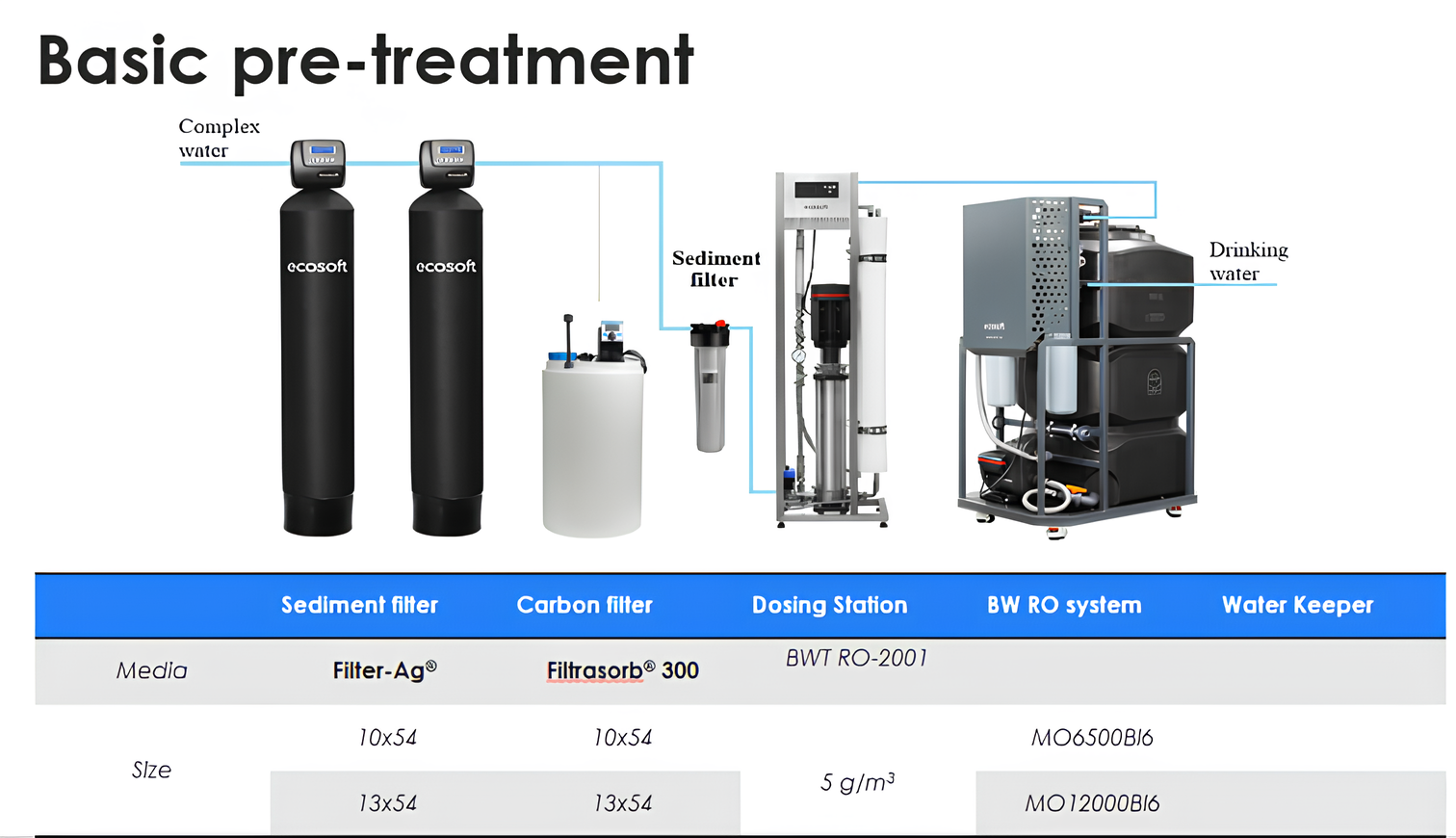
-
What additional applications can brackish water reverse osmosis systems support?
Brackish water reverse osmosis systems can also be used to increase overall water efficiency at a facility.
For example, reverse osmosis concentrate can be further treated and reused, allowing total water efficiency to exceed 90%, depending on the system configuration. An example of such a solution is shown in the illustration below.
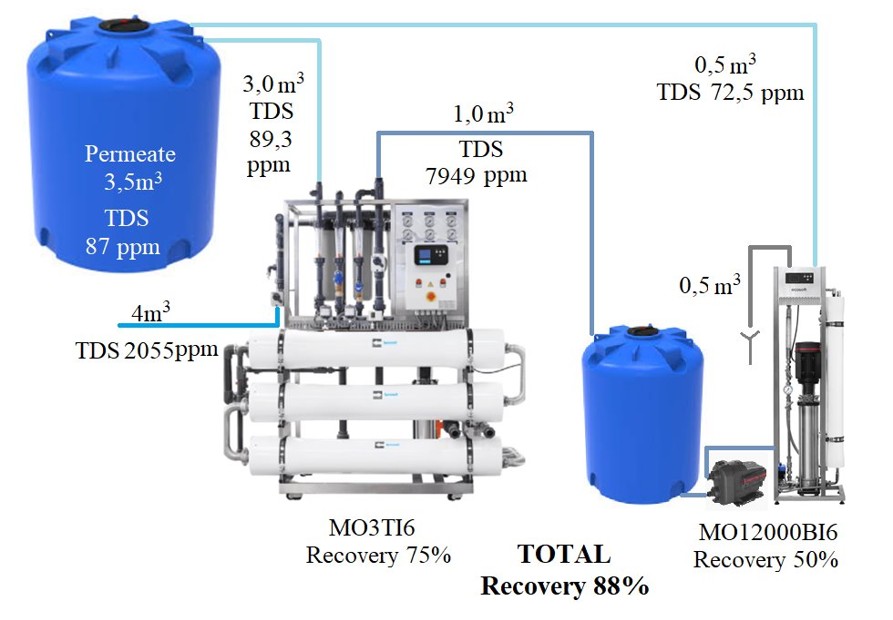
-
From which seas or coastal wells can water be treated using brackish reverse osmosis?
Brackish reverse osmosis systems are suitable for treating water with salt content up to 10,000 mg/L.
In Europe, this includes water from low-salinity seas such as the Baltic Sea, Bothnian Bay, Gulf of Finland, Gulf of Riga, the northwestern Black Sea, and the Azov Sea, as well as coastal wells influenced by these seas. Such water sources can be treated to produce drinking water using brackish reverse osmosis technology.
-
Why might the MO6500BI6 be suitable for my application?
The MO6500BI6 is designed for brackish water treatment in applications where feed water contains elevated salt levels. The system is built with AISI 316 stainless steel components without welding, ensuring reliable long-term operation with feed water TDS of up to 10,000 ppm.
The OC6000 controller supports stable operation and continuous monitoring, helping maintain consistent water quality.
-
What are the advantages of a brackish water reverse osmosis system?
Brackish water reverse osmosis systems offer several key advantages:
- suitable for feed water with TDS up to 10,000 ppm
- all wetted parts made of AISI 316 stainless steel for corrosion resistance
- Grundfos® CRN high-pressure pump designed for demanding conditions
- welded-free AISI 316 stainless steel piping
- operating pressure up to 25 bar for stable performance
-
Can activated carbon filters remove other impurities along with chlorine?
Yes, activated carbon filters are effective at removing a wide range of impurities, including chlorine, volatile organic compounds (VOCs), and some heavy metals, providing comprehensive water filtration.
-
-
-
Can chlorine in water be harmful to health?
Yes, chlorine in water can have adverse effects on health, including skin and eye irritation, respiratory issues, and the formation of disinfection byproducts (DBPs) that may be associated with health concerns.
-
-
How often should I replace the filters in my reverse osmosis system?
Filter replacement frequency varies but typically ranges from 6 to 12 months. Follow the manufacturer's recommendations for your specific system.
-
Is reverse osmosis water safe to drink?
Yes, reverse osmosis water is safe to drink as it eliminates harmful contaminants, making it suitable for consumption.
-
What is reverse osmosis water?
Reverse osmosis water is purified through a filtration process that removes contaminants and impurities, providing clean and safe drinking water.
-
What is the expected lifespan of the filter cartridges in this system?
With regular use and proper maintenance, the filter cartridges of our STANDARD reverse osmosis system typically last for around 6 to 12 months, depending on the quality of the feed water and the volume of water usage.
-
What is the warranty period for the CROSS90 direct flow reverse osmosis filter?
The CROSS90 direct flow reverse osmosis filter comes with a standard warranty of 2 years, guaranteeing peace of mind and reliable performance for an extended period.
-
How does the type of water softener salt used impact the maintenance requirements of the system?
Using the right type of salt, such as evaporated or pellet salt, can reduce the likelihood of salt bridges and ensure smoother regeneration
-
Can regular maintenance tasks for water softeners be performed by homeowners, or is professional assistance required?
Most routine maintenance tasks can be performed by homeowners, but professional assistance may be beneficial for more complex issues.
-
Are there any signs or indicators that suggest when it's time for water softener maintenance?
Indicators include changes in water hardness, decreased flow rate, or unusual sounds during regeneration.
-
What are the essential routine maintenance tasks for prolonging the lifespan of a water softener system?
Regularly checking and refilling the salt, cleaning the brine tank, and monitoring the regeneration cycles are crucial tasks.
-
Is the quality of water from a bottleless water cooler dispenser comparable to that of single-use bottled water?
Yes, the quality is often comparable or better, as many bottleless dispensers include advanced filtration systems to ensure water purity.
-
What are the key differences in convenience between a bottleless water cooler dispenser and relying on single-use bottled water?
Bottleless dispensers offer greater convenience by providing a constant water supply without the need to frequently purchase, store, and dispose of plastic bottles.
-
Are there any environmental benefits to choosing a bottleless water cooler dispenser over single-use bottled water?
Yes, bottleless dispensers significantly reduce plastic waste and the environmental impact associated with the production and disposal of single-use bottles.
-
How does the cost of a bottleless water cooler dispenser compare to the ongoing expenses of purchasing single-use bottled water?
Initially, bottleless dispensers may have a higher upfront cost, but they are more cost-effective over time compared to the recurring expense of buying bottled water.
-
Are there noticeable signs or symptoms that indicate when it's time to add salt to the water softener?
Signs include changes in water quality, such as feeling a slippery texture on the skin or spotting scale buildup on fixtures.
-
How frequently should salt be added to ensure optimal performance of a water softener?
The frequency depends on the hardness of your water and the amount of water used, but generally, it's recommended to check and refill salt every 1-2 months.
-
Is there a specific type of salt that is best for maintaining water softeners?
The best type of salt depends on your water softener model and water hardness. Solar and evaporated salts are generally more pure and efficient.
-
What happens if you neglect to add salt to your water softener as recommended?
Neglecting to add salt can lead to reduced efficiency, allowing hard water minerals to build up in your plumbing and appliances.
-
Are there specific concerns or benefits related to taste and odor when comparing well water to city water?
Well water may have a more natural taste, but can also contain minerals or contaminants affecting taste and odor. City water might have a slight chlorine taste due to the treatment process.
-
How do the maintenance and treatment requirements differ for well water and city water systems?
Well water requires personal management and treatment, whereas city water is treated at a municipal level, requiring less individual maintenance.
-
Is one source generally considered safer or healthier than the other?
City water is regulated and consistently treated, while well water requires individual maintenance and testing for safety.
-
How do you tell if you have well or city water?
Check your utility bills or contact local authorities. Homes with wells typically don't receive a water bill.
-
Can cucumber water contribute to weight loss, and if so, how?
Yes, its low-calorie nature and the ability to promote satiety can aid in weight loss efforts.
-
How does the nutritional value of cucumber water compare to other infused water options?
Cucumber water stands out for its high vitamin and mineral content, making it superior to many other infused waters.
-
Are there specific health benefits attributed to regularly consuming cucumber water?
Regular consumption supports hydration, skin health, weight management, and provides essential vitamins and antioxidants.
-
What makes cucumber water stand out as a healthy beverage choice?
Its combination of hydration, essential nutrients, and antioxidants sets it apart as a healthful choice.
-
Are there any financing or payment plans available for purchasing the Ecosoft Home Water Filtration System?
Availability of financing or payment plans can vary and should be checked with the provider.
-
How does the cost of the Ecosoft system compare to other home water filtration options on the market?
Ecosoft systems are competitively priced and offer a range of options to suit various budgets and needs.
-
Are there any ongoing expenses associated with maintaining an Ecosoft water filtration system?
Yes, regular maintenance such as filter replacement contributes to ongoing costs.
-
What factors contribute to the overall cost of an Ecosoft Home Water Filtration System?
System type, size, complexity, number of filters, installation, and maintenance are key factors.
-
Do salt-free water softeners require any special installation or maintenance considerations?
Installation can be complex, and while they require less maintenance than salt-based systems, periodic checks are recommended.
-
Can salt-free water softeners treat water with high hardness levels?
Their effectiveness can diminish in treating water with very high hardness levels.
-
Are salt-free water softeners suitable for all types of water hardness levels?
They are generally suitable for moderate levels of hardness but may be less effective in very hard water conditions.
-
How do salt-free water softeners differ from traditional salt-based systems?
Salt-free softeners condition water without using salt, and they don’t remove minerals but change their structure to prevent scaling.
-
Do rental water systems cater to specific water quality issues, or are they one-size-fits-all solutions?
Many rental services offer a range of systems designed to address various water quality concerns. From tackling water hardness to filtering out specific contaminants, rental options are often tailored to meet diverse needs.
-
What maintenance responsibilities come with renting a water softener, if any?
Most rental agreements include maintenance and repairs, significantly reducing the responsibility and burden on the renter. This can be a huge relief, particularly for those who are not mechanically inclined or prefer not to deal with maintenance issues.
-
Are there any long-term commitments or contracts when renting a water filtration system?
Rental agreements can vary. Some may offer month-to-month flexibility, while others might require a minimum commitment period. It's important to understand the terms before signing a contract.
-
How does renting a water softener compare to purchasing one in terms of cost?
Renting typically involves lower initial costs and predictable monthly payments, which can be more manageable than the larger upfront investment required when buying.
-
-
Can water softeners be installed without professional help?
While some homeowners may manage, professional installation is recommended for optimal setup and performance.
-
How do you choose the right softener?
Consider water hardness level, household size, and specific water quality needs.
-
Do water softeners require maintenance?
Yes, regular maintenance, such as salt replenishment and resin bed cleaning, is necessary for optimal performance.
-
Is boiling water an effective way to get rid of fluoride content?
No, boiling water does not remove fluoride. It requires specific filtration methods.
-
Are all water filtration systems effective in eliminating fluoride?
Not all systems are equally effective. Reverse osmosis and certain specialized filters are the most effective.
-
What methods can be used to remove fluoride from water at home?
Reverse osmosis, distillation, activated alumina, and bone char carbon filters are effective at home methods.
-
Is fluoride harmful in drinking water?
In small quantities, fluoride is beneficial. However, excessive fluoride can lead to health issues.
-
What is included in the Set of replacement filters 1-2-3-4 for RObust PRO?
The Set of replacement filters 1-2-3-4 for RObust PRO includes four essential filters for your RObust PRO system. These filters cover various filtration stages to ensure the best water quality: a pre-filter (1), a sediment filter (2), a carbon filter (3), and a post-filter (4). Together, they help remove impurities, sediment, chlorine, and enhance the taste of your water.
-
Is installation of the ROBUST PRO Reverse Osmosis Filter complicated, and do I need professional help?
Installing the ROBUST PRO is straightforward and can typically be done as a DIY project. The package includes clear instructions and all the necessary components. However, if you're not comfortable with plumbing tasks, you can always hire a professional plumber to ensure a hassle-free installation. Many customers find the installation process manageable and enjoy the added benefit of knowing how their filtration system works.
-
Are there any limitations or factors that can affect TDS readings?
Yes, there are several factors that can affect TDS readings:
- Temperature: TDS readings can be temperature-dependent, so it's essential to take measurements at a consistent temperature or use a TDS tester with automatic temperature compensation.
- Organic matter: TDS testers measure both inorganic and organic substances, so high levels of organic matter may contribute to higher TDS readings without indicating harmful contaminants.
- Dissolved gases: Gases dissolved in water, such as carbon dioxide, can affect TDS readings. Degassing the water sample before testing can help eliminate this interference.
- Sensor quality: The accuracy and reliability of TDS testers can vary depending on the quality and calibration of the device. Regular maintenance and calibration are necessary to ensure accurate readings.
-
How can I tell if my water is soft or hard?
You can determine whether your water is soft or hard by testing its mineral content. One common method is using a water testing kit that measures the levels of calcium and magnesium ions. Alternatively, you might notice some signs of hard water, such as soap scum, mineral deposits, or difficulty forming lather with soap.
-
What are shower filters and how do they work?
Shower filters are devices designed to remove impurities and chemicals from the water used for showering. They typically contain a combination of filtering media such as activated carbon, KDF (Kinetic Degradation Fluxion), and ceramic balls. These media work together to effectively reduce chlorine, heavy metals, bacteria, and other contaminants present in the water. As the water passes through the filter, these impurities get trapped, resulting in cleaner and healthier water for showering.
-
Why is my reverse osmosis system producing less water than before?
There could be several reasons why your reverse osmosis system is producing less water than before. Firstly, check if the water pressure in your home has decreased. Low water pressure can directly affect the production rate of your system. Additionally, a clogged pre-filter or sediment filter can restrict water flow and reduce production. It is recommended to inspect and clean or replace these filters regularly. Another potential cause could be a malfunctioning or worn-out membrane. Over time, the membrane may degrade or become damaged, resulting in decreased water production. If none of these solutions solve the issue, it is advisable to consult a professional for further assistance.
-
What are the physical properties of water?
Water possesses several important physical properties. It is a colorless, odorless, and tasteless liquid at room temperature. Its boiling point is 100 degrees Celsius (212 degrees Fahrenheit), and its freezing point is 0 degrees Celsius (32 degrees Fahrenheit). Water is unique in that it expands when it freezes, causing ice to float on its liquid form. It also has a high surface tension and can absorb a significant amount of heat before its temperature rises, making it an effective coolant.
-
How does ozone treatment contribute to water disinfection?
Ozone treatment is a powerful oxidation process that effectively disinfects water by destroying a wide range of microorganisms. Ozone, a highly reactive gas, is produced by passing air or oxygen through an electrical discharge. It acts as a strong oxidant, killing bacteria, viruses, and other pathogens. Ozone treatment also helps remove taste, odor, and color-causing compounds from water. However, ozone is unstable and dissipates quickly, so it is typically generated on-site and applied directly to the water to ensure effective disinfection.
-
What is UV disinfection, and how does it work?
UV disinfection is a non-chemical method that utilizes ultraviolet light to inactivate or kill microorganisms in water. UV light, specifically in the UV-C range, damages the genetic material of bacteria, viruses, and protozoa, preventing them from reproducing and rendering them harmless. UV disinfection is effective against a broad spectrum of pathogens and does not produce any harmful byproducts, making it an environmentally friendly option.
-
How is the quality of your bottled water ensured?
Bottled water quality is rigorously ensured through adherence to strict regulatory standards. The industry follows comprehensive testing protocols to guarantee that the water you consume meets or exceeds safety and purity requirements.
-
Are there health risks associated with poor tap water quality?
Yes, poor tap water quality can cause a variety of health problems, including diarrhea, cholera, typhoid, and dysentery. Contaminated water can also contain chemicals that can cause cancer and other chronic health problems.
-
Can I test water hardness on my own, or do I need a professional?
Yes, you can test water hardness on your own using one of the methods described above. However, if you are unsure about how to test your water or if you need help interpreting your results, you can contact a water quality professional.
-
Can I regenerate with untreated water?
Regenerating with untreated or raw water will not affect the performance of ECOMIX®.
-
-
How often should I change the filter cartridges?
Depending on the model, the replacement interval ranges from 1 to 24 months. Some models, such as the CROSS 90, even notify you via an integrated LED display.
-
-
Do I need to filter all the water in my home?
Not necessarily. Most pollutants are relevant for drinking and cooking. A filter under the kitchen sink is a great starting point – and fully suitable even in rented homes.
-
Are Ecosoft water softeners suitable for well water treatment?
Yes – the Titanium Gold and Anthracite Gold series are designed for treating well water.
-
Can I achieve type 1, 2, and 3 purity with your products?
It is possible to achieve type 3 purity with Ecosoft products alone by combining for example the reverse osmosis filter RObust 1500 with a demineralisation cartridge.
This water with type 3 purity is ideal for autoclaves, ultrasonic scalers, rinsing dishes, and preparing laboratory solutions.
Unfortunately, achieving type 1 and 2 purity isn’t possible with Ecosoft products alone at the moment – our reverse osmosis filters, however, can be a vital part of the purification system in your lab.
-
Do I need a reverse osmosis filter for my beverage production?
Yes, a reverse osmosis (RO) filter is always recommended for water treatment systems in the beverage industry.
As reverse osmosis removes about 99% of dissolved impurities from water, it’s a particularly good choice for the purification of water that’s used as an ingredient in drinks.
RO plays a vital role in achieving the quality required to meet food safety standards – and if you decide to use the commercial reverse osmosis systems from Ecosoft, you profit from great recovery rates of up to 70%.
Ecosoft has a wide range of reverse osmosis filter systems for both, small and large drink productions:
- Industrial 8’’reverse osmosis filter systems for large productions with a water consumption of 2+ m³/hour.
- Commercial 4” reverse osmosis filters systems for small productions with a water consumption of 0,25–2 m³/hour.
-
Do you provide customized solutions?
Yes, we do.
While our products are designed to work for as many companies as possible, we understand that one size doesn’t fit all.
So if there are any special considerations in your company, let’s see what kind of solution we can find for you. Maybe a combination of products or a change in dimensions will do the trick, or we’ll need to work out something new for you.
Either way, we’re happy to help!
-
How do you ensure your local partners are qualified?
Here at Ecosoft, we value our partners. As we are a manufacturing company, we rely on them to install our products and maintain them once they are on site with our customers – you.
It’s a partnership designed to bring you the best service possible – together with our partners, we are the ultimate water expert.
We provide our partners with documentation and other material they might need, and we offer continuous training to ensure they are perfectly equipped to install and maintain our products.
-
What are the standards of water quality?
Water meets drinking water quality if it complies with legal standards. It must be colorless, odorless, palatable, and free from pathogens and harmful substances like heavy metals, pesticides, or bacteria. However, the condition of your home’s plumbing also plays a crucial role. If you want to be sure, consider testing your water – with a home test kit or laboratory analysis.
-
Is it safe to drink water that smells like rotten eggs?
Technically, yes - but it's unpleasant and may signal deeper water quality issues. Treating the water not only improves taste but also protects your health and plumbing system.
-
Can Ecosoft systems reduce fertiliser and pesticide usage?
Yes.
When there’s nothing but water in your irrigation water, fertilisers and pesticides only work where you need them to – clean water improves the precision of fertigation, reduces reaction with dissolved salts, and lowers the risk of chemical inefficiencies or waste.
This leads to lower input cost and better crop health.
-
What is the difference between sorption and adsorption?
Adsorption is a type of sorption. While sorption includes both absorption (into the material) and adsorption (onto the surface), many water treatment methods rely on adsorption.
-
Is ion exchange water safe to drink?
Yes, when resins are certified for potable water use and properly maintained, the water is safe and meets drinking water standards.
-
Do your filtration products achieve SCA-compliant water for coffee making?
Yes, you can achieve SCA-compliant water with our products.
Our direct flow reverse osmosis system, RObust COFFEE, was specifically designed for coffee preparation and delivers water that meets SCA standards.
-
Which TDS do I need for the perfect brew and can I achieve it with Ecosoft?
Yes, Ecosoft water treatment systems can help you reach the TDS levels recommended by the SCA.
The SCA suggests a TDS range of 75–250 ppm, but it’s important to remember that the composition of total dissolved solids plays a major role in how your coffee tastes. With an optimal balance of calcium (Ca) and magnesium (Mg), the RObust COFFEE creates water that enhances the unique aromas and flavors of each coffee bean.
-
Do I need to use a tank with your water purification systems in my café?
While it’s not strictly necessary to use a tank with our water filtration systems, we do recommend it.
Using a tank helps stabilise TDS levels in the water, which results in more consistent coffee flavour.
-
What TDS levels can I achieve in my café with your water purification systems?
The exact TDS levels vary by product:
- RObust COFFEE achieves TDS levels of 60–120 ppm
- RObust Mini, RObust 1500 and similar models achieve 10–30 ppm
Some of our systems, like the RObust COFFEE, allow you to adjust the TDS level using flow restrictors. These restrictors are included in your café kit, and instructions can be found inside the box or under Downloads on this page (left sidebar).
-
What TDS is required for the inlet water?
The required TDS level of the inlet water depends on the filter model.
All our RObust reverse osmosis filters require a TDS level of 1,000 ppm or less except for RObust Coffee. For this one the required TDS is 150-500 ppm.
-
What recovery rates does the RObust 4000 have?
The RObust 4000 has an impressive recovery rate of 55–60%, making it one of the most efficient models in our lineup.
It’s built to support continuous operation for up to 20 hours per day and is ideal for restaurant environments where space is limited but performance matters. Thanks to its high recovery rate, this filter minimizes water waste while ensuring a consistent supply of purified water — up to 180 L/h.
-
Will water treatment improve food & beverage taste?
Yes — and that’s exactly why so many restaurants choose the RObust 4000.
By removing chlorine, minerals, and other taste-distorting substances from tap water, this system helps your food and drinks taste as they should — clean, consistent, and full of flavour.
-
Do I need to use a tank with your water purification systems in my restaurant?
Using a tank isn’t strictly necessary, but we do recommend it in many cases — especially when your system is connected to other equipment.
For example, when paired with a coffee machine, a tank helps stabilise TDS levels in the water, resulting in more consistent flavour.
-
What water treatment system is best for my kitchen equipment?
While all of our water treatment systems purify water for use in your kitchen equipment reliably, the perfect choice depends on a number of factors like the following:
- How many appliances will use the purified water?
- How high is the daily consumption of the purified water?
- How big or small is the space available for a water filtration system in your restaurant?
- What quality does the inlet water have in your restaurant?
Not sure which system is right for your setup? Email us at [email protected].
-
What recovery rates does the RObust 3000 MAX have?
The RObust 3000 MAX achieves a solid recovery rate of around 55%, ensuring efficient water usage and reliable performance.
Designed to serve a variety of commercial appliances — from steamers and dishwashers to ice machines — it delivers a flow rate of up to 160 L/h and supports continuous operation for up to 20 hours per day. It's also equipped with enhanced pre-filtration to handle more demanding water conditions.
-
What recovery rates does the RObust 1500 have?
The RObust 1500 offers an excellent recovery rate of 55–60%, making it an energy- and cost-efficient choice for small businesses and professional kitchens.
With a compact size and smart design that hides electrical components, this RO filter is built for continuous operation and reliable daily use, even in tight spaces.
-
What recovery rates does the RObust Mini have?
The RObust Mini provides a recovery rate of 50%, offering sustainable water purification for cafés, offices, schools, and similar spaces.
Despite its standard compact size, it delivers consistent performance and is designed for continuous operation throughout the day.
-
Will water treatment improve food & beverage taste?
Yes.
The RObust 3000 MAX removes substances that affect the taste of your water, helping you serve better coffee, meals, and drinks — every time. It’s a simple way to improve quality across your kitchen.
-
Will water treatment improve food & beverage taste?
Yes, it will.
The RObust 1500 provides purified water that’s free from unwanted tastes and odours, making it easier to achieve consistent flavour in everything you prepare and serve.
-
Will water treatment improve food & beverage taste?
Definitely!
Even in smaller setups, water quality matters. The RObust Mini helps cafés and compact kitchens improve the taste of what they serve with every filtered drop.
-
What is the Ecosoft AQUABOX 150 and what is its purpose?
The Ecosoft AQUABOX 150 is a water vending machine designed to purify mains water to bottled-water quality, compliant with Directive 2020/2184/EU, and automatically dispense it into consumers' bottles.
It includes multiple purification stages: mechanical filtration, activated carbon filtration, reverse osmosis membrane separation, remineralisation, additional carbon filtration for taste improvement, and UV disinfection.
-
How does the machine purify the water?
Water purification involves several stages: mechanical filtration to remove suspended particles, activated carbon to eliminate chlorine, antiscalant to prevent scaling on membranes, high-pressure reverse osmosis to reduce salts, microorganisms, and bacteria, remineralisation to adjust mineral content, post-carbon filtration for improved taste and odour, and UV disinfection.
Purified water is stored in a pressure tank before dispensing.
-
What payment methods does the machine accept?
The standard configuration includes a QR code reader for contactless payments.
Optional features include a bill acceptor, coin acceptor, and POS terminal allowing payments by cash, coins, or card, depending on the installed options.
-
Is the water dispensed by the machine safe to drink?
Yes. The purified water meets bottled water standards under Directive 2020/2184/EU and Ukraine’s sanitary-epidemiological requirements (Report No. 602-123-20-1/3637).
It undergoes rigorous treatment — including filtration, membrane separation, remineralisation, and UV disinfection — to remove impurities, chlorine, salts, bacteria, and microorganisms.
-
How often do the filters and consumables need to be replaced?
Replacement intervals depend on usage and source water quality:
- Mechanical pre-filter: every 3 months or after 60 m³
- Carbon pre-filter: every 3 months or after 50–60 m³
- Antiscalant cartridge: after 40 m³
- Membrane elements: every 12 months or after 60 m³
- Remineralisation & post-carbon cartridges: every 3 months or after 40 m³
- UV lamp: every 6 years
It’s also recommended to monitor pressure drops and water quality monthly.
-
What are the requirements for installing the machine?
The machine should be installed indoors, in a ventilated area, with:
- Inlet water pressure: 1.5–4 bar
- Temperature: 15 ± 5 °C
- Water quality within set limits (e.g. TDS < 1,000 ppm, hardness < 500 ppm CaCO₃)
Required connections:
- ½" inlet and drain
- 230 VAC power supply (max. 0.6 kW)
- Access to a sewer line
Before operation, ensure proper installation, set up the controller, and verify input conditions. Professional setup is strongly recommended to avoid issues.
-
How many times can I refill the AQUABOX Bottle?
The bottle is designed for up to 100 refills, making it a durable and sustainable solution for long-term use.
-
-
What is the AQUABOX Water Refill Bottle?
The AQUABOX Water Refill Bottle is a sustainable, reusable bottle designed for up to 100 refills. It has a 5 L capacity, a 45 mm wide neck for easy filling, and is BPA-free — making it an eco-friendly choice for reducing plastic waste.
-
How do I start using the AQUABOX Dispenser?
Install the drip tray and thoroughly clean both the cooling tank and baffle.
Connect the water supply and open the cold and hot water taps until the water runs clear and free of air bubbles.
Make sure the hot water tank is completely full before turning on the heater, located at the top left of the condenser on the back.
Wait 24 hours before switching on the dispenser to allow any residual odours to dissipate.
-
How do I clean and maintain the AQUABOX Dispenser?
Clean the drip tray and outer shell with a non-abrasive household cleaner. Avoid using steel wool or abrasive pads, as they may damage plastic surfaces.
Inspect the condenser regularly and clean it with a soft brush to remove dust and lint for optimal performance.
Always ensure the baffle is properly installed and clean the cooling tank thoroughly before use.
If the dispenser is not in use, drain all water from the system completely to prevent damage.
-
Can I use the AQUABOX Dispenser for liquids other than water?
No.
The dispenser is designed exclusively for water. Using other liquids may damage the system or reduce its performance.
-
Can I adjust the water temperature on the AQUABOX Dispenser?
No.
The thermostat is preset to deliver cold water at approximately 7 °C and hot water at around 85 °C. These settings are not adjustable.
-
What safety precautions should I take with the R600a refrigerant?
R600a is an environmentally friendly but flammable refrigerant. Please follow these safety precautions:
- Avoid damaging the refrigerant circuit during transportation or installation.
- Do not use sharp objects near the dispenser.
- If a leak occurs, unplug the unit, ventilate the area, and stay away from open flames or spark-producing devices. Contact customer service immediately.
- Only authorised service personnel with hydrocarbon refrigerant certification should perform repairs.
-
Why does the indicator remain red after replacing the filters?
After replacing a cartridge, press and hold the corresponding reset button for 5 seconds.
You will hear a short beep (1 second), the filter life indicator will blink purple twice, and then turn solid blue.
-
What does the purple indicator light on the filter mean?
The purple light means that less than 150 litres remain before the cartridge reaches the end of its service life.
We recommend purchasing replacement cartridges in advance.
-
Can I install this filter on inlet water containing turbidity and chlorine?
Yes, but you must install a CTO carbon filter or a combination of polypropylene and carbon filters before the system. This protects the membrane and ensures proper operation.
-
Why is it recommended to discard the first two glasses of water in the morning?
During periods of non-use, such as overnight, natural diffusion can slightly reduce water purity inside the system.
To ensure optimal quality, we recommend discarding the first two glasses or using them for non-drinking purposes like watering plants.
-
How will I know when it’s time to replace the cartridge?
The system will notify you with:
- A blinking power indicator
- Solid filter status indicators
- Audible alerts:
- 10 beeps every hour
- 10 beeps each time you open the tap for purification
-
What should I do after replacing the cartridge?
Press and hold the “Restart” button for 5 seconds.
A single beep will confirm that the reset is complete and the filter is ready for use.
-
-
What is basic automatic flushing?
Basic automatic flushing uses tap water to rinse the membrane.
hile it helps maintain system hygiene, we recommend discarding the first two glasses in the morning to ensure the highest water quality after periods of non-use.
-
When does the system flush itself and how long does it take?
The CROSS 90 performs automatic flushing in the following cases:
- After reconnecting the system to power (30 seconds)
- 5 minutes after each use (1 minute)
- After 12 hours of no use (1 minute)
Flushing is automatic and requires no action from you. It helps keep your water fresh and the system clean.
-
When does the system flush itself and how long does it take?
The CROSS 90 Balance performs automatic flushing in the following cases:
- After reconnecting the system to power (30 seconds)
- 5 minutes after each use (1 minute)
- After 12 hours of no use (1 minute)
Flushing is automatic and requires no action from you. It helps keep your water fresh and the system clean.
-
When does the system flush itself and how long does it take?
The CROSS 60 performs automatic flushing in the following cases:
- 5 minutes after each use (1 minute)
- After 12 hours of no use (1 minute)
Flushing is automatic and requires no action from you. It helps keep your water fresh and the system clean.
-
When does the system flush itself and how long does it take?
The CROSS Solo performs automatic flushing in the following cases:
- After reconnecting the system to power (18 seconds)
- 5 minutes after each use (6 seconds)
- After 24 hours of no use (10 seconds)
Flushing is automatic and requires no action from you. It helps keep your water fresh and the system clean.
-
Do you have any RO filters specifically designed for restaurants?
Yes, several of our reverse osmosis systems are well-suited for restaurants, cafés, and other HoReCa businesses. They are designed to deliver high water quality for kitchen equipment, cooking, dishwashing, and beverages — all while offering stable performance and easy operation.
RObust 4000 was specifically developed with restaurant use in mind. It features an ultra-compact, direct flow design, can operate continuously for up to 20 hours per day, and delivers up to 3 liters of purified water per minute. With a high recovery rate of 60–65%, it also helps reduce water waste.
This model is ideal for high-demand kitchens and ensures reliable protection of dishwashers, ovens, steamers, and more.
-
Do you have any RO filters specifically designed for restaurants?
Yes, several of our reverse osmosis systems are well-suited for restaurants, cafés, and other HoReCa businesses. They are designed to deliver high water quality for kitchen equipment, cooking, dishwashing, and beverages — all while offering stable performance and easy operation.
RObust 3000 MAX is a high-capacity direct flow RO system designed to supply purified water to multiple points of use at once. With its strong flow rate and energy-efficient operation, it is ideal for restaurants that rely on ice makers, steamers, ovens, dishwashers, and other kitchen appliances.
This model ensures consistent performance and long-term reliability even under demanding conditions.
-
Do you have any RO filters specifically designed for restaurants?
Yes, several of our reverse osmosis systems are well-suited for restaurants, cafés, and other HoReCa businesses. They are designed to deliver high water quality for kitchen equipment, cooking, dishwashing, and beverages — all while offering stable performance and easy operation.
RObust 1500 is a direct flow RO system with a high flow rate that makes it a great fit for small to medium-sized restaurants, cafés, and hotels. Its compact footprint and reliable purification performance also make it popular in offices, schools, laboratories, dental clinics, and private homes.
The system provides excellent water quality to protect kitchen equipment and improve the taste of food and drinks.
-
Do you have any RO filters specifically designed for restaurants?
Yes, several of our reverse osmosis systems are well-suited for restaurants, cafés, and other HoReCa businesses. They are designed to deliver high water quality for kitchen equipment, cooking, dishwashing, and beverages — all while offering stable performance and easy operation.
RObust Mini is a compact and affordable direct flow RO filter ideal for small cafés, bars, and coffee shops. Despite its size, it delivers reliable water purification for applications like coffee machines, dishwashers, and food prep areas.
It’s a great entry-level solution for businesses that need quality water without compromising on space or budget.
-
How can I calculate the capacity of the MO6500TP5 for my setup?
You can estimate the system performance using the graph provided in the Ecosoft Professional MO6500TP5 RO technical data sheet in the Downloads on this page (left sidebar).
To calculate the permeate flow rate at 25 °C and feed water TDS of 1 500 mg/L, refer to the chart below:
Ecosoft MO6500TP5 flow rate chart- On the FEED WATER TDS axis, mark the point corresponding to 1 500 mg/L (1).
- Draw a line to intersect the curve for 25 °C (2).
- From the point of intersection, draw a line toward the PERMEATE FLOW RATE axis (3).
The result is approximately 250 L/h.
To get the most accurate estimate, a complete feed water analysis is required.
If you already have this analysis and know the water temperature, feel free to send us the data. We will calculate the performance using specialized software such as Wave from DuPont or QPlus from LG. Contact us at [email protected] — we look forward to your requests.
-
What are the advantages of the Grundfos pump in this system?
The Grundfos pump used in this model offers several advantages:
- low energy consumption (0.67 kW)
- low noise level (55 dB)
- built-in dry-run protection
- high operating pressure (up to 16 bar)
- global manufacturer’s warranty from Grundfos
-
What is the difference between Standard PRO and PURE filters?
Standard PRO and PURE are reverse osmosis filters designed to provide clean, safe, and great-tasting drinking water at home. While both deliver high-quality water, they differ in mineralization technology and performance.
Standard PRO is a classic RO system that reliably provides purified water for everyday use. These models offer basic mineralization at a level of 20–30 mg/L, making them a simple and effective solution for users looking for a safe and affordable home filtration system. The system uses an Ecosoft 50 GPD membrane, a standard pre-filter set, and fills the tank in about 90 minutes.
PURE filters are designed for those who want consistently delicious water enriched with calcium and magnesium. With advanced mineralization technology, PURE systems maintain a stable mineral content of 60–80 mg/L in every glass. They also feature a water-saving function that reduces wastewater by up to 20,000 L per year. Thanks to a more efficient 75 GPD membrane and improved pre-filters, the tank is filled in just 60 minutes.
-
How does TDS change after treatment with ECOMIX® P?
TDS may increase by about 10% compared to the original level. This occurs because hardness cations are replaced with harmless sodium ions during ion exchange.
-
What is the typical service life of Ecolite Ultrasoft?
Under normal operating conditions, the resin lasts about 3–5 years, depending on water quality and regeneration frequency.
-
Can this filter be used for hot water?
No, this filter is designed for purifying cold water only. The water temperature should not exceed 50 °C.
-
-
When does my baby actually need extra water?
As long as your baby is breastfeeding or drinking formula, there’s no need to give extra water – even in hot weather. Once you start introducing solid foods (around 6 months), you can slowly begin offering small sips of water.
-
Why can’t my baby drink regular mineral water?
Most standard mineral waters contain too much sodium, sulfate, or other minerals – which can put strain on your baby’s kidneys. Always look for the label “suitable for preparing infant formula” and check the mineral content.
-
How often should I change my filter cartridge if I use it for baby formula?
Depending on your model and how often you use it, the cartridge should be replaced every 1 to 6 months. For optimal hygiene – especially when used for baby water – be sure to follow the product guidelines.
-
Can water filters spread germs?
If the cartridges are used too long or not cleaned properly, they can. That’s why it’s important to replace them regularly and keep the filter unit hygienic at all times.
-
Is desalinated seawater basically drinkable?
Yes, technically it is. But without remineralisation, it lacks essential nutrients and tastes flat.
-
Can you add too many minerals back into the water?
No. With high-quality systems like Ecosoft, the dosage is carefully regulated to create a natural balance – similar to fresh spring water.
-
Which minerals are most important in drinking water?
Magnesium and calcium are essential for your body. They support crucial functions and also ensure a well-balanced taste in your water.
-
Does desalinated water pose health risks?
Not in the short term. But long-term, a lack of minerals can become problematic – especially for children, pregnant women, and the elderly.
-
Why does desalinated water often taste bland?
That’s one of the drawbacks of reverse osmosis and desalination. The process removes not only the salt but also the minerals. Since minerals are vital for both health and taste, the difference is noticeable. Calcium makes water “round”, magnesium gives it a fresh note.
-
How can I make sure my water at home is ideally mineralised?
With an Ecosoft reverse osmosis system with mineralisation. That way, you stay in control of purity and mineral content – every single day.
-
Can I safely prepare baby formula with chlorinated tap water?
Ideally, no. Babies are much more sensitive to chemicals in water – even in small amounts. Even if the chlorine level is within legal limits, the taste or smell may be unpleasant for your baby, and there’s a higher risk of skin or stomach irritation. The best option is to use filtered or boiled water for baby formula.
-
Does chlorine in drinking water affect the taste of coffee or tea?
Absolutely. Chlorine reacts with the natural flavors in tea and coffee, making them taste flat, bitter, or chemical. If you care about the flavor of your drinks, a high-quality filter that removes chlorine is definitely worth it.
-
How often should I change my water filter if I want to remove chlorine?
If you’re dealing with chlorinated water, the filter should be replaced regularly – usually every 1 to 6 months, depending on the manufacturer’s instructions. Chlorine can degrade filter materials faster or saturate the activated carbon. If you wait too long, there's even a risk of recontamination.
Ecosoft filters come with helpful indicators or easy-to-schedule intervals – for consistently clean and safe water. -
How can I test if there’s chlorine in my drinking water?
There are chlorine test strips and digital meters available online or in stores that give you quick results. A simple clue? If your water regularly smells or tastes like a swimming pool, then yes – there is chlorine in your tap water. For precise readings, you can also use a full water test kit or contact a lab.
-
How do I know if the issue is in my home or with the water supplier?
A simple way to check: is the brown water coming from just one tap or the whole house? If it’s only happening in your kitchen, for example, it’s probably a problem within your plumbing. But if all taps are affected, the cause might be outside – such as construction or flushing in your area. It also helps to ask your neighbors: if they’re experiencing the same thing, it’s likely an issue for the water supplier to address.
-
What happens if I keep using brown water in appliances like the washing machine or dishwasher?
Even if you’re not drinking it, brown water from the tap can damage household appliances. Iron and manganese can settle in hoses, heating elements, or spray arms – reducing performance and leading to rust or breakdowns. Laundry can also get stained – especially white or light-colored fabrics. Installing a pre-filter or central water treatment system at the main connection can help prevent damage.
-
Why does brown water only appear in the morning?
If your water is brown mainly in the morning or after long periods of no use, it’s probably due to stagnation. Overnight, water sits in the pipes and can react with metal or deposits. When you turn on the tap, you flush that buildup out. A good solution is a point-of-use filter that cleans the water before you use it – no matter how long it’s been sitting.
-
-
Is a filter worth it even if my water looks clear?
Definitely. Just because your water looks clear doesn’t mean it’s free of contaminants. Invisible substances like PFAS, chlorine, heavy metals, or microplastics can still be present. A high-quality filter protects you proactively – so you don’t have to wait for problems to show up before taking action.
-
Do I have to pay a deposit for the refill package?
If you return your empty CO₂ bottles to us when you order new refill cartridges, no deposit is required. If you do not return empty bottles, a deposit of £45.00 will be charged approximately 30 days after purchasing a refill package.
-
Do I have to pay for the return of the empty CO₂ bottles?
The packaging already includes a return label, so there are no additional costs.
-
What packaging should I use for the return shipment?
Please use the box in which you received the bottles for the return shipment; it is marked accordingly. Further information can be found on the packaging.
-
How often should resins be regenerated?
It depends on water quality and usage — in homes, it can be every few days to a week, while in industry it’s often more frequent.
-
Is ion exchange water safe to drink?
Yes, if the resins are certified for potable use and the system is maintained. It can remove nitrates, heavy metals, and other harmful ions.
-
Where is ion exchange used?
In home softeners, drinking water treatment, and industry for high-purity water production.
-
Where do sediments in well water come from?
They naturally occur as water flows through layers of soil and rock, dissolving fine sand and clay particles. Old pipes and fittings can also contribute rust or scale flakes.
-
How often should I clean or replace the filter?
Depending on water quality, every one to three months. Backwashable models such as the 3P Housing can be flushed clean in minutes.
-
What happens if I skip sediment filtration?
Particles will build up in pipes and appliances, leading to reduced flow, blocked valves, and eventually costly repairs.
-
Can I combine a sediment filter with an ECOMIX® system?
Yes – and that’s actually the best setup. The sediment filter should always come first, installed at the point where the water enters your home. It removes sand, silt, and rust particles that could otherwise clog or damage the next stage. After that, the ECOMIX® system can work effectively, treating dissolved substances such as iron, manganese, hardness, ammonium, and organics.
This way, each filter does exactly what it’s designed for – giving you the cleanest, most reliable well water possible. -
Do water softeners also remove sediment?
No. Softeners target calcium and magnesium but don’t remove visible particles. That’s the job of a mechanical sediment filter.
-
What causes bacteria in well water?
Bacteria often enter private wells when rainfall washes organic material, soil or animal waste into the ground. Cracked well casings, damaged seals or old installations allow microorganisms to reach the water more easily. Because wells are not pressurised or disinfected like public systems, bacteria can multiply over time, making regular testing and proper treatment essential.
-
What are the signs of bacteria in well water?
Some bacteria cause clear changes – odd smells, cloudiness or a slight taste. Others leave no visual trace, which means you may only notice well water bacteria symptoms such as stomach discomfort, diarrhoea or recurring gastrointestinal issues. A slimy coating inside taps or pipes can also suggest bacterial growth. The safest way to confirm contamination is laboratory testing.
-
Does boiling water kill bacteria?
Boiling water kills many harmful microorganisms, including E. coli, but only in the water you heat at that moment. It doesn’t disinfect your plumbing system or protect showers, baths or appliances. While useful in emergencies, it’s not a long-term solution for households. Whole-house disinfection and filtration offer far more reliable everyday protection.
-
How can I remove bacteria from well water?
To remove bacteria from well water effectively, you need a treatment system designed for biological contamination. UV disinfection and chlorination are the most reliable whole-house options. Many homeowners also add reverse osmosis at the kitchen tap for drinking water. Ecosoft systems combine these methods with mechanical filtration, giving you complete, fuss-free protection.
-
Is bacterial contamination dangerous?
Not all bacteria are harmful, but the presence of coliforms or E. coli indicates faecal contamination that can pose health risks. These may lead to stomach problems, skin irritation or infections, especially in children or sensitive individuals. Even non-harmful bacteria can cause biofilm build-up in pipes. That’s why testing and proper treatment are crucial for private wells.
-
How often should I test my well water for bacteria?
Experts recommend testing at least once a year – and more often after flooding, heavy rainfall or plumbing work. Seasonal homes, shallow wells and older systems may require more frequent checks. Regular testing helps you detect changes early, prevent health concerns and stay confident that your water remains clean, safe and reliable throughout the year.
-
What causes manganese in private water supply?
Manganese naturally dissolves into groundwater as it passes through mineral-rich, oxygen-poor layers of soil and rock. From there it enters your well. Levels tend to rise in deeper aquifers or when water sits still for long periods. It often appears alongside iron, which can intensify discolouration.
-
What impact does too much manganese in well water have?
Excess manganese can make your well water cloudy, cause grey or black stains and create a metallic taste. Over time it settles inside pipes, hot-water tanks and appliances like washing machines. This reduces pressure, increases wear and can also lead to unpleasant discolouration on laundry and surfaces.
-
Is manganese in well water harmful?
Small amounts are harmless – it's even an essential trace element. But if levels remain high, you should take action, especially if infants, young children or sensitive individuals live with you. Too much manganese leads to tough deposits that lower water quality and damage equipment. Regular testing and proper filtration are key.
-
How can I remove manganese from my well water?
Manganese can only be removed reliably with specialised water filter for manganese systems. Ecosoft units with ECOMIX® use a combination of ion exchange and adsorption. This means manganese, iron, ammonium and organic matter are removed at the same time – without constant filter changes or complicated upkeep.
-
Does manganese often appear together with iron?
Yes, manganese and iron commonly occur side by side in natural groundwater. Both dissolve from rock formations when oxygen levels are low. That’s why manganese water filters that can treat both metals at once are the most effective option for private wells.
-
Can this filter be used for hot water?
No, this filter is designed for purifying cold water only. The water temperature should not exceed 43 °C.
-
Will this filter reduce my water pressure?
Not significantly.
The filter is designed for high flow capacity and optimized internal hydraulics. When the cartridge is replaced on time, you can expect clean water with no noticeable drop in pressure during normal operation.
-
Can I install the filter myself, or do I need a plumber?
The filter features a compact, installation-friendly design with standard 1/2″ or 3/4″ brass connections. Users with basic plumbing skills can install it themselves.
However, to ensure correct installation, leak-free operation, and warranty compliance, we recommend professional installation.
-
What makes the High Pressure model different from a standard one?
Standard filter housings are typically rated for pressures up to 6 bar. The reinforced High Pressure models are tested to withstand up to 30 bar, providing an extra safety margin against sudden pressure spikes and water hammer. This makes them a reliable choice for buildings with unstable pressure, high-rise installations, and older municipal water networks.
-
Is the plastic housing safe for drinking water?
Yes. All Ecosoft filter housings are made from European food-grade plastic and are completely BPA-free. They do not add any chemicals, odors, or plastic taste to drinking water.
-
Why is a 3-component housing better than a 2-component one?
A 3-component design provides more reliable sealing and easier handling. The nut applies even pressure on the gasket for a tighter seal, simplifies installation and removal, and distributes mechanical load evenly to reduce wear and the risk of leaks.
-
What causes well water with sulfur smell?
The smell is usually caused by hydrogen sulfide gas or sulfur-reducing bacteria in groundwater. These develop naturally in oxygen-poor environments and are common in private wells, especially deeper boreholes.
-
How do I get rid of sulfur in well water permanently?
Permanent removal requires a treatment system tailored to sulfur contamination. Whole-house oxidation and filtration systems are the most reliable way to remove sulfur from well water long term.
-
Is sulfur smell in well water harmful?
In low concentrations, it’s generally not harmful. However, high levels can cause nausea and corrode plumbing. More importantly, the smell makes water unpleasant and may hide other water quality issues.
-
Can boiling water remove sulfur smell?
Boiling may temporarily reduce odour in drinking water, but it won’t treat your plumbing or stop sulfur from returning. It’s not a practical household solution.
-
Does sulfur smell appear more in hot water?
Yes. Heat releases hydrogen sulfide gas more quickly, which is why the smell is often strongest from hot taps or showers.
-
How often does a sulfur filter need maintenance?
Ecosoft systems are designed for low maintenance. Most require only occasional refilling of filter media or salt every few months, depending on water usage and sulfur levels.
-
How can I use well water safely at home?
Often well water is suitable for most household uses without treatment. For drinking and cooking, testing and appropriate filtration are essential. A whole-house system combined with a drinking water filter offers maximum safety.
-
Is drinking well water dangerous?
Drinking well water isn’t dangerous by default. Problems only arise when contaminants go unnoticed. Regular testing and proper treatment make well water just as safe as mains water.
-
How often should well water be tested?
At least once a year – and after heavy rainfall, flooding or changes in taste, smell or appearance. Regular testing helps catch issues early.
-
Is borehole water good for plants and vegetables?
Yes, borehole water is usually excellent for plants. It often contains natural minerals that support growth. Only extreme mineral levels or contamination may require adjustment.
-
Can one system cover all uses of well water?
A complete well water treatment solution can cover all household needs. It typically combines whole-house filtration with additional point-of-use treatment (such as reverse osmosis) for drinking water.
-
What is the Ecosoft PURE Balance reverse osmosis filter?
PURE Balance is an advanced reverse osmosis water filter with a storage tank designed to deliver perfectly balanced, great-tasting drinking water. Unique mineralization enriches purified water with calcium and magnesium, while Aquagreen technology ensures highly efficient water use. Improved cartridges, high-quality components, and built-in safety features provide reliable performance and convenient everyday operation.
-
How does the Ecosoft PURE Balance system work?
The Ecosoft PURE Balance system uses a six-stage process to transform tap water. It first strips 99.8% of contaminants through a reverse osmosis membrane, then uses patented AquaGreen technology to restore a specific balance of calcium and magnesium. This results is rprovides safe, mineralized water for the whole family
-
What contaminants does the Ecosoft PURE Balance filter remove?
The Ecosoft PURE Balance filter removes sediment, chlorine, organic compounds, dissolved salts, PFAS, as well as bacteria and viruses, improving water safety, taste, and overall drinking quality.
-
Is the Ecosoft PURE Balance suitable for home use?
The Ecosoft PURE Balance is perfect for home use because it is compact enough to fit under any kitchen sink. It provides safe, mineralized water for the whole family while protecting your kettle and coffee machine from limescale buildup
-
Does the Ecosoft PURE Balance improve the taste of water?
Yes, the Ecosoft PURE Balance significantly improves the taste by removing chlorine and metals while adding calcium and magnesium. This process eliminates chemical odors and creates the crisp, flavor of natural spring water.
-
Can the system reduce chlorine, heavy metals, and bacteria?
Yes, the filter reduces chlorine and effectively removes heavy metals, bacteria, and other microscopic contaminants due to the fine RO membrane filtration, ensuring safe water for daily use.
-
What is the Ecosoft CROSS 90 direct flow reverse osmosis filter?
The Ecosoft CROSS 90 is a direct flow reverse osmosis filter for home use that delivers purified water on demand without a storage tank. It combines compact design, high performance, and consistent water quality for everyday use.
-
How does the Ecosoft CROSS 90 reverse osmosis system work?
The filter uses a 3-stage process: pre-filtration removes sediment and chlorine, the RO membrane removes dissolved impurities, and the carbon post-filter improves taste and odor. Pure water goes to the tap, waste is drained away.
-
What contaminants does the Ecosoft CROSS 90 remove from water?
The filter removes sediment, chlorine, organic compounds, dissolved salts, PFAS, as well as bacteria and viruses, improving water safety, taste, and overall drinking quality.
-
Does the Ecosoft CROSS 90 reduce chlorine, heavy metals, and bacteria?
Yes, the filter reduces chlorine and effectively removes heavy metals, bacteria, and other microscopic contaminants due to the fine RO membrane filtration, ensuring safe water for daily use.
-
Is the Ecosoft CROSS 90 suitable for drinking and cooking water?
Yes, the filter provides safe drinking water suitable for cooking and beverages. It improves taste and odor while ensuring consistent quality for everyday household use.
-
How often do the filters need to be replaced in the Ecosoft CROSS 90?
Pre- and post-filters typically require replacement every 12 months, while the RO membrane lasts up to 24 months. Actual lifespan depends on feed water quality and usage intensity.
-
How does the cartridge replacement indicator work?
The indicator tracks the remaining filter capacity. One segment turns off every 600 L of purified water. When about 200 L remain, the last segment turns red and the filter emits three short beeps when the drinking faucet is opened.
-
How do I reset the filter after replacing the cartridges?
After installing new cartridges, press the Restart button on the filter to reset the cartridge life indicator.
-
How often do the cartridges need to be replaced?
Both the prefilter and the RO membrane have a capacity of up to 2000 L. Actual lifetime may vary depending on the quality of the tap water.
-
Why does the filter perform automatic flushing?
Automatic flushing removes concentrated impurities from the membrane surface, helps maintain stable filtration performance, and prolongs membrane life.
-
Where can the CROSS MAX filter be installed?
The filter is designed for under-sink installation in apartments and houses and is intended for use with cold municipal tap water.
-
What is the stabilized salt rejection of this membrane?
Ecosoft HF-4040 membranes offer stabilized salt rejection up to 98.0%, which is slightly lower than the high rejection series, but sufficient for most commercial applications.
-
What is a Reverse Osmosis Filter?
Reverse osmosis is a water filter (filtration system) equipped with a semipermeable membrane that separates molecules of water, forced through it, from 99% of contaminants. Also, it usually has pre-filter cartridges.
-
Why is Reverse Osmosis Considered One of the Most Effective Water Filtration Technologies?
Due to the finest membrane and several purification stages, reverse osmosis provides the most effective water treatment.
-
What Does a Reverse Osmosis System Remove from Water?
A reverse osmosis system removes contaminants, including chlorine, microelements, microorganisms (bacteria and viruses), heavy metals, nitrates, chemicals, salts, sediments, hardness, and odours from water.
-
How Do You Install a Reverse Osmosis System?
If you use a domestic reverse osmosis system, you should start by arranging spare space under your sink. Then, you should:
- Turn off the cold water supply.
- Install the RO system under the sink, remembering about the space needed for maintenance.
- Connect the system to the main water supply line.
- Integrate the faucet for filtered water into your sink.
- Connect the system tubing to a tank, drainpipe, and faucet according to the manufacturer’s instructions.
- Turn on the cold water supply.
Now, you can launch the reverse osmosis system, check its performance, and ensure that there is no leakage.
-
How Long Does a Reverse Osmosis System Take?
The time the reverse osmosis system needs to fill a storage tank with treated water depends on the tank capacity. If its capacity is about 7 litres, it takes about 2–4 hours to fill it.
-
Where is a Reverse Osmosis System Connected?
A reverse osmosis system is typically connected to the cold water line and drain pipe. If it is equipped with a pump or a UV steriliser, it needs a power connection in addition.
-
Is It Healthy to Drink Only Osmosis Water?
Yes, it is. You can consume only osmosis water if the system includes a remineralisation stage, as such water composition is adapted to human needs perfectly.
-
What Benefits Does a Reverse Osmosis Water Filter System Offer in Daily Life?
A reverse osmosis water filter system provides you with safe, clean, great-tasting, and beneficial water, purified from contaminants and enriched with microelements that a human needs to support overall health. As a result, meals cooked with such water will have a better taste, and appliances will serve longer without limescale buildup.
-
Which Reverse Osmosis System is Best for Household Use?
For household use, it is better to choose a reverse osmosis system with a 1:1 water waste ratio or close to this performance to save water. Also, to get the highly purified water, you’d better prefer a system with at least 5 purification stages, which include remineralisation.
-
How Long Does a Reverse Osmosis Membrane Typically Last?
The life of a membrane depends on its construction and the quality of the incoming water. In some models, it should be replaced every 6 months. Others have cartridges with a maximum service life of 2 years. To know for sure, you should read the description of a product or contact us for a consultation.
-
Can a Reverse Osmosis Filter Remove Bacteria and Viruses?
Yes, a reverse osmosis filter removes 99,8% of bacteria and viruses.
-
How Does a Traditional Reverse Osmosis System Work?
A traditional RO system has a semi-permeable membrane. It lets only small water molecules pass through, preventing larger molecules of 99% of contaminants, which are sent to the drain with wastewater.
-
What Contaminants Does a Classic Reverse Osmosis Filter Remove?
Classic reverse osmosis filters remove 99% of contaminants, including minerals, chlorine, iron sediments, bacteria, viruses, heavy metals, limescale, nitrates, salts, and others.
-
Is Water from a Traditional Reverse Osmosis System Safe to Drink?
Water from a traditional reverse osmosis system is safe to drink. It is better to prefer the machines with remineralisation, when the clean water is enriched with calcium and magnesium. It makes water beneficial for bone health and overall physical well-being.
-
Does Traditional Reverse Osmosis Affect the Taste of Water?
Yes, traditional reverse osmosis removes odours and makes water fresh and tasty.
-
How Many Filtration Stages Does a Traditional RO System Have?
A traditional reverse osmosis system typically has 3 filtration stages. In fact, there are up to 5-stage solutions with pre-filtration cartridges, mineralisation, and a post-carbon filter, polishing the result.
-
Does a Traditional Reverse Osmosis System Require Regular Maintenance?
Yes, a traditional RO system requires regular maintenance. The membrane and cartridges should be replaced depending on the service conditions (the maximum service life is usually about 2 years). From time to time, it is recommended to check the system for leakage. To ensure safety, you can pick a model with built-in leak protection and pressure control.
-
What is Direct Flow Reverse Osmosis?
The direct flow RO solution comes without a storage tank. Drinking water osmosis filtration is instant when the system is turned on.
-
How Does Direct Flow Differ from Tank Systems?
Direct flow RO systems instantly deliver purified water, skipping tank storage, which is typical of tank systems. That is why the water is always fresh. It is possible because of a pump integrated into the system, while traditional RO filters use residential water supply pressure to force the water through a membrane.
-
What Level of Filtration Does a Direct Flow RO System Provide?
There can be 2-, 4-, or 5-stage filtration. The system can be equipped with a composite PP sediment filter, carbon block filter, RO membrane, and carbon block post-filter to remove 99,8% of contaminants.
-
What is the Capacity of a Direct Flow Reverse Osmosis Filter?
The flow capacity varies. The average one is 78 L/h, which allows you to fill a bottle of 1.3 L with clean, tasty water in a minute (or a glass in 10 seconds).
-
How Often Do Filter Cartridges and Membranes Need to Be Replaced?
The membrane should be replaced every 12 months or within the period of time specified for a certain model. Most filters are equipped with a smart indicator system that lets you know when it’s time to replace a filter cartridge. Simple replacement takes about 5 minutes.
-
Is Installing a Direct Flow RO Filter Complicated?
The installation process is straightforward and can be completed without a professional installer. The system is connected to the water supply, drainpipe, and electricity supply according to the manufacturer’s instructions.
-
Does a Direct Flow Filter Require Regular Maintenance?
Does a Direct Flow Filter Require Regular Maintenance?
Yes, direct flow filters require regular maintenance that includes cartridge replacement. If anything goes wrong with the system, status indicators will notify you about it on the display. Automatic flushing automatically cleanses the membrane. That is why it is recommended to discharge a couple of glasses of water after a long period of downtime.
-
How Do You Choose the Right Direct Flow Reverse Osmosis Model?
We choose a flow reverse osmosis filter according to the conditions it is supposed to be used in, the customer’s requirements, and budget, considering a flow rate, configuration, membrane capacity, smart functions, and pure-to-drain ratio.
-
What Are HORECA Reverse Osmosis Filters?
HORECA reverse osmosis filters are water treatment machines that deliver clean, tasty water purified with an RO membrane separating water molecules from 99% of contaminants. Typically, there are additional filters for several stages of purification. Such systems provide users with water instantly.
-
For Which Businesses in the HORECA Sector Are RO Systems Suitable?
HORECA reverse osmosis filters are developed in particular for cafes, restaurants, hotels, or any business in the food service industry. They can also be used in offices and other facilities where an instant delivery of pure, safe water of premium quality is paramount.
-
Why is Reverse Osmosis Important for Restaurants and Cafés?
Reverse osmosis units allow restaurants and cafes to cook delicious food and beverages due to tasty, clean water without odours. Also, such purified water does not cause the limestone deposit in kitchen appliances, which extends their service life.
-
Does Reverse Osmosis Improve the Taste of Coffee and Tea?
Yes, an RO filter contributes to the enhancement of the taste of coffee and tea due to the clean, fresh, and tasty water that beverages are made of.
-
How Does RO Water Affect Ice Cubes and Beverage Quality?
RO water improves ice and beverage quality. It removes contaminants and odours, so that the water does not interfere with a beverage's flavour. Moreover, in the purified water, there are almost no dissolved minerals. That is why ice cubes made of it are denser and melt more slowly.
-
Does Reverse Osmosis Protect Kitchen Appliances from Lime Deposits?
Yes, RO filters remove minerals and salts from the water, which prevents kitchen appliances from lime buildup.
-
What is the Performance of Reverse Osmosis Filters for the Hospitality Industry?
RO filters for HoReCa remove contaminants, including chlorine, microelements, microorganisms (bacteria and viruses), heavy metals, nitrates, chemicals, salts, and sediments from water. The flow rate ranges from 60 l/h to 180 l/h.
-
Does a HORECA RO System Need a Storage Tank?
Typically, direct flow RO systems are developed for hospitality businesses with constant water needs, as they deliver water on demand. These units are not equipped with a tank, as a built-in pump provides continuous water treatment. But you can install a tank when the RO system is connected to several devices.
-
What Water Quality is Recommended for Professional Coffee Machines?
The Specialty Coffee Association recommends that water be at:
- ideally 7.0 pH level (6.5-7.5);
- 150 ppm TDS;
- 50–175 ppm calcium hardness;
- 40–70 ppm total hardness (concentration of calcium and manganese);
- free from odours (chlorine).
There should be opaque and crystal-clear purified water. Some coffee machines can have stricter requirements than others due to higher intolerance to scale formation.
-
How Do You Choose the Right Reverse Osmosis System for the Hospitality Industry?
We consider source water characteristics that should comply with the requirements of a system. Then, according to the customer’s needs, we pick a unit with a suitable flow capacity, power, water consumption, and water waste. The configuration does matter.
-
What is a Water Softening System and How Does It Differ from a Simple Water Filter?
A water softening system is designed to remove calcium and manganese from water to make it softer and prevent lime formation. A water filter removes sediments, chemicals, and other contaminants to improve the taste and make it more beneficial for health.
-
Which is the Best Water Softening System?
The best water softening systems are based on the use of ion exchange systems with resin. Units have various designs and specifications. The choice depends on applications and the volume of water to be treated.
-
Which is the Best Water Softening System?
The best water softening systems are based on the use of ion exchange systems with resin. Units have various designs and specifications. The choice depends on applications and the volume of water to be treated.
-
How Much Does a Water Softening System Cost?
Prices for water softening systems vary significantly depending on the flow rate, capacity, and other parameters. There are units with ion exchange resin and without media in a package.
-
What is Better, a Salt-Based or Salt-Free Water Softening System?
For purposes of getting soft water, it is better to use a salt-based water softening system. This solution is required to treat extremely hard water. You will pay for the unit and for annual maintenance. But salt-free units are best for conditions with low maintenance. Though they do not remove calcium and manganese, they just protect appliances from scale formation by changing the physical or chemical state of minerals.
-
How Much Does a Water Softener for a Single-Family Home Cost?
The price for water softeners of approximately the same capacity depends on their design and other parameters, for instance, on the duration of regeneration or power consumption. The quality of a control valve does matter. You can view the prices in the catalogue.
-
Is a Water Softener for a Single-Family Home Worth It?
Yes, it is. A water softener for a single-family home removes hardness just like the more powerful unit does. It protects appliances, pipes, and equipment from scale formation and prevents skin and hair issues.
-
Can a Water Softening System Change the Taste of Drinking Water?
Yes, by removing calcium and manganese from drinking water, a softener makes the water taste smoother. But the taste cannot be ideally clean, as this unit does not remove other contaminants.
-
Does a Water Softener in the House Also Protect Boilers, Heat Pumps, and Tankless Water Heaters?
Yes, a water softener protects boilers, heat pumps, water heaters, and other equipment that uses water to operate. It removes a lime formation, preventing damage and dysfunction.
-
Can Iron-Rich Well Water Be Filtered?
Yes, you can filter iron-rich well water with the ECOMIX softening system that can be easily installed and used in private houses or apartments. The patented technology allows for removing iron, calcium, manganese, and solid sediments from the water, making it soft and improving its taste.
-
What Type of Filter is Needed for Well Water?
To treat well water, it is better to choose a multi-stage filtration system, which is perfectly embodied in a single ECOMIX unit that removes sediment and unwanted minerals. To ensure high-quality purification, we recommend RO filters.
-
How Can I Clean Iron-Rich Water?
The simplest way to remove iron from drinking water is to use an ECOMIX softener with the unique media that solves three issues simultaneously: it cleans iron-rich water, removes hardness, and filters solid particles, like sand or rust.
-
Why Use an Iron Filter?
An iron filter removes iron from drinking water. It improves the water taste, smell, and makes it transparent, without sediment. Iron-rich water causes damage to appliances, leaves stains on contacting surfaces, and changes the colour of fabrics.
-
Why is Hard Water a Problem for Businesses?
Hard water causes scale deposits in equipment, appliances, plumbing, heating systems, etc., which causes frequent breakdowns and damage, and entails repair or replacement expenditure. Moreover, hard water adversely affects foods and beverages, ruining their taste.
-
What Benefits Does the Use of a Commercial Water Softener Bring?
Commercial water softeners, depending on the type preferred, will replace calcium with sodium or just change the properties of the unwanted minerals to remove water hardness.
-
Which Industries Benefit the Most from Water Softeners?
Soft water is beneficial for all business sectors, but in particular, it is required for laundries, food processing, pharmaceutical manufacturers, hairdressing, etc.
-
Which Ecosoft Water Softener Models Are Available for Commercial Use?
In our online shop, there is a rich assortment of Ecosoft softeners designed for commercial use (Bi-Block, BasicSoft series, and softener assembly without media). They differ with a flow rate (up to >17.5 m³/h), quantity of resin (up to 1150 L), pressure tank volume (up to 42 × 72), and whether or not there is a media.
-
What Are the Prices for Different Industrial Water Softening Systems?
The price of a unit depends on its size, capacity, flow rate, and other parameters. The construction and operating principles also change the cost.
-
What is the Difference Between Simplex and Duplex Water Softeners?
A simplex unit features a single pressure tank, while a duplex water softener has two pressure tanks to align productivity with current demands.
-
Why Are Twin and Duplex Systems Especially Suitable for Businesses?
Twin and duplex systems are able to provide a continuous water flow without interruptions and without compromising on quality. This mode is beneficial for businesses, in particular for those that operate 24 hours a day without stopping and consume water for various applications.
-
Which Industries Benefit the Most from Twin and Duplex Systems?
Twin and duplex softeners deliver maximum benefits to the HoReCa sector, production plants, healthcare and pharmaceutical manufacturing, farms, food and beverage processing, laundries, car washes, etc.
-
What Are the Prices for Different Duplex Water Softeners?
The price varies depending on the technical parameters of duplex water softeners. Moreover, you can benefit from a tailored offer with an individually calculated price. It is better to find out the current price for a preferred model on our website or by phone.
-
How Do Commercial Water Softeners Differ from Classic Water Softeners?
The difference between commercial and classic water softeners lies in productivity. For commercial purposes, more powerful units with larger tanks are used.
-
What Benefits Does the ECOMIX® Technology Offer Over Conventional Solutions?
Standard conventional solutions with physical barriers remove sediments, sand, dirt, and chlorine, but they typically do not remove calcium. To do so, they need several cartridges for different contaminants. The ECOMIX® technology involves a single material to soften water through ion exchange and remove iron with some organic impurities. It is eco-friendly, as no harsh chemicals are needed for the regeneration of the saturated resin.
-
What Are the Prices for Different Commercial Water Softeners?
The prices vary in accordance with the technical parameters of a union.
-
How Much Does an Industrial Iron Softener Cost?
To find out the accurate cost of an industrial iron softener, you’d better look through the assortment on our website, pick a model that matches your needs, and figure out its price. If you want a customised solution, you can benefit from our tailored offer with an individually calculated cost.
-
What Are Industrial Twin and Duplex ECOMIX® Iron Softeners?
Industrial twin and duplex ECOMIX® iron softeners are water treatment systems equipped with two pressure tanks for uninterrupted operation. They use the ECOMIX filter material, which is Ecosoft’s patented technology intended to remove calcium, iron, manganese, ammonium, and natural organic matter at a time with no need for additional media.
-
What Are the Benefits of Continuous Water Softening Without Interruptions?
Continuous water softening reduces production downtime, provides stable operation, and increases the manufacturer's profit.
-
Why is the Combination of Softening and Iron Removal Especially Important?
Dissolved iron contributes to water hardness, caused mostly by calcium. As a result of such double trouble, not only does scale cause damage, but also iron makes water brown, interferes with its taste, and spoils the product quality. Iron sediments result in equipment failure because of clogging and corrosion. That is why it is crucial to soften water and remove iron.
-
How is the Installation of a Twin or Duplex ECOMIX® Iron Softener Done?
Twin and duplex ECOMIX® iron softeners are easily installed. You should integrate it with utility infrastructure (the water and energy supply and the drainpipe). If it sounds complicated, you can use the expertise of local professionals. You should let us know, and we’ll connect you with our partners in close proximity.
-
What Are the Prices for Different Industrial Twin and Duplex Iron Softeners?
The prices for iron softeners depend on their technical parameters and capacity. It is recommended to look through the assortment on our website and find out the price for a preferred model.
-
What Long-Term Savings Can Be Achieved with the Use of Twin and Duplex Systems?
Twin and duplex water softeners allow saving money, offering constant treatment without downtime due to another tank in the system. Also, they reduce both energy bills, as scale deposits do not present an efficient operation of the equipment, and maintenance costs due to rare equipment and appliance failures.
-
Which is the Best Water Softening System?
The best water softening systems are based on the use of ion exchange systems with resin. Units have various designs and specifications. The choice depends on applications and the volume of water to be treated.
-
How Much Does a Water Softening System Cost?
Prices for water softening systems vary significantly depending on the flow rate, capacity, and other parameters. There are units with ion exchange resin and without media in a package.
-
What is Better, a Salt-Based or Salt-Free Water Softening System?
For purposes of getting soft water, it is better to use a salt-based water softening system. This solution is required to treat extremely hard water. You will pay for the unit and for annual maintenance. But salt-free units are best for conditions with low maintenance. Though they do not remove calcium and manganese, they just protect appliances from scale formation by changing the physical or chemical state of minerals.
-
What is a Big Blue 4.5"x20" in-line water filter used for?
A Big Blue 4.5"x20" filter is a high-capacity, heavy-duty in-line housing designed for whole-house or high-flow commercial water filtration
-
What contaminants can this filter remove from water?
The contaminants a Big Blue 4.5"x20" filter can remove depend entirely on the type of cartridge installed inside the housing. The filter can remove mechanical impurities, reduce the levels of chlorine and iron, or improve the colour or smell of the water
-
Is this filter suitable for whole-house water filtration systems?
Yes, the Big Blue 4.5"x20" is the industry standard and arguably the most popular choice for whole-house water filtration systems.
-
What is the flow rate of the Big Blue 4.5"x20" filter?
The flow rate of a Big Blue 4.5"x20" filter is not a single fixed number, as it depends heavily on the type of cartridge installed inside. However, for most standard applications, the typical flow rates are up to 1.8 m³/h for special cartridges and up to 2.8 m³/h for cartridges designed to remove sediment impurities
-
How often should the filter cartridge be replaced?
The replacement frequency for a Big Blue 4.5"x20" filter cartridge depends on your water quality and usage, but the standard guidelines is one time per 3 months
-
What type of filter cartridges are compatible with a 4.5"x20" Big Blue system?
A 4.5" x 20" Big Blue filter is a universal standard size, meaning it is compatible with a wide range of cartridges from various manufacturers, as long as they match these physical dimensions.
-
What is included in the PURE Balance set of 6 replacement filters?
The Ecosoft PURE Balance set of 6 replacement filters includes:
Stage 1: 5-micron sediment filter for sand and rust.
Stage 2: GAC coconut shell carbon filter for chlorine removal.
Stage 3: AquaGreen filter to protect the membrane and save water.
Stage 4: 75 GPD reverse osmosis membrane for 99.8% purification.
Stage 5: PURE Balance mineralizer for calcium and magnesium.
Stage 6: Coconut shell carbon post-filter for the final "polishing" stage of the system.
-
Which PURE Balance systems are these replacement filters compatible with?
The Ecosoft PURE Balance replacement filters 12 months kit are designed with a specific "plug-and-play" architecture. While they are part of a universal standard size, they are optimized for a specific range of Ecosoft PURE Balance systems
-
How often should I replace the filters in the PURE Balance system?
Pre- and post-filters typically require replacement every 6 months, while the RO membrane lasts up to 12 months. Actual lifespan depends on feed water quality and usage intensity.
-
How do I know when the PURE Balance filters need to be changed?
The best practice is to replace the pre-filters every 3–6 months (including the mineralizer and post-filter). Replace the entire system (including the membrane) every 12 months
-
Do the replacement filters improve the taste and odor of water?
Yes, these replacement filters are specifically designed to remove sediment from the water and improve its organoleptic properties (taste, odor, and clarity)
-
What contaminants do PURE Balance replacement filters help reduce?
The filter removes sediment, chlorine, organic compounds, dissolved salts, PFAS, as well as bacteria and viruses, improving water safety, taste, and overall drinking quality.
-
Are these filters suitable for home use?
Yes, they are specifically designed for home use.
-
What is the Big Blue 4.5"x10" in-line water filter used for?
A Big Blue 4.5"x10" filter is a high-capacity, heavy-duty in-line housing designed for whole-house or high-flow commercial water filtration
-
What contaminants does this filter help remove from water?
The contaminants a Big Blue 4.5"x20" filter can remove depend entirely on the type of cartridge installed inside the housing. The filter can remove mechanical impurities, reduce the levels of chlorine and iron, or improve the colour or smell of the water
-
Is this filter suitable for whole-house water filtration systems?
Yes, the Big Blue 4.5"x20" is the industry standard and arguably the most popular choice for whole-house water filtration systems.
-
What is the size of the Big Blue 4.5"x10" filter cartridge?
A 4.5" x 10" Big Blue filter is a universal standard size, meaning it is compatible with a wide range of cartridges from various manufacturers, as long as they match these physical dimensions.
-
How often should the filter cartridge be replaced?
The replacement frequency for a Big Blue 4.5"x10" filter cartridge depends on your water quality and usage, but the standard guidelines is one time per 3 months
-
Is the Big Blue 4.5"x10" filter suitable for residential and commercial use?
Yes, the Big Blue 4.5"x10" filter is highly suitable for both residential and commercial applications, offering a balance between high flow capacity and a more compact than the larger 20" version.
-
What materials is the Big Blue 4.5"x10" filter made from?
The construction of a Big Blue 4.5"x10" filter housing is designed for high-pressure durability and chemical resistance. It is made from high-quality reinforced polypropylene (PP), which ensures it is food-safe, corrosion-proof, and capable of withstanding significant water pressure over time
-
What is the Ecosoft mineralizing postfilter used for?
The Ecosoft mineralizing postfilter is designed to act as the final stage in a reverse osmosis system. Its primary purpose is to transform "technically pure" water into healthy, great-tasting drinking water.
-
How does a mineralizing postfilter improve reverse osmosis water?
Standard reverse osmosis effectively removes 99.8% of all impurities, but it also strips away beneficial elements. The Ecosoft mineralizing postfilter is specifically engineered to reintroduce essential minerals through a controlled dissolution process.
-
Is the Ecosoft mineralizing postfilter compatible with all RO systems?
The Ecosoft mineralizing postfilter is technically compatible with almost any standard reverse osmosis system on the market, regardless of the brand.
-
How often should the mineralizing postfilter be replaced?
Ecosoft mineralizing postfilter should be replaced every 6 months.
-
Is this postfilter suitable for home reverse osmosis systems?
Absolutely. The Ecosoft mineralizing postfilter is specifically designed for residential use and is the ideal finishing stage for home reverse osmosis systems.
-
What is the difference between a postfilter and a mineralizing postfilter?
The primary difference lies in what they add to the water. While a standard postfilter is designed only to clean and "polish" the water, a mineralizing postfilter is designed to adding essential elements.
-
What is the purpose of this filter?
The JOI under sink water filter system is designed to provide high-quality drinking water directly from your tap. It is a convenient alternative to bottled water and reduces 97% of chlorine, heavy metals such as lead, and organic impurities.
-
How does it improve daily use?
It improves the taste, smell, and clarity of water, making it suitable for drinking and cooking. Its compact design saves kitchen space, while the high flow rate provides purified water for coffee, tea, and everyday meals.
-
Can I install the JOI Under Sink Water Filter System myself?
Yes. The system is designed for DIY installation and connects directly to the cold water supply line. All necessary fittings are included in the box.
-
Does it remove scale or water hardness?
The JOI system is designed to reduce chlorine, heavy metals, and organic odors to improve taste. It can also remove some sediment that contributes to scale, but it is not a dedicated water softener.
Explore our range of water softeners and find the right solution for your home. -
How often should I replace the filter?
For the best results, replace the filter every 6 months or after 18,000 L of use, whichever comes first.
-
Does this filter reduce water pressure?
The system is optimized for a high flow rate of 4 L/min. However, because it uses a fine 0.5 μm filter, the flow may decrease over time as the filter captures sediment. This is a clear sign that the cartridge should be replaced.
-
What Is a Membrane Element in a Reverse Osmosis System?
A membrane in a reverse osmosis system is a key filtration material that provides the finest water purification possible, removing over 99% of contaminants.
-
How Often Should RO Membrane Elements Be Replaced?
The membrane should be replaced according to the manufacturer’s recommendations, which vary. Typically, it lasts for 3-5 years. The replacement schedule depends on operational conditions, feedwater quality, and regular cleaning.
-
What Factors Affect Membrane Element Performance?
A membrane element’s performance is affected by feedwater quality, temperature, pH level, and operating pressure. Proper maintenance is also important.
-
Can Membrane Elements Be Cleaned and Reused?
To restore performance, membrane elements should be purified by the CIP method, which suggests the use of chemical agents and flushing under low pressure. They can also be soaked in specific solutions to remove deposits.
-
What Contaminants Do Membrane Elements Remove?
Membrane elements remove minerals, dissolved salts, bacteria, viruses, chemicals, microplastic particles, radioactive elements, sediment, most organics, etc.
-
How Do I Know Which Membrane Element Fits My RO System?
Consider a membrane type, capacity, and size (diameter and length). You can compare these parameters with those of an old membrane to buy the analogue. Find its model number that includes the information you need. Or you are welcome to consult with our experts by phone or any convenient contact method.
-
What Are Filtration Materials Used For Water Treatment?
To purify water, activated carbon, sand, natural mineral clinoptilolite and calcite can be used. In addition, specific materials, like Ecomix or ion-exchange resins, are also highly efficient.
-
What Types of Filtration Media Are Most Commonly Used?
Activated carbon is a widely used filtration material thanks to its versatility and long presence in the market. However, other options are also popular for more specific applications.
-
How Often Do Filtration Materials Need to Be Replaced?
The replacement schedule depends on the material and operating conditions. Typically, they can be replaced every 12 months. Reduced water flow and quality are the key indicators.
-
Can Filtration Materials Remove Iron from Water?
Yes, Birm ideally removes high concentrations of iron, while activated carbon can filter low concentrations of iron.
-
How Do You Choose the Right Filtration Media for Your System?
Consider temperature and pressure compatibility and identify the contaminants a particular filter media removes. For instance, to purify water from chlorine, activated carbon is recommended.
-
Are Ecosoft Filtration Materials Certified for Drinking Water Use?
Yes, Ecosoft filtration materials are certified for drinking water use. Ecomix is safe for drinking water, which is confirmed by a hygienic certificate. We hold prestigious international certifications, like NSF, EN, and ISO (9001, 14001, and 45001).
-
What Is ECOMIX® Made Of?
ECOMIX is made of five components, such as HumiSorb to remove organic matter, cation exchange resin to remove calcium and magnesium, quartz sand to maintain consistent flow, and inert resin and FerrSorb to reduce iron.
-
What Contaminants Does ECOMIX® Remove from Water?
The ECOMIX removes iron, calcium, manganese, ammonium, and natural organics from water of various complexities. There are three options to choose from according to the water quality.
-
How Is ECOMIX® Different from Standard Ion-Exchange Resins?
ECOMIX differs from standard ion-exchange resins in multipurpose applications. It removes 5 types of contaminants by consuming less salt and water. That is why there is no need for multiple units that take up a lot of space for installation. It also reduces three types of iron (ferrous, organic, and colloidal).
-
How Long Does ECOMIX® Last Before Replacement?
The average lifespan of Ecomix is 5 years, provided that it is properly maintained.
-
Is ECOMIX® Suitable for Both Residential and Commercial Use?
Yes, Ecomix is suitable for residential and commercial use, producing highly purified and tasty drinking water.
-
Does ECOMIX® Require Regeneration and How Is It Done?
When Ecomix is saturated with impurities, it should be regenerated with the use of water softener salt (NaC). The process is set up via the controller. First, backwashing is performed to flush out the iron and manganese compounds. Then, the brine is added to the tank to remove calcium and manganese from the cation exchange resin. In about an hour, the media should be rinsed.
-
How Does a UV Water Steriliser Work?
The steriliser contains a lamp, a UV light emitter, that treats the water passing through the unit. The UV-C light penetrates pathogenic microorganisms and damages their DNA, killing them, which is enough for reliable disinfection.
-
What Microorganisms Does a UV Steriliser Eliminate?
99,99 % of microorganisms are killed or deactivated by a UV steriliser, including E. coli, Salmonella, Staphylococcus aureus, COVID-19, Hepatitis A, parasites, fungi, mould spores, yeast, etc.
-
Does UV Treatment Affect the Taste or Chemical Composition of Water?
Upon UV sterilisation, water retains its natural chemical composition, fresh taste, and odour. The taste can be enhanced thanks to the elimination of bacteria that can give a musty or earthy flavour.
-
How Often Should the UV Lamp Be Replaced?
UV lamps should be replaced once a year. In addition, simple cleaning of the unit components is required.
-
Can a UV Steriliser Be Used with a Reverse Osmosis System?
Yes, a UV steriliser is often used as a post-treatment stage in a reverse osmosis system for final disinfection.
-
Is UV Sterilisation Safe for Drinking Water?
UV sterilisation is completely safe for drinking water thanks to no chemical residue. However, it can provide insufficient treatment if the purpose is to remove chlorine and calcium from tap water or other contaminants in addition to microorganisms.
-
What Contaminants Do 1.25″–1.5″ Commercial Filters Remove?
The target contaminants depend on the filter media you use. The system accepts granular activated carbon, Birm, and Filter-AG materials. They remove sediments, iron, chlorine, organic compounds, VOCs, pesticides, etc.
-
What Flow Rates Are Supported by 1.25″–1.5″ Commercial Systems?
The Ecosoft 24x72 backwash filter assembly supports a flow rate of 15.9 m³/h in service mode and 11.8 m³/h in backwash mode.
Ecosoft 21x62 backwash filter assembly supports a flow rate of 7.7 m³/h in service mode and 7.3 m³/h in backwash mode.
-
How Are Commercial Filtration Systems 1.25″–1.5″ Installed?
Though these systems are pre-assembled, it is better to invite a professional for installation to ensure proper connection to the main water and drain lines. Pre-filtration by a sediment filter is highly recommended.
-
How Often Do These Commercial Filters Require Servicing?
Thanks to a backwash mechanism, these commercial filters do not require frequent servicing. Inspect for signs of clogged filters every month. Filter media can be replaced every 5 years or sooner, depending on the operating conditions.
-
Are 1.25″–1.5″ Systems Suitable for Both Iron Removal and Softening?
Yes, 1.25″–1.5″ systems can be paired with different filter media, including those that remove iron and manganese. If you add Ecomix, it removes both iron and hardness minerals.
-
What is the difference between the Siemens S7-1200 and Ecosoft OC5000 or OC6000 controllers?
The Siemens S7-1200 supports robust networking through integrated PROFINET, making it suitable for integration into factory-wide SCADA systems and advanced remote monitoring. Its modular design allows operators to add specialized I/O modules or communication processors when needed.
Systems with the Siemens controller also include more instrumentation, such as feed water and permeate conductivity probes, electronic pressure gauges, electronic flow meters, and electronic temperature sensors. Native integration with high-resolution HMI touchscreens allows membrane data to be displayed in real time and gives the operator more detailed process control.
Both controller types can perform standard reverse osmosis tasks. The Siemens PLC is better suited for industrial projects where integration, flexibility, and advanced monitoring are important. The OC5000 and OC6000 controllers are a more compact and cost-effective solution for standard water treatment systems where plant-wide network integration is not required.
-
What additional instruments are available on models with a Siemens controller?
Models with a Siemens controller include several additional instruments. The feed water conductivity cell, CE-01 on the piping and instrumentation diagram, and the permeate conductivity cell, CE-02, continuously measure dissolved solids to help monitor water quality.
Hydraulic performance is monitored by two electronic flow sensors, EFI-01 and EFI-02, located on the permeate and concentrate lines. The system is also equipped with electronic pressure transmitters, EPI-01 to EPI-04, which monitor pressure before and after the sediment filters, at the inlet of the membrane vessels, and on the concentrate line.
An electronic temperature sensor, ET-01, is installed on the permeate line and provides data on permeate temperature.
-
What are the functions of pressure sensors before and after the sediment filter?
The pressure sensors before and after the sediment filter are used to monitor pressure drop. As sand, rust, scale, and other particles accumulate, filter resistance increases. The inlet pressure stays similar, while the outlet pressure drops.
If the pressure drop across the sediment filter rises to 0.6–0.8 bar, the filter should be replaced. If the pressure after the sediment filter drops below 2 bar, the low-pressure switch activates and the system enters fault mode.
If the low-pressure switch is faulty or disabled, the pump may not receive enough water. Pressure below 2 bar can cause cavitation. No pressure may cause dry running, which can damage the pump’s internal components within minutes. If the differential pressure suddenly drops to zero while flow remains high, this may indicate mechanical damage to the filter and it should be replaced.
-
What is the purpose of the pressure sensor after the pump and before the membrane housing?
The pressure sensor located between the pump and the membrane housing is the main instrument for monitoring the operating pressure applied to the membrane. This sensor operates within a 0–16 bar range.
The required pressure can be set on the variable frequency drive. When the sensor reads the set value, the variable frequency drive controls the pump speed to maintain the required pressure.
-
Why is there a high-pressure sensor after the membrane housings?
The high-pressure sensor installed after the membrane housings is located on the concentrate line. It monitors hydraulic resistance inside the membrane elements and supports safe operation of the filtration process.
The sensor before the membrane shows the pressure applied to the system. The sensor after the membrane shows the residual pressure of the reject water before it passes through the concentrate control valve. Using both readings, the Siemens S7-1200 controller can display the differential pressure across the membrane stack.
Differential pressure is one of the key indicators of scaling or fouling. If the pressure drop between the inlet and outlet increases by 10–15%, this may indicate that the feed spacers inside the membrane are becoming clogged with mineral deposits or biological matter, and the operator can decide whether chemical cleaning is required.
-
Where are the conductivity cells located, and what is their purpose?
There are two conductivity cells: CE-01 on the feed water line and CE-02 on the permeate line, as shown on the piping and instrumentation diagram.
The feed water conductivity cell measures the electrical conductivity of the incoming water and provides a baseline for the total dissolved solids entering the system. The permeate conductivity cell measures permeate quality and helps confirm that the reverse osmosis process is removing salts effectively.
An increase in permeate conductivity at CE-02 may indicate membrane damage, scaling, or the need for chemical cleaning. CE-01 and CE-02 usually operate within a similar range of 0–2000 mg/L. If required, the sensors can be changed to match specific process needs. For example, a sensor with a range up to 4000 mg/L can be installed at the feed water inlet, while a more sensitive sensor up to 200 mg/L can be used at the permeate outlet.
-
Where are the flow indicators located, and why are they needed?
There are two electronic flow indicators: EFI-01 on the permeate line and EFI-02 on the concentrate line, as shown on the piping and instrumentation diagram.
EFI-01 measures the volume of purified water produced by the membranes. EFI-02 monitors the volume of concentrate discharged to drain. Together, these readings help the operator evaluate the hydraulic balance and efficiency of the system.
The controller displays this data on the screen. By analyzing the flow readings, the operator can detect changes in system performance. For example, a decrease in permeate flow at EFI-01 may indicate membrane fouling.
-
Is there a 4–20 mA analog level sensor in the system?
The analog 4–20 mA level sensor is not included in the standard package. However, it can be installed in the permeate collection tank as a monitoring device for the Siemens S7-1200 controller.
Unlike a simple float switch that provides only on/off signals, an analog level sensor gives the operator continuous data on the exact water level and available volume in the tank.
-
What is the advantage of pump frequency control in this model range?
Frequency control of the high-pressure pump provides several technical and operational benefits. It helps the system maintain stable pressure or permeate flow under changing operating conditions, such as feed water temperature changes or gradual membrane fouling.
In a standard system, the pump runs at full capacity. With a variable frequency drive, the pump operates only as fast as needed to meet the current pressure demand. This can reduce energy consumption, lower operating costs, and reduce mechanical stress on system components.
The customer also benefits from quieter operation, more stable water quality, and improved equipment durability.
-
Why is there a water temperature sensor on the permeate line?
The water temperature sensor on the permeate line is important because membrane permeability changes with temperature. When water becomes colder, higher pressure may be required to maintain the same flow.
When the operator compares temperature data with pressure and flow readings, it becomes easier to understand whether lower output is caused by seasonal water cooling or membrane fouling. This helps the operator make better manual adjustments to operating pressure and valve positions to maintain stable production.
-
What protocol is used for data exchange in this model range?
Data exchange in this system is primarily based on the PROFINET protocol. This industrial standard enables communication between the Siemens S7-1200 controller and the Siemens KTP700 Basic HMI panel.
The system is also designed for high-level integration into Building Engineering Management through SCADA or BMS systems. This supports remote monitoring and control across several operating levels.
Pressure, temperature, conductivity, and flow sensors transmit real-time data to the controller through analog and digital inputs. The Ethernet-based PROFINET interface synchronizes key parameters, such as pump discharge pressure, flow rates, and TDS levels, between the local HMI and connected supervisory systems.
-
How can the system be controlled from SCADA?
The operator can manage the unit from a remote workstation. The system can be stopped remotely in an emergency or restarted if a software-based fault occurs.
The SCADA system also provides real-time visualization of sensor data, including pressure, temperature, and conductivity. This allows comprehensive remote monitoring without the need to be physically present at the unit. Remote access supports faster response to alarms and reduces the need for on-site intervention during routine operation.
-
What can be displayed on the SIMATIC HMI KTP700 Basic control panel?
The Siemens SIMATIC HMI KTP700 Basic panel is a centralized touchscreen interface that displays real-time operating data and system controls.
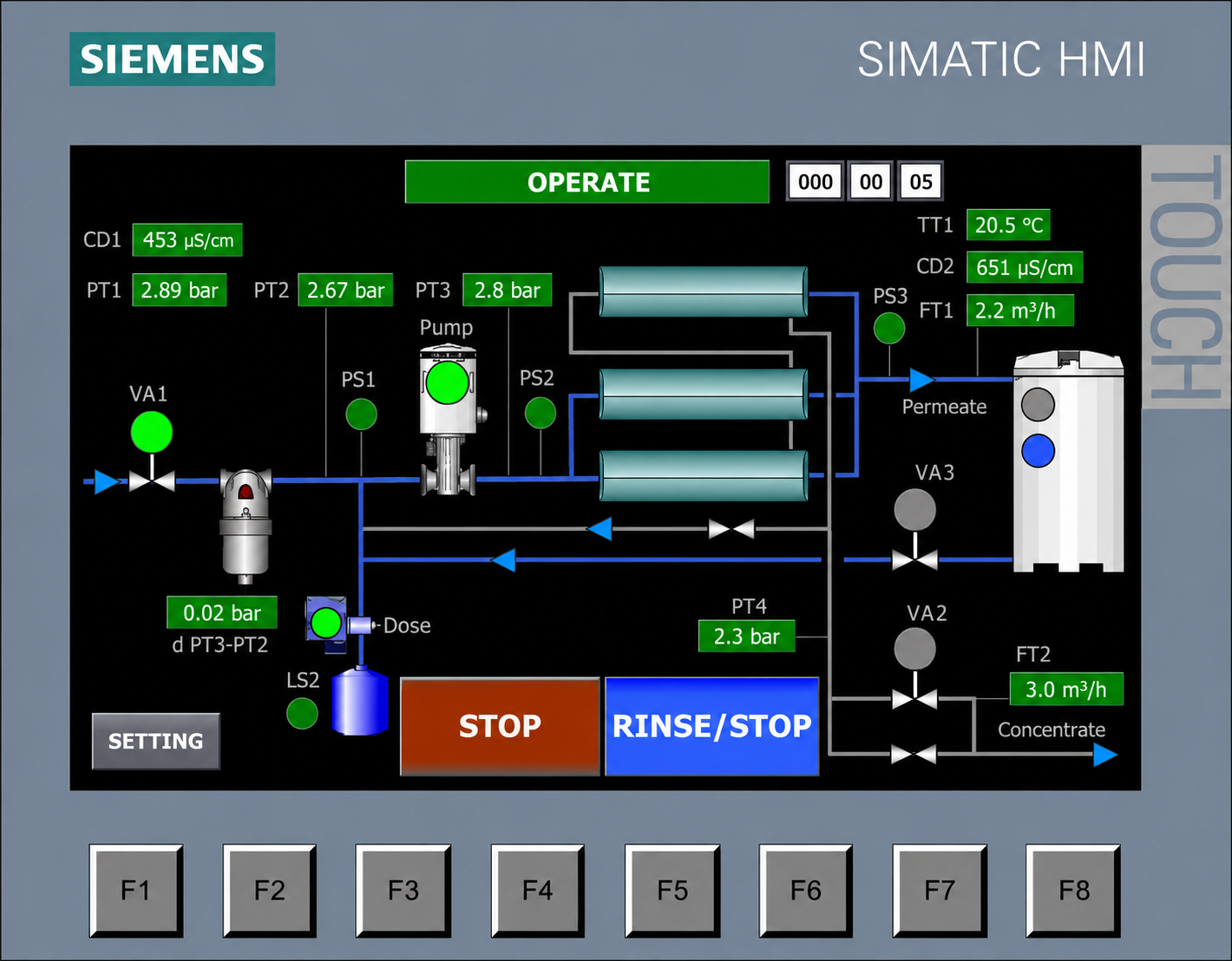
On the main OPERATE screen, the operator can monitor the current operating mode, such as service, stop, alarm, or standby. The panel also displays key hydraulic parameters, including permeate and concentrate flow rates, permeate temperature, and TDS levels for both feed water and permeate.
The display shows the pressure profile of the unit, including feed pressure, pressure after the sediment filters, pump discharge pressure, and pressure after the membranes. If an analog 4–20 mA level sensor is connected, the HMI can show the permeate tank level. If a float switch is connected, the controller can display whether the tank is full. The controller can also show a low antiscalant level.
In addition to monitoring, the panel allows the operator to control motorized valves for feed water, forward flushing, and permeate flushing. It can also display three alarm modes. These elements are combined in one dashboard for local system management and fast diagnostics.
-
Why does this system cost more than other models?
The higher cost of this system compared with other models is mainly due to the use of industrial components, including the Siemens S7-1200 controller and pump frequency control.
Although the initial investment is higher, the frequency inverter can reduce operating costs by adjusting pump power consumption to actual demand and water temperature. This helps avoid unnecessary energy use.
The Siemens controller provides precise monitoring of technical parameters, allowing the operator to maintain the correct hydraulic balance and reduce mechanical stress that can shorten membrane life. Over time, service costs can be reduced because detailed monitoring helps identify fouling early and supports timely chemical cleaning before membrane replacement becomes necessary.
-
What Are Ion-Exchange Resins Used For in Water Treatment?
Ion-exchange resin serves as a filtration material that removes hard metals and unwanted minerals from water. It is used for softening, deionisation, dealkalisation, and demineralisation of both household and industrial water.
-
What Is the Difference Between Cation and Anion Resins?
Cation resin replaces positively charged ions, like calcium and magnesium, while anion resins replace negatively charged ions, namely sulfates and chlorides.
-
How Long Do Ion-Exchange Resins Last?
The lifespan of ion-exchange resin depends on its type, treated water quality, and maintenance. Typically, it can last for more than 3 years (up to 10 in some cases), provided that it is timely regenerated. Treating water at high temperatures and with high iron levels can reduce the service life.
-
Can Ion-Exchange Resins Remove Heavy Metals from Water?
Yes, they can remove lead, copper, nickel, and cadmium. For this purpose, we offer strong acid cation and strong base anion exchange resins, like the AmberLite™ MB20 from DuPont.
-
How Do You Regenerate Ion-Exchange Resins?
To regenerate ion-exchange resins, they should be treated with an appropriate regenerant (brine or acid). First, the media is backwashed to remove large sediments. Then, the regenerant is slowly passed through the beads. Finally, the resin is washed with pure water to remove the remaining regenerant.
-
Are Ion-Exchange Resins Safe for Drinking Water Systems?
Ion-exchange resins are considered safe and can be used for treating drinking water. They replace contaminants with harmless ions.
-
What Does Activated Carbon Remove from Water?
Activated carbon mainly removes organic compounds, pesticides, herbicides, chlorine, volatile organic compounds, and other chemicals from water.
-
What Is the Difference Between Granular and Block Activated Carbon?
Granular activated carbon consists of particles of various sizes and ensures fast flow rates and proper purification. The block of activated carbon is pressed from powder. Due to high density, the flow rate is slow, but such media filters very efficiently, removing contaminants like lead.
-
How Often Should Activated Carbon Be Replaced?
Activated carbon should be replaced once a year or as often as the manufacturer recommends.
-
Does Activated Carbon Remove Bacteria from Water?
No, activated carbon does not remove bacteria from water. For microbiological purification, reverse osmosis membranes or ultraviolet light systems should be used.
-
Can Activated Carbon Improve the Taste and Odour of Water?
Yes, activated carbon significantly improves the taste and odour of water, making it fresh and tasty.
-
Is Activated Carbon Safe for Use in Drinking Water Filters?
Activated carbon is considered entirely safe for application in drinking water filters. It removes contaminants, improves taste, and does not introduce chemicals into the treated water.
-
Why might the Ecosoft MO3TISIEM be suitable for my purposes?
The Ecosoft MO3TISIEM is an industrial-grade reverse osmosis system designed for reliable purified water production. It combines efficient performance, digital control, and durable stainless steel construction.
The system can be integrated into a plant-wide upper-level network for monitoring and control of technological processes via SCADA or BMS.
-
Why might the Ecosoft MO9TISIEM be suitable for my purposes?
The Ecosoft MO9TISIEM is a high-capacity industrial-grade reverse osmosis system designed for reliable purified water production. It combines efficient performance, digital control, and durable stainless steel construction.
The system can be integrated into a plant-wide upper-level network for monitoring and control of technological processes via SCADA or BMS.
-
How does the Ecosoft Pink 150 water softener work?
The Ecosoft Pink 150 works as a cation exchange water softener with 15 L of strong acid cation exchange resin. After setting the water hardness and current time in the control valve, pour salt into the salt tank, open the water supply, and start forced regeneration by holding REGEN for 5 seconds. This cleans the media from impurities and stratifies it.
-
What water hardness level can the Ecosoft Pink 150 handle?
The Ecosoft Pink 150 can handle influent water hardness up to 750 mg/L as CaCO₃.
-
Is the Ecosoft Pink 150 suitable for a private house or apartment?
Yes. The Ecosoft Pink 150 is a compact 15-liter water softener for tap water. It is suitable for residential use, including small apartments and families of up to 4 people.
-
What are the main benefits of using the Ecosoft Pink 150 water softener?
The main benefits of the Ecosoft Pink 150 are ultra-compact dimensions, a space-saving design that fits easily under the kitchen sink, high flow and softening capacity for its size, a pre-configured reliable Clack® DV valve with a built-in mixing valve, and 15 L of resin. Its operating flow rate is 1.3 / 1.5 m³/h.
-
What type of salt is required for the Ecosoft Pink 150 water softener?
The Ecosoft Pink 150 requires softener salt pellets. Fill the salt compartment at least half full, or pour salt into the salt tank to 1/2–2/3 of the tank volume.
-
What is the Ecosoft Pink 100 water softener used for?
The Ecosoft Pink 100 softens tap water and helps protect plumbing and appliances from limescale. It is an ultra-compact high-flow softener for space-saving installation, with a built-in mixing valve and Ecosoft DV control valve. It contains 10 L of resin.
-
How does the Ecosoft Pink 100 water softener work?
The Ecosoft Pink 100 works by cation exchange. Its 10 L of ion exchange resin reduces water hardness, while the Ecosoft DV control valve manages operation and regeneration after programming, salt loading, and forced regeneration by holding REGEN for 5 seconds.
-
What water hardness level can Ecosoft Pink 100 handle?
The Ecosoft Pink 100 can handle influent water hardness up to 750 mg/L as CaCO₃. Its documented volume capacity is 1.2 m³ at 250 mg/L as CaCO₃, with an average mixing rate of influent hardness up to 0.3 m³. These values describe different limits.
-
Is the Ecosoft Pink 100 suitable for a private house or apartment?
Yes. The Ecosoft Pink 100 is suitable for residential use in a private house or apartment. Its ultra-compact cabinet is designed for under-sink installation in small kitchens and for households of up to 3 people, where space at home is limited.
-
How often does the Ecosoft Pink 100 need regeneration?
The Ecosoft Pink 100 regenerates when the set capacity is reached or when the day override is reached, if enabled. The control valve supports rES, dELY, and on 0 modes, and the day override can be set from 1 to 28 days or OFF, depending on settings.
-
What is the Ecosoft Pink 200 water softener used for?
The Ecosoft Pink 200 softens tap water and helps protect plumbing and appliances from limescale. It is an ultra-compact high-flow softener with a built-in mixing valve and Ecosoft DV control valve. It contains 20 L of resin and has an operating/maximum flow rate of 1.6 / 1.8 m³/h.
-
How does the Ecosoft Pink 200 water softener work?
The Ecosoft Pink 200 softens water by cation exchange. It uses 20 L of ion exchange resin to reduce water hardness, while the Ecosoft DV control valve manages operation and regeneration. After programming, pour salt into the salt tank to 1/2–2/3 of its volume and start forced regeneration by holding REGEN for 5 seconds.
-
What water hardness level can the Ecosoft Pink 200 handle?
The Ecosoft Pink 200 can handle influent water hardness up to 750 mg/L as CaCO₃. This is the documented maximum hardness limit for feed water. Correct system settings depend on the actual hardness value entered in the Ecosoft DV control valve.
-
Is the Ecosoft Pink 200 suitable for a private house or apartment?
Yes. The Ecosoft Pink 200 is suitable for residential use in a private house or apartment. It is an ultra-compact 20-liter softener for tap water, designed for households of up to 5 people and space-saving installation in bathrooms or utility rooms.
-
What type of salt is recommended for the Ecosoft Pink 200?
The Ecosoft Pink 200 requires softener salt pellets. Fill the salt compartment with salt pellets and keep it at least half full. During setup, add salt to 1/2–2/3 of the salt tank volume after programming, then start forced regeneration by holding REGEN for 5 seconds.
-
What is the Ecosoft Robust Mini direct flow reverse osmosis system?
The Ecosoft RObust Mini is a direct-flow reverse osmosis filter for cafés, petrol stations, offices, schools, and stores. It has a flow capacity of 55–60 L/h and water consumption of 110–125 L/h. Filtration stages include a 5 micron sediment filter, GAC carbon filter, 3 reverse osmosis membranes, and CTO carbon post-filter.
-
How does the Ecosoft Robust Mini direct flow reverse osmosis system work?
The Ecosoft RObust Mini works as a multistage direct-flow reverse osmosis system. Feed water passes through pre-filtration, then a booster pump sends it to the membranes. Permeate passes through the CTO carbon post-filter to the outlet or tank connection, while concentrate is discharged to the drain. Low- and high-pressure switches control pump operation.
-
What contaminants does the Ecosoft Robust Mini remove from water?
The Ecosoft RObust Mini removes harmful impurities, including nitrates and viruses, using reverse osmosis membranes. Its pre-filtration removes suspended particles such as rust, sand, and hemp strands before the water reaches the membranes.
-
Is the Ecosoft Robust Mini suitable for home or commercial use?
Yes. The Ecosoft RObust Mini is suitable for both home and light commercial use. Ecosoft describes it as an entry-level solution for small offices, coffee corners, household kitchens, cafés, petrol stations, schools, and stores.
-
What is Ecosoft ECOMIX® C filter media used for?
ECOMIX® C is a blend of ion exchange and sorption materials for treating problem water in domestic, commercial, and industrial systems.
-
What contaminants does ECOMIX® C remove from water?
ECOMIX® C reduces hardness, iron, manganese, ammonium, and natural organic matter. It reduces organic matter by 80%.
-
Is Ecosoft ECOMIX® C suitable for well water treatment?
Yes. ECOMIX® C is suitable for well water and municipal water with high organic matter. It can be used when raw water quality changes seasonally.
-
Does ECOMIX® C help soften hard water?
Yes. ECOMIX® C helps soften hard water. The filter capacity and service cycle are calculated based on water hardness.
-
What is the Ecosoft RObust 3000 MAX direct flow reverse osmosis system?
Ecosoft RObust 3000 MAX is a direct-flow reverse osmosis system for restaurants, water production facilities, small breweries, car washes, and private homes. Its flow capacity is 150–160 L/h, water consumption is 250–300 L/h, power supply is 180–240 V, and power consumption is 0.12–0.16 kW. The system dimensions are 466 × 523 × 406 mm. The package includes an assembled filter, pre-filters, reverse osmosis membranes, drain saddle, installation fitting set, tubes, and service wrenches
-
How does the Ecosoft RObust 3000 MAX work?
Ecosoft RObust 3000 MAX is a multistage direct-flow reverse osmosis system. Cold feed water first passes through pre-filtration. A booster pump then sends the water to the reverse osmosis membranes. If feed pressure drops below 0.15–0.2 bar, the low-pressure switch closes the inlet valve and turns off the pump. Purified water, or permeate, goes to the purified water outlet or pressure tank outlet, if installed, passing through the carbon post-filter if the filter design includes one. Concentrate is discharged to the drain through the flow restrictor. The high-pressure switch starts the system when pressure drops in the permeate line and stops it when pressure builds up again.
-
What contaminants can the RObust 3000 MAX remove from water?
RObust 3000 MAX purifies tap water from harmful impurities, including nitrates and viruses. Its pre-filtration removes suspended particles such as rust, sand, and hemp strands before the water reaches the reverse osmosis membranes.
-
What is Filter-Ag Plus® filter media used for?
Filter-Ag Plus® is used as a highly efficient filter media for reducing suspended matter. It removes dirt, silt, organic matter, and other particulate matter from water. It can also be used to reduce water turbidity and retain iron particles in low concentrations.
-
How does Filter-Ag Plus® improve water filtration?
Filter-Ag Plus® improves filtration through its clinoptilolite structure, large surface area, and microporous granules. It provides deep bed filtration, lower pressure loss, deeper sediment penetration into the bed, higher sediment loading, longer filter runs, and lower backwash frequency. It can typically reduce suspended solids to 5 microns or less.
-
What types of contaminants can Filter-Ag Plus® remove?
Filter-Ag Plus® reduces suspended matter, including dirt, silt, and organic matter. It is also used to reduce turbidity and can help retain oxidized iron floc in deironing systems.
-
Is Filter-Ag Plus® suitable for residential water treatment systems?
Yes. Filter-Ag Plus® can be used in pressure or gravity flow systems where quality water filtration and water conservation are important. It can also be used to replace multimedia in existing filter systems.
-
How much filter media is included in the 28.3 L package?
The 28.3 L package contains 28.3 liters of Filter-Ag Plus® filter media. The bag weight is 22.6 kg.
-
What are the main benefits of using Filter-Ag Plus® filter media?
The main benefits of Filter-Ag Plus® are deep bed filtration, lower pressure loss, longer filter runs, less out-of-service time, reduced backwash water use and lower backwash frequency, high service flow rates, lower equipment costs, and space savings. It can also replace multimedia in existing installations. Filter-Ag Plus® is an all-natural, environmentally safe product certified to NSF/ANSI/CAN Standard 61.
-
Can Filter-Ag Plus® help reduce sediment and suspended solids?
Yes. Filter-Ag Plus® is a highly efficient media for reducing suspended matter. It helps remove suspended solids such as dirt, silt, and organic matter, and deep bed filtration can typically reduce suspended solids to 5 microns or less.
-
How does the filter set help prepare water according to coffee brewing requirements?
The filter set supports multi-stage water treatment by reducing impurities that can negatively affect coffee taste and by adding calcium and magnesium through the COFFEE cartridge. This helps create water with a more suitable mineral balance for coffee extraction, improving the aroma and flavor of the final beverage.
-
How should the flow restrictor be selected for the RObust COFFEE system depending on inlet water salinity?
The flow restrictor should be selected according to the salt content of the inlet water to achieve the target mineral content after the RObust COFFEE cartridge.
According to SCA recommendations, the desired salt content of water for coffee preparation is 75–250 mg/L. For inlet water with lower salinity, a restrictor that provides higher mineral enrichment may be required, while for water with higher inlet salinity, a lower enrichment option may be more suitable.
Correct restrictor selection helps keep the final water composition within the recommended range, ensuring stable coffee extraction, balanced taste, and consistent beverage quality.
-
What does the Ecosoft total hardness test kit measure?
It measures total water hardness based on calcium and magnesium content.
-
How does the test work?
The test uses simple titration. Add the reagent drop by drop until the water changes from red to green. This color change shows the endpoint of the analysis.
-
How do I read the result?
Each drop equals 1 German degree (°dH). The result can also be converted into °f, meq/L, or ppm as CaCO₃.
-
Where can the test kit be used?
It is suitable for on-site hardness checks in residential water systems, water treatment applications, service maintenance, and laboratory control.
-
What is the purpose of the MULTIBLOCK INLINE 1″ module?
It supports easy shut-off and bypass control, making softener maintenance more convenient.
-
Are the drainage and brine line pipes included in the kit?
No. The pipes are not included in the kit, but they are supplied with most water softener models.
-
What type of water can be used with the filter?
The filter is designed for cold municipal tap water with a recommended inlet TDS level of up to 500 ppm.
-
Does the filter require plumbing installation?
No. The countertop design works without connection to the water supply.
-
How often should the filter cartridge be replaced?
The filter cartridge lifespan is up to 2 000 L or approximately 12 months, depending on water quality and usage.
-
How will I know when the filter cartridge needs replacement?
The built-in indicator automatically reminds you when it is time to replace the filter cartridge.
-
Is filter replacement complicated?
No. The integrated filter cartridge can be replaced in a few simple steps without special tools.
-
Does the filter provide hot water?
Yes. The filter offers multiple temperature modes, including room temperature, warm, hot, and near-boiling water.
-
Is the water purified before heating?
Yes. Water passes through reverse osmosis and UV treatment before dispensing.
-
What should I do before first use?
Before drinking water for the first time, run the initial flushing cycle according to the instructions.
-
What maintenance is required?
Regularly clean the water tank and drip tray, replace the filter cartridge on time, and refresh the water in the tank periodically.
-
What if the filter has not been used for several days?
Flush the filter before reuse to ensure fresh water quality.
-
What is included in a commercial water treatment setup?
The setup depends on a commercial water treatment system. Typically, the system can include pre-filters, like a sediment filter to prevent membrane damage, a softener to remove the hardness, reverse osmosis membranes that remove over 99% of contaminants, and a post-filter or UV steriliser.
-
How often should commercial filters be serviced?
The maintenance schedule differs according to the filer type. For instance, an Ecosoft PP melt-blown sediment filter should be replaced every 4 months, while a membrane element should be replaced every 6 months, provided that its productivity becomes lower by over 20%. Also, a membrane can be cleaned without replacement if the conditions allow.
-
What affects the cost of commercial water treatment?
The technology that is chosen according to the target water purity and the system capability greatly affects the cost of commercial water treatment systems. Also, the cost of water treatment increases if the recovery rate and energy consumption of the unit are high. The inlet water quality parameters do matter. The more contaminated the water, the higher the price for the purification system and the higher the operating expenses.
-
What maintenance is required for restaurant filtration systems?
Maintenance of restaurant filtration systems depends on the selected unit and its operating principle. Mostly, a regular replacement of membrane elements and media is required. The schedule varies.
-
Can one system supply the entire restaurant?
Yes, we’ve got powerful filtration systems with a high flow rate that can supply the entire restaurant without interruption. For instance, the Ecosoft RObust 4000 direct flow reverse osmosis system with a flow rate of up to 180 L is designed for 20 hours of continuous operation.
-
What should restaurants consider before choosing a filtration system?
Before choosing a filtration system, it is required to test the feed water to know its parameters and calculate the demand for purified water. Also, the expected result should be clear: whether the business needs softening only or wants to have comprehensive water purification.
-
What water filtration system is best for espresso machines?
Systems using ion-exchange resin are quite popular for espresso machines. Actually, our water treatment systems have standardised fittings and match commercial coffee machines from various brands. For the best, consistent result, consider a powerful Ecosoft RObust COFFEE direct flow reverse osmosis system with a space-saving design.
-
How often should cafe filtration systems be changed?
You do not have to change the filtration system. It is enough to replace cartridges roughly every 3 months and membranes every 12 months.
-
Can one system support several coffee machines?
Yes, our filtration systems can support multiple coffee machines.
-
What should cafes consider when choosing water treatment?
Cafes should consider the desired effect provided by various technologies, whether it is a softener or an RO filter. Also, the inlet water quality does matter (pH, TDS, hardness, chemical content, etc.).
-
Are compact lab water systems available?
Yes, there are space-saving lab water systems with dimensions that suit small rooms.
-
What factors affect laboratory water system selection?
The source water characteristics and the information about how much water a laboratory water system processes are key factors that affect the choice.
-
How do laboratory purification systems work?
An operating principle of a laboratory purification system depends on its construction. RO filters allow only small water molecules to pass through the finest membrane. Carbon filters trap odours and sediments inside carbon pores. Ion exchange softeners replace hard minerals with soft ones.
-
Can reverse osmosis provide spot-free rinsing?
To ensure the highest level of purification, a reverse osmosis system with a softener module should be used to provide spot-free rinsing in a car wash.
-
Is water recycling possible in car wash systems?
Water recycling is highly possible in car washes. Water is treated by mechanical and chemical methods before it is ready to be reused.
-
How often should car wash filters be serviced?
Maintenance schedules depend on filter type. Most sediment filters are replaced every 4 months.
-
Can filtration reduce operational costs?
Filtration reduces operational cost because soft, purified water prevents a limescale buildup that causes increased energy consumption and frequent repairs. Recycling also lowers tap water usage.
-
What system size is suitable for a car wash business?
A filtration system size depends on business needs. You can choose our powerful, framed INOX IoT MO3 8" reverse osmosis system with the capacity of 3-4 m³/h or prefer a more compact two-stage multifunctional filter AQUAPOINT, with a flow capacity of 1.8 m³/h.
-
How can emergency systems provide safe drinking water?
The Ecosoft emergency systems feature efficient purification technologies, like multimedia filters, water softeners, and reverse osmosis, to deliver safe drinking water.
-
How quickly can emergency systems be deployed?
The Ecosoft fully automated emergency systems are pre-installed. They are transported via standard container carriers to areas where they are needed and used almost immediately without specific deployment.
-
How long can emergency water systems operate continuously?
The uninterrupted run-time depends on a unit. Typically, containerised systems are designed to treat water 24/7.
-
What maintenance is needed for cooling water systems?
Cooling water systems need routine water composition control and preventative cleaning to avoid limescale deposits. To reduce maintenance expenses, water filtration systems are recommended.
-
Can treated water extend equipment lifespan?
Treated water can significantly extend the lifespan of cooling water systems, as it does not contain hard minerals and microorganisms that can cause scale buildup and clogging in pipes, which causes early wear and tear of the equipment.
-
Can reverse osmosis improve product consistency?
Reverse osmosis significantly enhances beverage consistency, as water is a key ingredient and dramatically affects the taste and odour. When its quality is controlled by reliable RO systems, fluctuating results are reduced to the absolute smallest possible degree.
-
What water treatment systems are used in bottling plants?
Typically, bottling plants use a multi-stage filtration combining reverse osmosis filters with pre-filtration and final disinfection.
-
What water quality is required for soft drink production?
Soft drink production is subject to standard drinking water regulations. Water is expected to be colourless, purified of chlorine, meet microbiological sterility, and have a neutral taste and odour. Low levels of TDS are allowed.
-
How often should beverage filtration systems be serviced?
The maintenance schedule depends on the system chosen. Typically, sediment filters and media are replaced every 4-6 months, while membrane elements are replaced every year or more rarely, depending on inlet water quality.
-
What affects the cost of industrial beverage water treatment?
The water treatment system affects the purification cost. When choosing a unit, you should consider its energy consumption, consumables to replace, and its recovery rate. Also, source water parameters and the intensity of equipment usage do matter.
-
What contaminants can home water filters remove?
The range of contaminants removed depends on the technology. A softener removes hardness. ECOMIX removes hardness, iron, and organics. Reverse osmosis removes over 99% of contaminants.
-
What is the difference between whole-house and under-sink systems?
A whole-house system treats all water that enters the house. An under-sink system treats water at this particular faucet.
-
How often should home water filters be replaced?
Water filters are typically replaced every 4–6 months. RO membranes are replaced every 12 months.
-
What system is best for hard water treatment?
To remove hardness, you should consider water softeners with ion exchange resin.
-
What maintenance does a home filtration system require?
Maintenance of a home filtration system depends on its configuration and the technology it is based on. Typically, consumables like media, salt, and membranes should be replaced.
-
What is the best filter for iron in well water?
ECOMIX is the best media to remove iron from well or borehole water. Though the choice depends on the iron type and its levels.
-
Can iron filtration improve water taste and smell?
The iron filtration perfectly removes metal taste and smell, which results in fresh, clean water.
-
What is the difference between ferric and ferrous iron?
When water is rich in ferrous iron, it comes out of the tap clear, but when it contacts oxygen, it becomes brown and leaves rusty-orange stains. Water rich in ferric iron contains tiny flakes of rust and comes out of the tap already reddish.
-
Why does filtered water improve coffee taste?
Purity of water is crucial for the coffee taste. No undesired odours and tastes interfere with the coffee aroma. Also, balanced mineral composition enables beneficial interaction with natural coffee chemicals to extract taste nuances.
-
Does a coffee machine water filter remove chlorine?
The most effective water filters for removing chlorine are activated carbon filters and RO membranes. Typically, they are treatment stages of our reverse osmosis systems.
-
Why Does Tap Water Smell Like Chlorine?
Tap water in most countries in the world can smell like chlorine because it is disinfected with this chemical element, which efficiently kills bacteria, parasites, and viruses.
-
Can Chlorine Affect Skin and Hair?
Chlorine irritates skin, making it dry due to the breakdown of the body's natural protective oil barrier. Repeated contact with water rich in chlorine causes fine lines, premature skin ageing, and leaves hair weak and brittle.
-
What Causes Limescale in Appliances?
Limescale builds up in appliances, causing clogging, increased energy consumption, and eventual failures.
-
Which Filter Removes Chlorine Best?
Carbon filters remove chlorine best. For the most comprehensive water treatment, we recommend choosing an RO system with several purification stages, including a cartridge with activated carbon media.
-
How Can I Reduce Limescale at Home?
To reduce limescale at home, install our filtration system with a water softener. Ion-exchange resin perfectly traps calcium and magnesium. You can use a point-of-entry system to serve the whole house, including plumbing, or prefer a point-of-use filter connected to a tap in the kitchen, for instance. To decide, you should compare whole-house vs kitchen-tap options.
-
What contaminants can RO systems remove?
RO systems remove over 99% of impurities, including hardness salts, nitrates, PFAS, heavy metals, most viruses, bacteria, and other contaminants.
-
How is RO different from standard filtration?
RO membrane differs from other filters in a high-tech, semi-permeable material that allows only small water molecules to pass through.
-
How often should RO membranes be replaced?
RO membranes are typically replaced every 1–2 years. The interval depends on source water quality and the intensity of filter usage.
-
Can reverse osmosis improve water taste?
Reverse osmosis significantly improves water taste, making it crisp and fresh. It is possible because an RO membrane removes impurities that cause unpleasant odours and tastes.
-
Can house softeners improve shower water quality?
House softeners dramatically enhance shower water quality, which improves skin and hair. Soft water does not cause limescale deposits in a bathroom.
-
What contaminants do house softeners remove?
House softeners remove mostly calcium and magnesium from drinking water. We offer media that also fight sulfates, chlorides, iron, manganese, ammonium, and natural organics.
-
Which filtration system is easier to maintain?
Water softeners with automatic flushing are easier to maintain, as only refilling the salt is required. Also, twin-tank systems regenerate automatically.
-
What Causes Limescale in Household Appliances?
High levels of calcium and magnesium in water cause limescale deposits in household appliances.
-
How Can I Tell If I Have Hard Water?
If surfaces in your kitchen and bathroom that come in contact with water are covered with chalky coating, the water in your house is hard. Also, reduced pressure in pipes and frequent failures of appliances are signs.
-
Can Hard Water Affect Skin and Hair?
Hard water makes skin and hair extremely dry. Interacting with soaps, it forms a film on contact surfaces that dehydrates them.
-
Which Appliances Suffer Most from Limescale?
Appliances such as electric kettles, coffee machines, dishwashers, washing machines, and ice makers suffer most from limescale because they constantly come into contact with water.
-
How Often Should Water Softeners Be Serviced?
A maintenance schedule depends on water hardness, the softener model, and the frequency of its use. Typically, you are expected to check the salt level in the brine tank every 4 to 8 weeks to ensure it is above the water level and add it, if necessary.
-
Does Softened Water Improve Laundry and Cleaning?
Softened water improves laundry, as it contributes to a deeper stain removal and softens fabrics. Also, it is better for keeping the house clean because of more efficient interaction with detergents and the reduced use of household cleaning products.
-
What is an RO calculator?
An RO calculator is an online tool that helps you estimate and configure the performance of a commercial reverse osmosis system. It uses feed water data and system settings to calculate key parameters such as permeate flow, recovery rate, concentrate flow, salt rejection, and expected water quality.
The calculator is useful for preliminary system selection and setup planning. It helps water professionals understand how an RO system may perform under specific operating conditions, but it does not replace a detailed engineering design or final technical assessment.
-
What is a Commercial Reverse Osmosis System Calculator used for?
A Commercial Reverse Osmosis System Calculator is used to estimate how an Ecosoft commercial RO system may perform under specific operating conditions. It helps calculate key parameters such as permeate flow, concentrate flow, recovery rate, salt rejection, and expected product water quality based on feed water data and system settings.
The calculator supports preliminary system selection, configuration, and service checks. It can help water professionals compare different operating conditions, adjust flow settings, and better understand how changes in feed water TDS, temperature, pressure, or recovery may affect system performance. The results should be used as a planning and support tool, not as a replacement for final engineering design or certified hydraulic calculation software.
-
How does the RO Membrane Flow Calculator work?
The RO Membrane Flow Calculator estimates system performance based on feed water data, membrane parameters, and selected operating settings. It compares the feed flow, permeate flow, and concentrate flow to calculate the recovery rate and expected productivity of the RO system.
The calculator also takes into account key factors that affect membrane performance, such as feed water TDS, pressure, temperature, and salt rejection. This helps water professionals understand how the system may behave under different conditions and adjust the configuration before installation, commissioning, or service.
-
What data do I need to enter into the RO calculator?
To use the RO Calculator, you need to enter the main system, membrane, and feed water data. This includes the RO system model, membrane type and condition, permeate tank type, feed pressure, water temperature, feed water TDS, and water source type.
You also need to enter the hydraulic settings, such as the concentrate and recirculation rotameter values. Based on these inputs, the calculator estimates the expected flow rates, recovery, and system performance under the selected operating conditions.
-
How do I calculate the required RO membrane flow rate?
To calculate the required RO membrane flow rate, you need to know the target permeate flow and the expected concentrate flow. The RO Calculator uses these values to estimate the total feed flow required for the system.
It also checks the recovery rate, which shows how much of the feed water becomes purified water. This helps you understand whether the selected settings are realistic for the membrane and operating conditions.
-
What is membrane flow rate in a reverse osmosis system?
Membrane flow rate in a reverse osmosis system shows how much water passes through the RO membrane and becomes permeate. In practice, it helps estimate the system’s productivity and understand how much purified water the membrane can produce under specific operating conditions.
The membrane flow rate depends on several factors, including feed water pressure, temperature, TDS, membrane condition, and system recovery. It should always be assessed together with the concentrate flow and overall system settings to make sure the RO system operates efficiently and within the recommended range.
-
How do I understand the recovery rate in the calculator?
Recovery rate in the RO Calculator shows what percentage of feed water is converted into purified water, or permeate. A higher recovery means that more of the incoming water becomes product water, while less water leaves the system as concentrate.
However, recovery should not simply be set as high as possible. If the recovery rate is too high for the feed water quality and operating conditions, minerals can become more concentrated inside the system and increase the risk of scaling. The calculator helps check whether the selected recovery is realistic for the system setup.
-
Is this RO calculator suitable for industrial water treatment systems?
No, this RO Calculator is not suitable for industrial water treatment systems. It is designed for Ecosoft commercial reverse osmosis systems and helps estimate their performance, adjust operating settings, and support preliminary configuration for commercial RO applications.
Industrial water treatment systems require project-specific engineering calculations, detailed hydraulic assessment, and verification according to the actual system design and operating conditions. The commercial RO Calculator should not be used to size, configure, or evaluate industrial RO systems. If you need help with an industrial water treatment project, please contact us and our team will help you choose the right solution.
-
Can I use this calculator for drinking water reverse osmosis systems?
No, this calculator is not intended for domestic drinking water reverse osmosis systems. It is designed for Ecosoft commercial reverse osmosis systems and helps estimate their performance under selected operating conditions.
For domestic drinking water RO filters, use the product documentation or selection tools created specifically for that product category. The commercial RO calculator should not be used to size, configure, or evaluate domestic RO systems.
-
How accurate are the results of the RO calculator?
The RO Calculator provides estimated results based on the input data and selected operating settings. It is useful for preliminary system selection, configuration, and performance checks, but it should not be treated as an exact prediction of real system operation.
Actual performance may vary depending on feed water quality, temperature, pressure, membrane condition, installation, and hydraulic settings. For this reason, calculator results should always be checked against real system measurements during commissioning or service.
-
What is the Ecomix Water Softener Calculator?
The ECOMIX Water Softener Calculator is an online selection tool that helps choose a suitable Ecosoft water softener configuration based on the application type, water consumption, and source water quality.
The calculator guides you step by step: you select the application type, enter basic usage data such as the number of bathrooms, residents, and daily water consumption, and add water test parameters including hardness, iron, manganese, ammonium, and TOC. You can also choose the filter type and filter material, such as ECOMIX® C, ECOMIX® A, ECOMIX® P, Ecolite Soft, or Ecolite Ultrasoft.
Based on these inputs, the calculator provides a recommended system configuration and key operating parameters, including media volume, tank size, valve settings, flow rates, capacity, regeneration interval, and estimated salt and water consumption. The results should be used as a practical selection and configuration guide, not as a replacement for full water analysis or professional system design.
-
How does the Commercial Water Softener Calculator work?
The Commercial Water Softener Calculator works by collecting the main data needed to size and configure a water softening system. It uses the selected application type, estimated water consumption, and water quality parameters to recommend a suitable system setup.
You enter information such as the number of bathrooms, residents, daily water use, hardness, iron, manganese, ammonium, and TOC. The calculator then helps match these conditions with the right filter type and filter material. For ECOMIX® systems, this is especially useful because different ECOMIX® media are designed for different water conditions, from stable water quality to more complex water with organic matter, iron, manganese, or ammonium.
The result includes the recommended configuration, such as ECOMIX® volume, tank size, brine tank size, control valve, DLFC, and injector. It also shows operating and regeneration parameters, including service flow rate, backwash flow rate, volume capacity, regeneration interval, salt and water consumption, and the regeneration stages for programming the valve.
The calculator supports preliminary selection and configuration. The final choice should always be checked against the full water analysis, product documentation, and real operating conditions.
-
What information do I need to use the calculator?
To use the calculator, you need the main application, water consumption, and water quality data. Start by selecting the application type, such as a household or professional water softener, and then enter the basic usage information: number of bathrooms, number of residents, and estimated daily water consumption per resident.
You also need water test results, including hardness, iron, manganese, ammonium, and TOC. After that, select the filter type and filter material, such as ECOMIX® C, ECOMIX® A, ECOMIX® P, Ecolite Soft, or Ecolite Ultrasoft. Based on this data, the calculator can recommend a suitable configuration and show the key operating and regeneration parameters.
-
Can I use this calculator for commercial water treatment systems?
Yes, the calculator can be used for commercial water treatment systems, including professional water softeners and systems with ECOMIX® filter media. It helps estimate the required system configuration based on application type, water consumption, and water quality parameters.
For commercial applications, the calculator can provide useful configuration and operating data, such as media volume, tank size, brine tank size, control valve, DLFC, injector, flow rates, volume capacity, regeneration interval, and estimated salt and water consumption.
The results should be used for preliminary selection and configuration. The final system choice should always be checked against a complete water analysis, project requirements, product documentation, and real operating conditions.
-
Is the calculator suitable for hotels, restaurants, and offices?
Yes, the calculator is suitable for light commercial applications such as hotels, restaurants, cafés, offices, and similar facilities. It helps estimate the required water softener configuration based on water consumption, application type, and water quality parameters.
For these applications, the calculator can support preliminary selection of the filter type, filter material, media volume, tank size, valve configuration, flow rates, and regeneration parameters. The final system choice should always be checked against actual water analysis, peak water demand, installation conditions, and project requirements.
-
Can the calculator help choose the right Ecomix softener size?
Yes, the calculator can help choose the right ECOMIX® softener size. It uses the selected application type, estimated water consumption, and water quality parameters to recommend a suitable configuration.
The result includes the key sizing data, such as ECOMIX® volume, tank size, brine tank size, service flow rate, volume capacity, and interval between regenerations. This helps you understand which softener setup can match the required water demand and source water quality.
The final selection should still be checked against the full water analysis, peak flow requirements, installation conditions, and product documentation.
-
What does the calculator result show?
The calculator result shows a recommended softener configuration and the key operating parameters for the selected conditions. It includes the filter material and its required volume, tank size, brine tank size, control valve, DLFC, injector, service flow rate, backwash flow rate, volume capacity, and expected interval between regenerations.
The result also shows estimated salt and water consumption for regeneration, expected service life of the filter material, and the regeneration stages needed for valve programming. This helps check whether the selected system configuration matches the water quality, water demand, and operating requirements.
The result should be used as a selection and setup guide. Final system configuration should be verified against the full water analysis, peak flow demand, installation conditions, and product documentation.
-
How accurate are the calculator results?
The calculator results are estimates based on the data you enter, including water consumption, water quality parameters, filter material, and system settings. The more accurate and complete the input data is, the more reliable the recommended configuration will be.
Actual system performance may vary depending on real water quality, peak flow demand, installation conditions, valve settings, and how the system is used after installation. The calculator should be used for preliminary selection and configuration, while the final setup should be verified against a full water analysis, product documentation, and real operating conditions.
-
What should I do after getting the calculator result?
After getting the calculator result, review the recommended system configuration and check whether it matches your project requirements. Pay attention to the filter material, media volume, tank size, valve configuration, flow rates, volume capacity, regeneration interval, and estimated salt and water consumption.
Before making the final selection, verify the result against a full water analysis, peak flow demand, installation conditions, and product documentation. If the system is used for a commercial application or complex water, we recommend checking the configuration with Ecosoft specialist.
-
What is a reverse osmosis system and how does it work?
A reverse osmosis system is a water filtration system that uses pressure to push water through a semi-permeable membrane. The membrane lets water molecules pass through while reducing dissolved salts, hardness minerals, heavy metals, bacteria, and other unwanted substances.
In a typical RO system, water first passes through prefilters that reduce sediment and chlorine. Then it goes through the RO membrane, where the main purification takes place. The purified water, called permeate, goes to the faucet or storage tank, while the water with concentrated impurities is sent to the drain as concentrate.
Some reverse osmosis systems also include a postfilter or mineralization stage to improve taste or add minerals back to the purified water. To explore available systems, visit our reverse osmosis filters range. For more details about the technology, read our guide: Everything you need to know about reverse osmosis water.
-
Why should I choose an Ecosoft reverse osmosis system?
Choose an Ecosoft reverse osmosis system if you want reliable water filtration for your home, business, or industrial application. Ecosoft RO systems help reduce dissolved impurities, chlorine, hardness minerals, heavy metals, bacteria, and PFAS, providing cleaner and better-tasting water for everyday use or specific water quality requirements.
For homes, the Ecosoft range includes classic under-sink systems with a storage tank, direct flow systems, models with pumps for low inlet pressure, and systems with mineralization for a fresher, more balanced taste. Some models also use AquaGreen technology to reduce water waste and improve recovery.
If you are interested in commercial or industrial reverse osmosis solutions, Ecosoft can help select a system based on your water quality, required capacity, application, and operating conditions. Depending on your needs, commercial and industrial RO systems can be configured to match your specific request – from cafés, restaurants, hotels, and car washes to manufacturing, boiler feed water, and other demanding applications.
To find the right model for your home, explore our reverse osmosis filters range. For business or industrial needs, you can also view our commercial reverse osmosis systems and industrial reverse osmosis systems categories. The final system choice depends on your water quality, required capacity, application, and operating conditions. If you need help selecting the right solution, please contact us – our team will review your request and help choose the best configuration.
-
What contaminants does reverse osmosis remove from water?
Reverse osmosis reduces a wide range of common water contaminants, including dissolved salts, hardness minerals, heavy metals, chlorine, PFAS, pesticides, bacteria, viruses, and fine particles. It can also help reduce limescale, nitrate, lead, and microplastics, depending on the water quality and the specific RO system.
In a reverse osmosis filter, the membrane does the main purification work by separating purified water from concentrated impurities. Prefilters and postfilters support the process by reducing sediment, chlorine, taste, and odor before or after the membrane stage. But the actual reduction depends on the source water, system type, membrane condition, and regular filter replacement.
-
Is reverse osmosis water safe for daily drinking?
Yes, reverse osmosis water is safe for daily drinking when the system is installed correctly, used with suitable feed water, and maintained according to the manufacturer’s instructions. RO filtration reduces many unwanted substances, including dissolved salts, heavy metals, bacteria, viruses, chlorine, PFAS, and other impurities, helping provide clean and better-tasting drinking water.
Because reverse osmosis also reduces minerals naturally present in water, many Ecosoft systems include a mineralization stage. It adds calcium and magnesium back to the purified water for a fresher, more balanced taste.
To choose a system for everyday drinking water, explore our reverse osmosis filters range. You can also read more in our guide: Everything you need to know about reverse osmosis water.
-
Does reverse osmosis remove chlorine from tap water?
Yes, reverse osmosis systems reduce chlorine from tap water. In most RO systems, chlorine is mainly reduced at the prefiltration stage, where carbon cartridges help protect the RO membrane and improve the taste and odor of the water.
The RO membrane then provides deeper purification by reducing dissolved salts, heavy metals, bacteria, viruses, PFAS, and other microscopic contaminants. Together, these stages help provide clean, better-tasting water for everyday drinking and cooking.
Please note, the actual chlorine reduction depends on the system model, feed water quality, cartridge condition, and regular filter replacement.
-
Can reverse osmosis remove heavy metals from water?
Yes, reverse osmosis can reduce heavy metals from water. The RO membrane acts as a very fine barrier, helping reduce dissolved contaminants such as lead, mercury, cadmium, arsenic, and other heavy metals that may be present in tap or well water.
In an RO system, heavy metals are separated from the purified water and leave the system with the concentrate stream. This helps provide cleaner and safer water for drinking, cooking, and everyday use.
The actual reduction depends on the water quality, system model, membrane condition, and regular cartridge replacement. To learn more about heavy metals in water and available purification options, read our guide: Heavy metals in water: risks, sources, and purification solutions.
-
Does an Ecosoft reverse osmosis system improve water taste?
Yes, an Ecosoft reverse osmosis system can improve the taste of tap water. RO filtration reduces substances that often affect taste and odor, such as chlorine, dissolved salts, hardness minerals, and organic compounds.
Many Ecosoft RO systems also include a carbon postfilter or mineralization stage. The postfilter helps polish the taste before water reaches the tap, while mineralization adds calcium and magnesium back to the purified water for a fresher, more balanced taste.
-
What is the difference between reverse osmosis and regular water filtration?
The main difference is the level of purification. A filter jug or flow-through drinking water filter usually improves taste and odor and reduces selected impurities such as chlorine, sediment, and some organic compounds, depending on the cartridge used.
A reverse osmosis system provides deeper purification. It uses pressure to push water through a semi-permeable membrane that reduces dissolved salts, hardness minerals, heavy metals, nitrates, PFAS, bacteria, viruses, and other microscopic contaminants.
In simple terms, filter jugs and flow-through filters are a good option for basic taste and odor improvement, while reverse osmosis is designed for more advanced drinking water purification. To learn more about how RO works, read our guide: Everything you need to know about reverse osmosis water.
-
How many filtration stages does an Ecosoft reverse osmosis system have?
The number of filtration stages depends on the Ecosoft reverse osmosis system model. Different systems use different cartridge configurations, so the number of stages and the number of cartridges are not always the same.
For example, Ecosoft PURE Balance has 6 stages of water purification and uses a 6-element annual replacement set: three prefiltration cartridges, an RO membrane, a Balance mineralizing postfilter, and a coconut carbon postfilter.
Ecosoft CROSS 90 provides 5-stage filtration in a direct flow design, but the system uses only 3 cartridges: a complex prefilter, an RO membrane, and a carbon block and postfilter. This compact cartridge setup helps provide multi-stage purification while keeping replacement simple.
Ecosoft SPARK combines 4-stage RO filtration in one 4-in-1 cartridge. It is a countertop RO dispenser that provides purified water in several options, including sparkling, cold, ambient, warm, and hot water.
-
How often should I replace reverse osmosis filters?
The replacement schedule depends on the Ecosoft RO system model, water quality, and daily water consumption. Generally, replacement frequency should always be checked in the documentation for your specific model.
For example, the PURE Balance annual replacement filter set is designed for yearly maintenance and includes all cartridges for a full one-time replacement. Cartridge replacement frequency depends on water quality, and the maximum cartridge service life from installation is 6-12 months.
For CROSS 90, pre- and postfilters typically require replacement every 12 months, while the RO membrane lasts up to 24 months. Regular cartridge replacement helps keep water quality stable, protects the RO membrane, and maintains the system’s performance.
-
How often should the reverse osmosis membrane be replaced?
The RO membrane replacement schedule depends on the Ecosoft system model, water quality, water consumption, pressure, temperature, and the condition of the prefilters. In many domestic RO systems, the membrane is replaced every 12–24 months, but the exact interval should always be checked in the documentation for your specific model.
For example, the PURE Balance annual replacement filter set is designed for yearly maintenance and includes the RO membrane for a full one-time replacement. For CROSS 90 Balance, the RO membrane is replaced every 24 months.
You may also need to replace the membrane earlier if water production drops noticeably, the TDS level of purified water increases, or the taste of the water changes. Regular prefilter replacement helps protect the membrane and maintain stable system performance.
-
Is professional installation required for an Ecosoft reverse osmosis system?
Professional installation is recommended for most Ecosoft under-sink reverse osmosis systems. Correct installation helps ensure safe connection to the cold water supply, proper drainage, leak-free operation, and stable system performance.
Some users may install a domestic RO system themselves if they have the required plumbing skills and follow the user manual, local plumbing standards, and regulations. However, if you are not sure about the installation steps, water pressure, feed water quality, or connection requirements, it is better to contact a qualified installer.
For commercial and industrial reverse osmosis systems, professional installation and start-up are required. These systems must be installed by specialists with the right qualifications and experience.
-
What is a water softener and how does it work?
A water softener is a system that reduces water hardness. Hard water contains calcium and magnesium minerals, which can cause limescale on taps, tiles, pipes, boilers, washing machines, dishwashers, and other household appliances.
Most Ecosoft water softeners work using ion exchange. As hard water passes through the resin inside the softener, calcium and magnesium ions are exchanged for sodium ions. This helps prevent limescale buildup and makes water softer for everyday household use.
When the resin becomes saturated with hardness minerals, the softener automatically regenerates it with a salt solution. After regeneration, the resin is ready to soften water again.
For more complex water problems, Ecosoft also offers ECOMIX® iron softeners. ECOMIX® systems are designed not only to reduce hardness, but also to help reduce iron, manganese, ammonium, and natural organic matter in water. To learn more about the technology, read our guide: What are water softeners? The complete guide.
-
Why should I install a water softener at home?
Installing a water softener at home helps protect your plumbing, bathroom surfaces, and household appliances from limescale caused by hard water. Softened water can help reduce scale buildup in pipes, boilers, washing machines, dishwashers, faucets, and showerheads.
It also makes everyday water use more comfortable. Soft water helps soap and detergents work more effectively, can reduce white marks on taps and tiles, and may help keep laundry softer after washing.
An Ecosoft water softener is a good choice if your main problem is hard water and limescale. If your water also contains iron, manganese, ammonium, or natural organic matter, an ECOMIX® iron softener may be a better solution for more complex water quality issues.
-
What problems can hard water cause?
Hard water can cause limescale buildup in pipes, boilers, water heaters, washing machines, dishwashers, faucets, showerheads, and other household appliances. Over time, this can reduce water flow, lower heating efficiency, and increase the risk of appliance wear or service issues.
Hard water can also leave white marks on taps, tiles, glass, and shower screens, making cleaning more difficult. In daily use, it may make soap and detergents less effective, so you may need to use more cleaning products, laundry detergent, or shampoo.
For the home, hard water often means more cleaning, more limescale, and less efficient appliance operation. Installing an Ecosoft water softener can help reduce hardness and protect your plumbing and appliances. If hard water is combined with iron, manganese, ammonium, or natural organic matter, an ECOMIX® iron softener may be a more suitable solution.
-
How do Ecosoft water softeners remove hardness from water?
Ecosoft water softeners reduce hardness using ion exchange. Hard water contains calcium and magnesium ions, which are responsible for limescale buildup. As water passes through the resin inside the softener, these hardness ions are exchanged for sodium ions.
Over time, the resin becomes saturated with calcium and magnesium. To restore its softening capacity, the system automatically regenerates the resin with a salt solution. During regeneration, calcium and magnesium are flushed away to the drain, and the resin becomes ready to soften water again.
This process helps reduce limescale formation in pipes, boilers, washing machines, dishwashers, faucets, and other appliances. In ECOMIX® systems, hardness reduction is combined with the reduction of other common water impurities, such as iron, manganese, ammonium, and natural organic matter.
-
What are the benefits of using an Ecosoft water softener?
An Ecosoft water softener helps protect your home from the effects of hard water. It reduces calcium and magnesium hardness minerals, helping prevent limescale buildup in pipes, boilers, washing machines, dishwashers, faucets, showerheads, and other household appliances.
Softened water can also make everyday cleaning easier. It helps reduce white marks on taps, tiles, glass, and shower screens, and allows soap, shampoo, and detergents to work more effectively.
Using a water softener can support longer appliance service life, more stable water flow, better heating efficiency, softer laundry, and a more comfortable daily water experience. For homes with more complex water quality issues, Ecosoft ECOMIX® systems can also help reduce iron, manganese, ammonium, and natural organic matter together with hardness.
-
How can a water softener protect household appliances?
A water softener protects household appliances by reducing calcium and magnesium hardness minerals in the water. These minerals are responsible for limescale, which can build up inside boilers, water heaters, washing machines, dishwashers, coffee machines, faucets, and showerheads.
When limescale forms inside appliances, it can reduce water flow, make heating less efficient, increase energy use, and cause parts to wear faster. Softened water helps reduce scale buildup, so appliances can work more efficiently and require less cleaning and maintenance.
This is especially important for appliances that heat water, because limescale can form faster at higher temperatures. By reducing hardness before water reaches the appliance, a water softener helps support stable performance and longer service life.
-
Does softened water help reduce limescale buildup?
Yes, softened water helps reduce limescale buildup. Limescale forms when calcium and magnesium hardness minerals are present in water, especially when the water is heated or evaporates on surfaces.
A water softener reduces these hardness minerals before water enters the home plumbing system. As a result, less scale can form in boilers, water heaters, washing machines, dishwashers, faucets, showerheads, tiles, and glass surfaces.
This helps keep appliances more efficient, reduces white marks and deposits, and makes everyday cleaning easier. The level of protection depends on the incoming water hardness, system settings, and regular softener maintenance.
-
Is softened water safe for everyday use?
Yes, softened water is safe for everyday household use. It can be used for washing, showering, cleaning, laundry, and most daily tasks around the home.
A water softener reduces calcium and magnesium hardness minerals and replaces them with sodium ions during the ion exchange process. This helps reduce limescale, but it can slightly increase the sodium content of the water. For most household uses, this is not a problem.
If softened water is also used for drinking or cooking, its suitability depends on the original water quality, hardness level, and personal dietary needs. For drinking water, it is best to install an additional reverse osmosis filter. RO filtration provides deeper purification and helps reduce dissolved salts, hardness minerals, heavy metals, PFAS, bacteria, viruses, and other unwanted substances.
-
Can an Ecosoft water softener improve water quality for washing and cleaning?
Yes, an Ecosoft water softener can improve water quality for washing and cleaning by reducing hardness minerals in the water. Softened water helps soap, shampoo, and detergents dissolve and work more effectively, so you may need less product for everyday cleaning and laundry.
It also helps reduce white marks, scale deposits, and soap residue on taps, tiles, shower screens, glass, and bathroom fixtures. This can make surfaces easier to clean and help them stay cleaner for longer.
For laundry, softened water can help fabrics feel softer after washing and reduce mineral buildup inside the washing machine. The final result depends on the incoming water hardness, softener settings, and regular system maintenance.
-
What water hardness level requires softening?
Water softening is usually recommended when hard water starts causing visible or practical problems, such as limescale on taps, shower screens, tiles, kettles, boilers, washing machines, or dishwashers.
The exact need for softening depends on the hardness level in your water analysis, water consumption, temperature, plumbing, appliance use, and personal comfort. If you see scale deposits, white marks, reduced appliance efficiency, or need frequent descaling, a water softener can help protect your home from hard water.
To choose the right solution, use the Ecosoft Wizard. It helps select a suitable water treatment system based on your water consumption, source water quality, and desired water quality, or contact us – our team will help you choose the best solution.
-
Can Ecosoft water softeners be used for private houses?
Yes, Ecosoft water softeners can be used for private houses. They are suitable for homes with hard water and help protect plumbing, boilers, water heaters, washing machines,
dishwashers, faucets, showerheads, and other household appliances from limescale buildup.
For a private house, the right softener depends on the water source, hardness level, number of residents, bathrooms, water consumption, and available installation space. If the water also contains iron, manganese, ammonium, or natural organic matter, an ECOMIX® system may be a more suitable option.To choose the right solution, use the Wizard or contact us – our team will help select a system based on your water quality and household needs.
-
Are Ecosoft water softeners suitable for apartments?
Yes, Ecosoft water softeners can be suitable for apartments, especially if hard water causes limescale on taps, shower screens, tiles, kettles, washing machines, dishwashers, or bathroom fixtures.
For an apartment, the right solution depends on the available installation space, water connection point, water pressure, hardness level, number of residents, and daily water consumption. Compact softeners can be installed where there is enough space and access to the water supply, drain, and power connection. To find a suitable option, use the Ecosoft Wizard tool.
For smaller homes or apartments, you can consider compact models such as the Ecosoft A-Soft 110 water softener or the Ecosoft CUBE 100 water softener.
-
How do I choose the right Ecosoft water softener model?
To choose the right Ecosoft water softener model, start with your water analysis. The most important parameters are hardness, iron, manganese, ammonium, and natural organic matter. If the main issue is only hardness and limescale, a standard Ecosoft water softener may be suitable. If the water has a more complex composition, an ECOMIX® system may be a better choice.
You should also consider the number of residents, bathrooms, daily water consumption, peak water demand, water pressure, and available installation space. These factors help determine the required softener capacity, flow rate, and regeneration frequency.
To choose the right solution, use the Ecosoft Wizard tool. It helps select a suitable water treatment system based on your water consumption, source water quality, and desired water quality.
-
Will there be enough pressure if the RO filter is not installed under the sink?
For stable operation, the system requires water supply pressure of at least 3 bar. If the RO filter is installed in another room, such as a pantry, basement, or technical room, the distance and lifting height may slightly reduce the pressure.
If the inlet pressure is below 3 bar or the water needs to be supplied to a second floor, choose a model with a pump or install a pump separately. For a comfortable flow rate from the faucet, place the storage tank as close to the faucet as possible.
-
Can the RO filter be connected to a custom or non-standard faucet?
Yes. Most modern designer 3-in-1 faucets with hot, cold, and filtered water connections are compatible with standard reverse osmosis systems.
The RO system uses a standard 1/4″ tube connection. Many designer faucets already include an adaptor for a standard RO tube. If the adaptor is not included with the faucet, a standard fitting adaptor can be used, for example John Guest 1/4″ to 1/2″ or 3/8″ thread.
Make sure the faucet is designed specifically for drinking water and has a separate internal channel and outlet. This prevents purified water from mixing with tap water.
-
What is the power cable length?
The standard power adaptor cable length for systems with a pump is 1.0–1.1 m.
If the socket is located farther from the installation point, we recommend planning a nearby power socket in advance or using a high-quality extension cable.
-
What is the noise level of filters with a pump?
The booster pump usually operates within a noise range of 40–50 dB. This is comparable to a quiet conversation or a modern low-noise refrigerator.
Most noise does not come from the motor itself, but from vibration if the pump touches cabinet walls or rigid pipes. Using rubber dampers or anti-vibration feet can significantly reduce this noise.
-
What are the benefits of drinking hot water?
Benefits of drinking hot water include adequate hydration, eased nasal congestion, proper digestion, and constipation relief.
-
Is it good to drink hot water in the morning?
It is good to drink about 200–300 ml of hot water in the morning. It mildly hydrates your body after sleeping at night and gives your digestive system comfort. You should not drink hot water as a magical cure, but it truly makes you feel better and improves well-being.
-
Can hot water help with digestion?
Drinking hot water reduces belly discomfort, soothes stomach tension, and triggers the gut's normal reflex. Through hydration, it prevents bile from becoming too thick. As a result, bile flows smoothly and mixes well with food to break down fats.
-
Does drinking hot water help with weight loss?
Warm water does not directly reduce weight, but it can replace drinks and foods rich in calories when you prefer it during the day instead of a bite. Additionally, hot water in the morning helps to start the day healthily.
-
Can hot water improve skin health?
Hot water cannot improve skin health. While being well hydrated, the skin looks younger and healthier. Actually, for this purpose, the water temperature has no special clinical benefit.
-
How much hot water should I drink daily?
In the morning, 200 to 300 millilitres of hot water is a sufficient amount for healthy adults. Your total daily goal is around 1.5 to 2 litres of plain water. The temperature can be any you like. Intense physical activity, hot weather, and health status can change daily hydration guidelines.
-
What is the best temperature for drinking water?
There is not a single standard, as it changes depending on personal preferences. In most cases, the best temperature for drinking water is about 37°C.
-
Is cold water bad for digestion?
Consumption of cold water is not bad for digestion for most healthy people. However, it is true that ice water can cause temporary delays in stomach emptying. Those who have sensitive guts should prefer warm water to prevent discomfort. Also, it brings a shock to the body systems, which can be a benefit under certain circumstances.
-
Should I drink warm water in the morning?
Warm water is highly recommended to drink in the morning, as it perfectly rehydrates you after the night and activates your digestive tract. It is a safe and healthy habit.
-
Does water temperature affect hydration?
No, water temperature does not affect hydration. For this purpose, you can drink any water as long as it is clean and safe.
-
Can hot water be harmful?
Yes, hot water can be harmful if it exceeds approximately 65°C. Such hot water may cause thermal injury to the esophagus. The World Health Organisation classifies beverages at the higher temperature as probably carcinogenic for humans. The reason is repeated cellular damage, which may increase the risk of oesophageal cancer over time.
-
What temperature is best during exercise?
Not much has been published on this topic yet, but water at a temperature of about 17°C is enough for cooling. The amount and water quality are more important, as you need proper hydration during exercise.
-
Does room-temperature water have advantages?
Room-temperature water is easier to drink in large amounts for most people. It feels smoother if you have sensitive teeth. Also, lukewarm water supports easier digestion.
-
Is tap water safe to drink in the UK?
Yes, tap water is mostly safe to drink in the UK without boiling and additional filtration. Just ensure that pipes and plumbing are not old, and consider other factors related to decentralised water supply. Even if it is safe, you might want to reduce harmless hardness and change the mineral content. In this case, water softeners and filters can be of help.
-
Why does tap water taste different in some regions?
Water taste depends on the mineral content and regional treatment methods used for disinfection. Also, local geology affects water sources. In the southern and eastern regions of the UK, water is rich in calcium and magnesium. Dissolved minerals make water hard and cause its distinct salty or chalky taste. People living in the northern and western regions consume soft water with a neutral taste.
-
Can tap water contain contaminants?
Tap water in the UK is thoroughly treated and tested for contaminants. Still, in some regions, particularly in old houses and buildings that use water from private supplies, you can find tap water with trace amounts of lead, PFAS, pesticides, agricultural nitrates, and microplastics. You can remove these impurities with a reverse osmosis filter.
-
Do I need a water filter in the UK?
In most cases, you do not need a water filter in the UK, as the local tap water is highly safe. But if you want to improve taste and odour, remove hard minerals, and ensure tap water from old plumbing is properly purified, you are highly recommended to use water filters.
-
Is hard water safe to drink?
Hard water is safe to drink. However, it is better to reduce hardness to avoid limescale deposits in kitchen appliances and prevent skin and hair dryness. Also, hard minerals affect the taste of meals and beverages made from water rich in calcium and magnesium.
-
How often is UK tap water tested?
Water companies in the UK test tap water daily. Additionally, UK water mains and the wider public supply network undergo many quality and safety tests every year.
-
Can children drink tap water safely?
The answer depends on the child's age. But in general, UK tap water is very safe for children to drink. The NHS Guidelines on Drinks and Cups recommend that adults can give kids at 6 months old tap water to drink without boiling it. As soon as they begin eating solid foods, tap water is safe for them in the UK. For kids under 6 months, to prepare meals from powdered infant formula, tap water must be boiled first.
-
What does a water softener do?
Water softeners reduce the amount of calcium and magnesium to make hard water softer and safer. They use a specific ion-exchange resin that serves as the media, trapping ions of hard minerals. The mechanism of action is based on the peculiarities of porous beads permanently infused with chemical ions. These functional groups attract oppositely charged ions, which are calcium and magnesium.
-
What contaminants does reverse osmosis remove?
A reverse osmosis system removes salts, dissolved mineral ions, bacteria, most viruses, pesticides, herbicides, pharmaceuticals, nitrates, natural organic acids, synthetic "forever chemicals” (PFAS), heavy metals like lead and arsenic, and some other contaminants.
-
Which system is better for hard water?
Both solutions are good for hard water. But if you want to remove solely hard minerals and avoid overspending, you should consider a water softener.
-
Can I use both systems together?
Yes, you can use both systems together if your RO unit does not include ECOMIX. A point-of-entry softener should be installed on the main water line to treat all incoming water and protect pipes. A point-of-use RO system should be incorporated beneath a kitchen or bathroom sink to treat drinking water at a single faucet.
-
Is reverse osmosis water safe to drink?
Reverse osmosis water is entirely safe to drink without boiling. It is clear. You can remineralise it to make it beneficial for health, as treatment removes both harmful and beneficial minerals.
-
How much maintenance do these systems require?
Water softeners require refilling the salt when it is depleted. Replacement is not frequent. You will need a new resin in about 5–10 years, depending on water quality. To maintain RO systems, you should replace filters every 4–6 months and membrane elements every 1–2 years.
-
Which option is more cost-effective?
In general, a water softener is more cost-effective, as the consumables it requires are to be replaced every 5 or more years. RO filters and membrane elements should be replaced every half a year or two years, depending on their purpose and water quality.
-
What is a reverse osmosis system?
A reverse osmosis filter is a highly effective water treatment solution based on the use of an RO membrane. The element is made of three layers of polymer materials with the finest pores. Only the smallest water molecules pass through them, while over 99% of contaminants are restrained. The concentrated wastewater is sent to the drain.
-
How do I choose the right RO system?
You should make a test the local water to define its key parameters, such as pH, total dissolved solids, hardness, chlorine, total iron, etc. Then, calculate a peak flow rate per day, define water pressure in your plumbing, and start looking for a system that meets your conditions. Or you can consult our managers, who can help you make a choice.
-
What should I compare before buying?
Before buying, you should compare flow capacity, membrane capacity, recovery rate, number of filtration stages, inlet pressure, TDS, and other purified water parameters.
-
How often should filters be replaced?
Maintenance frequency depends on the system requirements and purified water quality. Typically, filters are replaced every 4–6 months; a membrane element is replaced every 1–3 years.
-
Is reverse osmosis suitable for every home?
A reverse osmosis filter can be used for household purposes, provided that the water pressure in the house meets the requirements. And even if the flow is slow, the system can be paired with a pump. Aggressive water with high carbon dioxide and low pH can also be a limitation because it corrodes the metal parts of the system. Another issue that can make an RO filter unsuitable for every home is the fact that reverse osmosis removes most salts, which means that water needs remineralisation to support bone and tooth health.
-
How much water does an RO system use?
RO systems typically send about 50% of water to drain. But we have industrial stations with a recovery rate of 75%.
-
What are the main benefits of RO filtration?
The main benefits of RO filtration include the highest level of water treatment achieved through physical filtration without chemicals. It is a safe and efficient method.
-
Why is water quality important for restaurants?
Water quality is important for restaurants because the fundamental reason they exist is just making money on meals and beverages. Also, water is used for processing purposes to wash dishes and textiles, which makes a first impression on guests, particularly when they first see and visit the venue, and builds a business reputation.
-
What filtration system is best for cafes?
For cafes, we’d recommend direct flow filtration systems based on the use of an RO membrane, which provides the highest level of purification.
-
Is reverse osmosis suitable for commercial use?
Reverse osmosis stations are absolutely suitable for commercial use. Ecosoft offers a range of solutions with various flow capacities (units can treat 1000 L per hour) and stable performance. They are equipped with energy-efficient pumps that work quietly and with reliable Ecosoft controllers.
-
Do restaurants need water softeners?
Most restaurants need water softeners. If the source water is enriched with calcium and magnesium, softeners are badly required to prevent kitchen appliances and equipment from failing. Also, hard minerals adversely affect meal and beverage taste.
-
How often should commercial filters be serviced?
Maintenance frequency depends on the filter and technology used in it. RO filters require replacement of filters every 3 to 4 months, and membrane replacement every 1 to 3 years. Some softeners use an automated control valve to flush and regenerate on their own, while basic models require an operator to start the regeneration process manually. The schedule depends on a range of factors.
-
How do I choose the right purification system?
To choose the right purification system, ensure that you know what you need. You should understand the technical parameters of your source water and your technological requirements for purified water to find a match in our catalogue.
-
Can water treatment improve beverage quality?
Beverage quality depends on water treatment, as purified water has a fresh, neutral taste and odour, does not interfere with ingredients, and does not spoil the taste.
-
Why is the Ecosoft Slim MO20000 4″ reverse osmosis system suitable for my application?
If you use tap water and have a water softener or an ECOMIX® system installed before the reverse osmosis unit, the system can work very well. We recommend using it after softeners or ECOMIX® systems to help protect the membranes and maintain stable operation.
-
Can the Ecosoft Slim MO20000 4″ reverse osmosis system be used with only an antiscalant dosing station?
Yes, it is possible, but only if the water analysis is not complicated and the system will operate at about one-third of its daily capacity. If the water has a complex composition and the system needs to run 24/7, we recommend using the Professional line. Professional systems have hydraulic flushing and can be connected to a permeate flush kit, such as PIMO612 or PIMO2436.
-
What will the capacity of the Ecosoft Slim MO20000 4″ reverse osmosis system be in my case?
You can estimate the system performance using the Ecosoft Slim MO20000 flow rate chart. The chart shows how permeate flow depends on feed water TDS and water temperature.
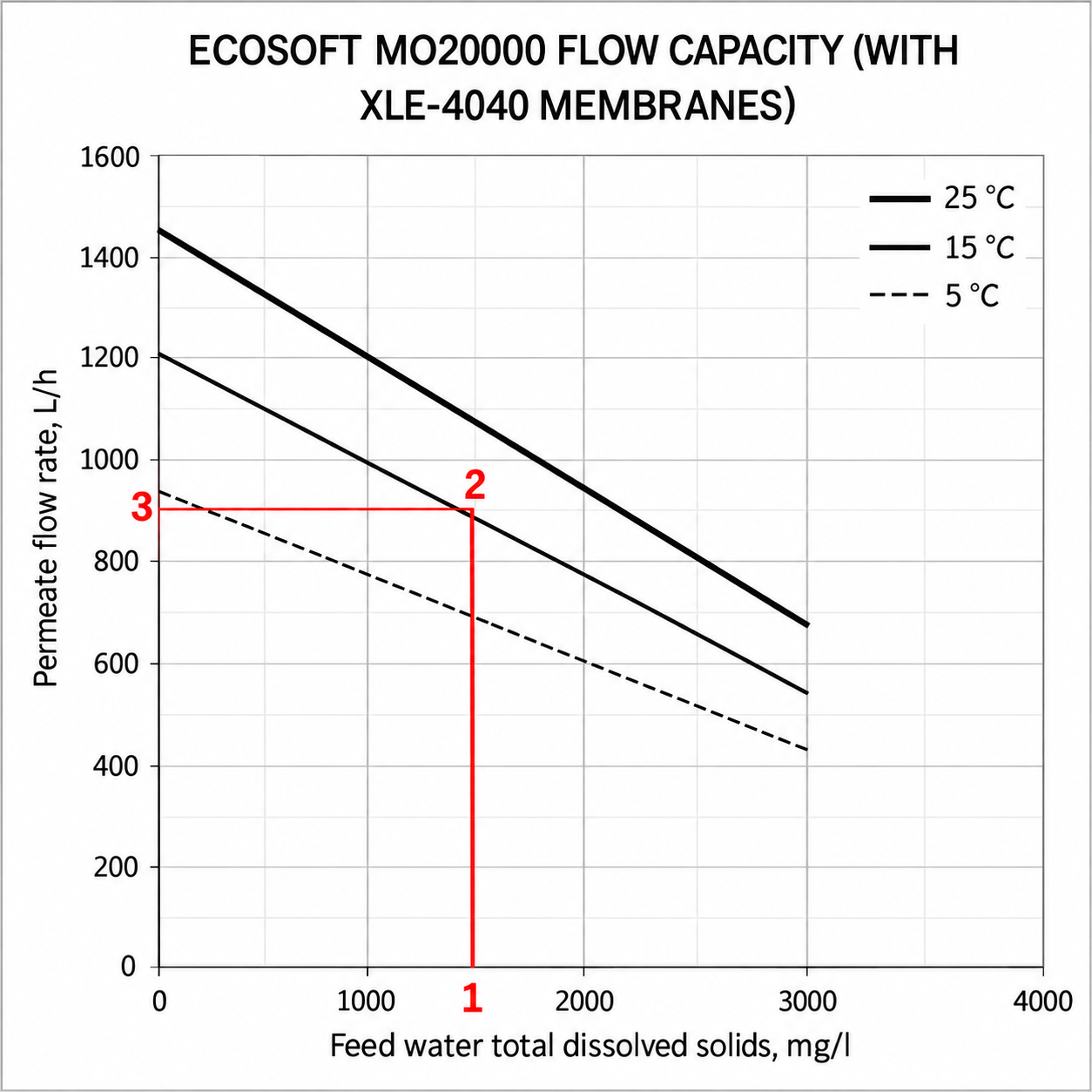
For example, to calculate the permeate flow rate at a water temperature of 15 °C and feed water TDS of 1500 mg/L, mark point 1 on the feed water TDS axis. From point 1, draw a line to the 15 °C curve and mark the intersection as point 2. From point 2, draw a line to the permeate flow rate axis and mark point 3. In this example, the estimated capacity is about 900 L/h.
A detailed analysis of your source water is necessary to get a more accurate estimate of system performance for your specific application. If you have feed water analysis data and know the water temperature, send us the information and we can calculate the expected performance using specialized software, such as DuPont WAVE or LG Q+ projection software.
-
Is it possible to know exactly what water quality I will get after the system?
To estimate the water quality after the system, specialized software can be used to calculate operating parameters and purified water quality. For example, DuPont WAVE, LG Q+ projection software, and the Ecosoft RO calculator can help calculate the expected water quality.
-
What are the main technical differences between the Slim line and the Professional line?
The main differences can be found in the comparison table for each model. The key differences are:
- No conductivity cells on the permeate line
- No hydraulic flushing
- Non-adjustable inlet and permeate pressure sensors
- No convenient ports for connecting universal units for permeate flushing or blending
- No convenient connection port for the dosing station
-
Why should I choose the Ecosoft Slim MO30000 4″ reverse osmosis system?
The Ecosoft Slim MO30000 is a practical solution for businesses that need purified water with low TDS. It works particularly well with municipal tap water that has been pretreated using a water softener or an ECOMIX® system. We recommend installing these treatment systems before the reverse osmosis unit to help protect the membranes and maintain stable performance.
-
Can the Ecosoft Slim MO30000 operate with only an antiscalant dosing station?
Yes, but this option is recommended only for feed water with a relatively simple composition and when the system operates at approximately one-third of its rated daily capacity.
For more complex water conditions or continuous 24/7 operation, we recommend choosing a system from the Ecosoft Professional line. These systems feature hydraulic flushing and support the connection of permeate flushing kits, such as PIMO612 or PIMO2436.