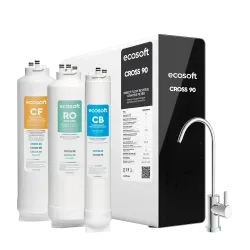
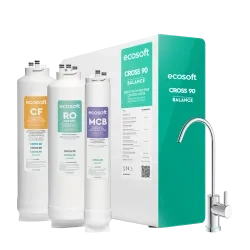
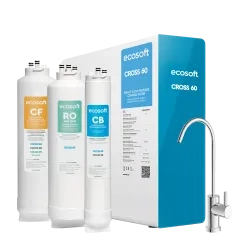
Ecosoft CROSS MAX direct flow reverse osmosis filter

- New
- Most popular


- New
- Most popular
Ecosoft CROSS MAX direct flow reverse osmosis filter
- High flow rate delivers up to 2 L/min of purified water
- Prefilter protects the RO membrane from sediment and chlorine
- Automatic shut-off helps protect the system from overtime operation
- Replacement indicator reminds you when cartridges need changing
- Ultra-compact tankless design saves valuable space under the sink
- Quick installation and tool-free cartridge replacement


Product information
Ecosoft CROSS MAX direct flow reverse osmosis filter is a high-performance tankless water filter designed for under-sink installation in apartments and houses. With purified water flow up to 2 L/min, it provides a steady supply of water for drinking, cooking, and beverages. Its ultra-compact design fits easily into standard kitchen cabinets and saves space under the sink.
The filter uses a four-stage reverse osmosis process to reduce PFAS, mineral impurities, and other dissolved contaminants, while also improving water taste and odor. A prefiltration cartridge protects the RO membrane from sediment and chlorine, while automatic flushing, a cartridge replacement indicator, and overtime shut-off help ensure reliable operation and convenient maintenance.




Technical information
To maintain optimal performance, the CROSS MAX water filter requires periodic replacement of its filtration cartridges.
Cartridge replacement frequency
- Replacement prefilter for CROSS MAX (CPVCBDFRO) : replace after 2000 L of purified water (aprox. 12 months).
Removes sediment and reduces chlorine, protecting the RO membrane and ensuring stable filtration performance. - Replacement RO membrane for CROSS MAX (CSVPDRO800) : replace after 2000 L of purified water (aprox. 12 months).
Reduces PFAS, dissolved contaminants, and mineral impurities while providing high-flow filtration performance.
Actual cartridge life depends on the quality of the municipal tap water.
Cartridge life monitoring
The built-in cartridge life indicator tracks the remaining capacity: one indicator segment turns off every 600 L of purified water, and when only 200 L remain, the last segment turns red. At the same time, three short beeps sound when the drinking faucet is opened.
Easy cartridge replacement
Cartridge replacement is quick and tool-free. After replacing the cartridges, press Restart to reset the indicator and continue using the filter normally.
Automatic flushing
The CROSS MAX filter is equipped with an automatic membrane flushing function that helps maintain stable filtration performance and water quality.
Flushing is performed automatically in the following cases:
- After each use of the drinking faucet — short flushing to remove concentrated impurities from the membrane surface.
- After connecting the filter to the power supply — initial flushing to prepare the filter for operation.
- After 24 hours of inactivity — preventive flushing to maintain membrane performance.
Additionally, the user can activate manual flushing using the button on the filter control panel.
Automatic flushing helps reduce natural diffusion during idle periods and support longer membrane service life.
Automatic filter protection
The CROSS MAX filter is equipped with an overtime protection function. If the filter operates continuously for more than 10 minutes, it automatically shuts off the water supply. This helps to prevent possible water leaks and protect the system from overload and supports safe operation.
Replacements
-
€ 21.67 excl. VAT€ 26.00 incl. VAT
-
€ 85.83 excl. VAT€ 103.00 incl. VAT


FAQ
-
How does the cartridge replacement indicator work?
The indicator tracks the remaining filter capacity. One segment turns off every 600 L of purified water. When about 200 L remain, the last segment turns red and the filter emits three short beeps when the drinking faucet is opened.
-
How do I reset the filter after replacing the cartridges?
After installing new cartridges, press the Restart button on the filter to reset the cartridge life indicator.
-
How often do the cartridges need to be replaced?
Both the prefilter and the RO membrane have a capacity of up to 2000 L. Actual lifetime may vary depending on the quality of the tap water.
-
Why does the filter perform automatic flushing?
Automatic flushing removes concentrated impurities from the membrane surface, helps maintain stable filtration performance, and prolongs membrane life.
-
Where can the CROSS MAX filter be installed?
The filter is designed for under-sink installation in apartments and houses and is intended for use with cold municipal tap water.
-
Will there be enough pressure if the RO filter is not installed under the sink?
For stable operation, the system requires water supply pressure of at least 3 bar. If the RO filter is installed in another room, such as a pantry, basement, or technical room, the distance and lifting height may slightly reduce the pressure.
If the inlet pressure is below 3 bar or the water needs to be supplied to a second floor, choose a model with a pump or install a pump separately. For a comfortable flow rate from the faucet, place the storage tank as close to the faucet as possible.
-
Can the RO filter be connected to a custom or non-standard faucet?
Yes. Most modern designer 3-in-1 faucets with hot, cold, and filtered water connections are compatible with standard reverse osmosis systems.
The RO system uses a standard 1/4″ tube connection. Many designer faucets already include an adaptor for a standard RO tube. If the adaptor is not included with the faucet, a standard fitting adaptor can be used, for example John Guest 1/4″ to 1/2″ or 3/8″ thread.
Make sure the faucet is designed specifically for drinking water and has a separate internal channel and outlet. This prevents purified water from mixing with tap water.
-
What is the power cable length?
The standard power adaptor cable length for systems with a pump is 1.0–1.1 m.
If the socket is located farther from the installation point, we recommend planning a nearby power socket in advance or using a high-quality extension cable.
-
What is the noise level of filters with a pump?
The booster pump usually operates within a noise range of 40–50 dB. This is comparable to a quiet conversation or a modern low-noise refrigerator.
Most noise does not come from the motor itself, but from vibration if the pump touches cabinet walls or rigid pipes. Using rubber dampers or anti-vibration feet can significantly reduce this noise.
Related products